
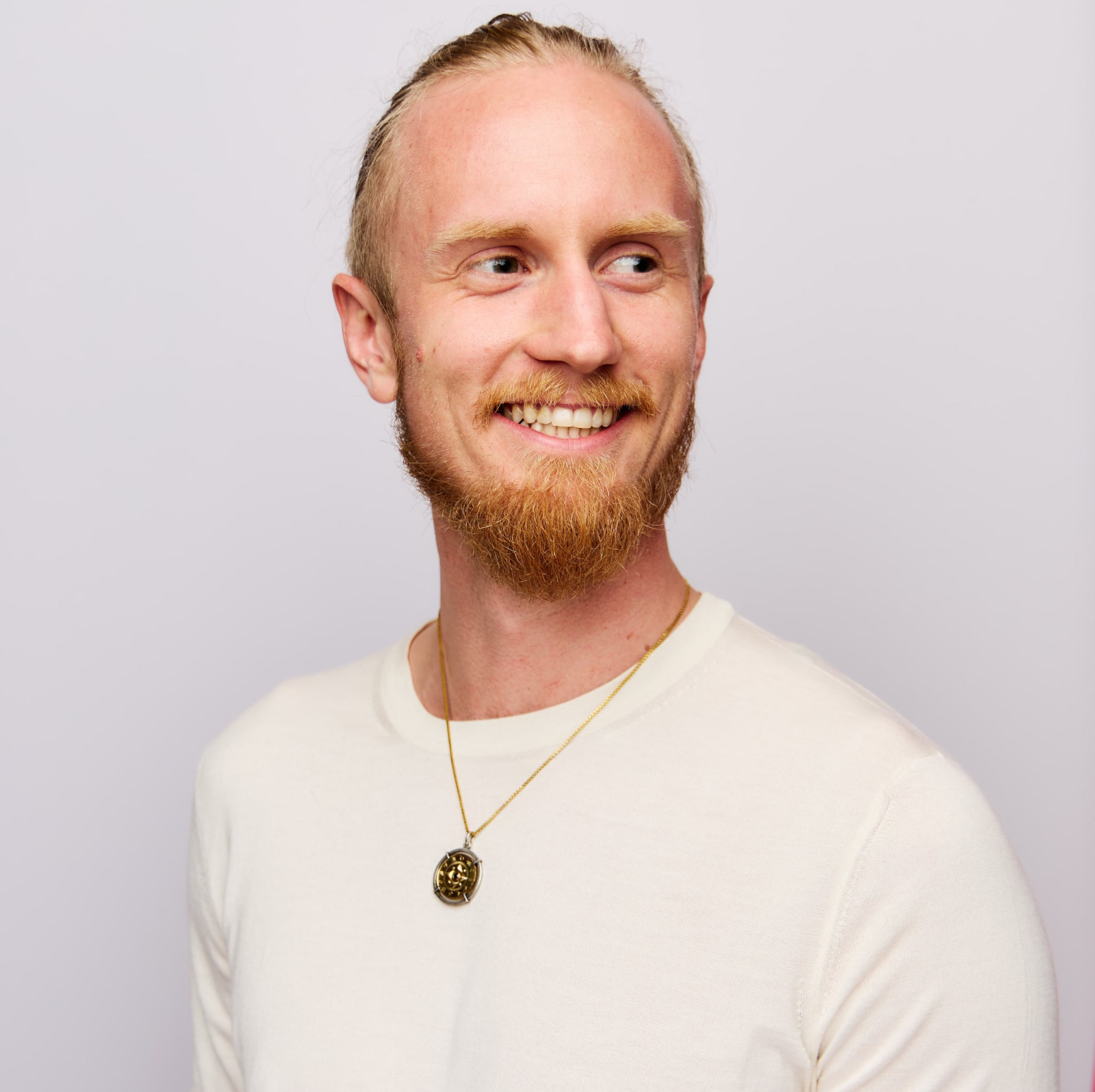
BEGINNINGS
Let’s start with who you are now. How would you identify or describe yourself?
Out of the blue, I have a body (laughs). I’m in a state of life right now where I’m very plugged in to what I do. A lot of ideas are coming. How can I show up better for this project? I’m working with my routines, optimizing my sleep, I’m optimizing my diet, my movement practices. And there’s this paradoxical optimization of just letting go, usually on weekends. Optimizations across the entire spectrum of existence I’d say.
Where and when were you born?
In Stockholm, Sweden, 1992.
Describe the town or neighborhood where you grew up?
I lived very close to my kindergarten. I stayed in that house until I was 18. So I was living around my birth place for a long time, which was beautiful. When I was 9-10 years old, I went into the city by subway. I had this group of friends at home but I liked exploring outside of that little bubble of safety, penetrating through it, going to see what was on the other side.
If I were to talk to your neighbors from the time you were a little boy, how would they describe you?
There was an old woman on one side of the house and, the moment I learned how to walk, I ran over to eat her berries and hang out. They invited me over for fika, which is Swedish for a coffee break. I sat there and they got me something sweet. She was probably in her 70s. She thought I was adorable, a little blonde boy who just learned how to walk and could barely speak. I disappeared a lot. My mum often told me a story where I had a friend on the other side of the road, cars were driving 50 km/ hr, and I ran across the road only, a toddler. When I learned how to walk, I wanted to see the neighbors, I could never sleep in a crib. They had to give me a bed the moment that I was born, I couldn’t be contained very well. My mum always said that I worked best with a long leash; she gave me one, with a lot of trust. It was all good. The more constraints, the more chaos.
Besides your accent, what about your way of looking at the world is influenced by being Swedish?
I’m realizing more and more what it means to grow up in a socialist country. We import a lot of culture from America. One example was Black Lives Matter, we went out and made demonstrations about a group of people that didn’t exist in Sweden. We translated it, we made it about something else, but we still used the same brand. In Sweden, it seems like we’re getting confused sometimes about our own present existence. Because we’re still a very small country up in the North. We’re apparently very fashionable in the virtues we stand for, we haven’t had much war, we’re very diplomatic, humble people. We supported Nazi Germany a little bit, but we kind of also didn’t. We find good on both sides of the polarity most of the time and find ways to make it peaceful. We’re afraid of conflict. If someone charismatic comes in and they believe in something, we tend to follow without much questioning We’re followers I’d say.
My mum always said that I worked best with a long leash.
Is there a Swedish business ethos?
Yes. It’s what I love. We create, we work with wood, we work with iron, we have a lot of mining. The business ethos as a whole is to create things, to create quality. You make sure that the product is functional and it works. One of the wealthier families in Sweden has this saying which captures it all, ‘act in silence.’ Which means that you are there to produce immense value, but you’re not going to put your face on it. Just let it work. And you’re standing behind that. It’s the law of jante, you’re not supposed to think you’re better than anyone else. But you’re also not supposed to think you’re worse than anyone else. Sweden, it’s a very average mentality, you kind of fit yourself somewhere, to be accepted with radical viewpoints, you must be able to both speak for the other side, to be respected. But in general, don’t speak out loud from the general norms, don’t do anything weird.
Sweden is a successful force in capitalism but there are socialist or social democratic values. What does that mean for you?
I’ve grown up with a mentality that no matter how much a person fucks up, we’ll make sure that they come along. That is a cultural way of relating, which has its upsides and downsides. We tolerate everything. When there were immigrants, we’ve had a few waves throughout history, people are like “ Are we just gonna let people stand there and die?” No, we open it up. And then we deal with the problems. I think I still haven’t figured that out. Because I have that in me with romantic relationships, I allow everything and then work with it… it’s confusing (laughs). It’s a lack of boundaries I’d say. Sweden as a nation has had problems with boundaries.
An entrepreneur who created a massive company in Sweden, recognized internationally, said when he started his company it was more honorable to win the lottery than it was to make money from a business venture. It’s okay to have money. But if you have gone out there to get it then the general thought is, “Hey, what kind of corpse have you walked over to get that money?” It still lives there to a certain degree.
The business ethos as a whole is to create things, to create quality.
Tell me about selling candles?
I was around 16 years old and It was a guy probably in his early or mid 20s driving this van with 12 young people to a neighborhood of nice villas. The trunk was packed with candles and socks. We got these fruit boxes stacked, 20 candles, 20 pairs of socks, and it was a gamified competition, who could sell the most. If you reached a certain level, you got a financial bonus. So you also played around with the pricing of this product, because we had to give back five euros each. Anything we priced over was our profit. If I sold a lot, I got bonuses. It was a kind of price setting, understanding what it’s worth to sell it. If I bundle tons of products, I will not get so much profit, but I will get a bonus. Calibrating the financial scale of this type of selling strategy was fun.
What did you learn from that?
I learned about selling something in high quantity versus low quantity but at a higher price. We worked three hours, Thursday and Friday evenings, and six hours on the weekends. But there was more than just selling skills. When I made a connection with a person, they invited me into their home. I was very curious about beautiful homes, a genuine curiosity of what is going on in this family’s house.
I have one potent memory. I was walking up a street and spoke to several families. It was a weird potent vibe in the households; eventually I spoke to an old lady. She shared that they were holding refugees, housing families with kids illegally. They were very warm-hearted. It was just so interesting, it felt like a secret type of society thing.
Another learning passage: selling magazine subscriptions.
Then I worked for a telemarketing company, selling magazine subscriptions. You earned for every magazine subscription you sold. You had to find ways to do a lot of calls, work with quantity. There was a political newspaper. In which you could bind them for two years, that was the maximum, and then you earned 50 euros, 10 times more than the regular subscription. I learned how to tweak my selling process. Out of pure laziness. I would sell three of these and then I’m done for the day, then I’m happy. That’s enough. I’ve never been really driven by money. But I’ve been driven by finding solutions to problems, usually “problems” which I found boring and uncomfortable to do. And it felt like I hacked it. I knew that if I pushed it and called I could make a lot. But that wasn’t enough for me, like I hacked the game, I figured it out, it was the most difficult thing to sell, I managed to sell it effortlessly, and it worked. I never became a really great salesperson in these types of quantitative selling jobs. I thrived in the big difficult contracts. When you have to work with diplomacy in sales. How can we get this deal in? How can we figure out what value? What do they want to get out of it? How can I give to you so I get what I need?
You learned at that early age how to connect to people, to build in 90 seconds some connection and relationship of trust. Yeah. That came from pure curiosity. I think that was why it was effortless. Because I’m genuinely curious to understand and to learn about the person on the other side.
What were you seeing in the world in terms of a shift in the range of opportunities that were available to you, things that you might want to do in your future? What ideas took hold?
It’s a good question. I had dreams when I was a kid. I failed my dream as a football player. I wanted to become the best football player in the world. And over my teenage years it started showing that I failed, this kept me away from daring to dream for almost a decade. After many years of therapy for other problems, I dared to dream again. I was 24-25 when the world started opening up for me again. I started listening and seeing what was happening in the world. Before that age, it was just about how I could save myself, because I was terrible with finances.
So first I got my foundation together. I learned how to run a household, pay bills on time, and manage regular health routines. That’s when I started dreaming. It’s still a journey for me. The true authentic dreams I have are rarely about stuff I want. It’s more about how I want to live. I remember at the age of 25 I created my ideal workday. I wanted to split half my day in producing and the other half in research, to learn and become better at what I was doing. At that age that’s what I wanted, because I was stuck in a 9 – 5 job and I only had a few hours in the evenings and weekends to work towards my own projects, which eventually became Finally Together.
I’m genuinely curious to understand the person on the other side.
Talk about your education?
I did high school. I worked and partied a lot during high school. I aced the subjects which I felt were important for me to learn. And I didn’t bother to show up at the ones which I couldn’t justify. I was at war with academics for a long time because I felt it was stupid. I got an ADHD diagnosis later on, which taught me that academics weren’t stupid, I just couldn’t plug myself into sitting and listening and then repeating information. For me to understand I had to try it or to learn actively. For me to learn, I processed data by testing data, I was an active learner.
You asked me about aspirations, what I wanted. My first “dream” was very simple: I wanted to be able to go into a grocery store and not have to look at the price tags. I just wanted to be able to let my hunger guide me. And I also remember that I had a dream that I wanted to be able to put on fresh new socks and underwear every morning when I woke up (laughs).
The Move To Malta
How did you get to Malta and what did you do there?
A friend from my high school recruited me for a customer support job when I was 19 years old. He said “Freddie, you would love this. This suits you very well, this lifestyle.” I trusted him so I applied and was given the job. I told my mum that I probably need to go to Malta. Two weeks later I was there without any money whatsoever. But I had a job. And that became a three and a half, almost four years journey to get into the corporate world.
Describe that journey?
The Maltese company had 1,000 employees. There was a mix of all types of cultures and nationalities. When I first came I couldn’t get by with English. I couldn’t justify it in school. I didn’t understand why it was necessary. I came there the first day and realized, oh shit, this job is in English. I learned all the terminology, I was doing support at the time helping visitors of this website. I was able to hang out with people in the office because I knew the lingo and the English for the business. It took another year for me to be able to hang out socially with people outside of work and have fun. I was very determined. I think my main drive in that business was not to come home empty handed, I was miserable in Malta, I didn’t like the country. But I was quite miserable in Sweden too. I kind of escaped Sweden to Malta. A big motivator was to come back to Stockholm and not start from zero again, career wise.
I was promoted. I did a good job. I wasn’t good at the grind, just doing those basic things that were needed. I went for the groundbreaking results instead. I was probably quite a volatile employee, but appreciated. I was good at networking, I was friends with the owner that started the business, his father started the business in the 1960s. Then the son started the digital version of that company. So I made myself kind of untouchable in the company. I made sure that my back was covered. That was my game, I played politics, for sure. Rather than creating value for the business, I played politics.
I think my main drive in that business was not to come home empty handed.
How long were you there?
Three and a half years.
How did your own entrepreneurial ideas and your aspirations for what you wanted to build or create begin to emerge from those three years?
We were in entertainment, but gambling comes with very rough… when someone can’t handle gambling, it becomes really nasty, really, really nasty. Because people start stealing, people start borrowing. They borrow in family members’ names. Other addictions are more visible. If someone smoked weed all the time, you see that they’re super high. But if someone gambles a lot, you can do that in secret for a long time before it becomes visible. When it becomes visible, it’s really, really bad. I was working a lot of night shifts, I was in contact with these people. People told me things to do. And I followed.
We had a person that works specifically with this thing. So we were kind of respectful and treated these cases with respect, there were good processes to meet, to advise them to seek help, like all of that was done well. But when I went up in the organization, and I started working with people who didn’t come from support, they came from finance or marketing, they came into the organizations without seeing that side, I saw that it was such a dissonance. On one hand you had these people who really optimized for growth, for better results, without the awareness of what is coming out on the other end. The early founders that created these casinos, they were gamblers themselves, they loved poker, they loved sports betting. Good poker players are the winners. The more they win, the more they gamble, so the heavy gamblers are also the winners with poker. It’s kind of a positive. The casino makes money when the players are paying fees in the tournaments, so the people that pay more fees, they are the ones that make money.
You had these people who really optimized for growth, for better results, without the awareness of what is coming out on the other end.
If someone comes into poker and they lose all the money immediately, the casino won’t make much money. The players will make much money off that person but the casino won’t make much because they are just getting the fee. So it’s better to have people who play a lot, those are the winners because they can take the winnings back. There was a big shift while I was there when it pivoted from being 99 percent poker revenue into being slot machines. All of a sudden the customers who were valuable for the casinos were the one that got sacked and took all the money down to the slot machine until it was empty. I was in contact with these people that brought in the poker players, I got to meet them in tournaments, I got to wine and dine them, get to know them, the players and the person that brought in the players. It had a nice vibe. Then these other VIP players, who were the losers, the casino players came to the same events and the vibe was so different. Because they were not the winners. It was a heavy, heavy energy around that. And the people that were working with the companies that brought in these players. My clients that brought in the poker players, they were friends with all of them, they had a good vibe, it was like community style, it was fun. The people that brought in the players from the casino side, they were numbers people, they work with numbers, they’d never met these people, they had a website, they got visitors, they sent them to us, they were never in contact with the humans that they gave us. So they didn’t know who they sent in, it was just numbers for them. If you do more of that, we’re getting more numbers. If we do more of that we do more. Then you do more of whatever works and you make more money. And the worst, horrible extreme, they figured out if Sweden has a good welfare system, Sweden’s giving away a lot of money to people who have problems that can’t work, like handicapped people, or people with low education. So this guy figured out how to find these people through Facebook groups, their interests, and he targeted these people. He knew when the money came in, so he knew when to send the ads. He basically channeled those government spendings back into the casinos in a way through these disabled, troubled people. And he made them completely dry.
In a way I played the same game. Yeah. I justified it in ways that resonated within my virtues, but in one way or another, that was the industry I was in. That was something that in my own personal journey I had to come to acceptance with. That I am there, I’m doing it. I’m feeding it in one way or another.
Philosophically, we can drag it to the extent that we’re here on this earth and murderers exist, am I not part of it in one way or another? You can prolong it, but I do believe in free will. I do believe that we have a way to participate in our life here on earth that will change our path and outcome. I think I’m on that side of existentialism, of responsibility.
From Sales to Entrepreneurship
You talked about the virtues and values that your current app project is built upon. You’ve had a series of experiences as a young man, then as an adult in your professional life, gradually building and observing things, the good and the bad. So talk about the virtues and values that your products, that this app is built upon?
Good. Because it’s a great pivot from what we just talked about. I started my own company, it was still within gambling, we started doing questionnaires. I realized that even though we set out to work with good regulations, helping out a market that was abusing a lot of bad habits when it came to this, we were there to help. I realized if I’m in this industry, people have problems, this is not the place to make the world a better place. And so at that point I was done. I felt that I wanted to contribute to something more.
But also important learning, seeing the negative effect of business practices, the opportunity to contrast that with the direction you wanted to take, then beginning to move in that direction.
For sure. And at the same time, I also saw I had a problem with drinking. I had a dopamine addiction. Anything that could stimulate me and give me stimuli I was sure to find. Constantly being around people was probably my biggest problem at that point. So I got to know addiction firsthand. And I saw that there was a level of addiction and a level of abusing other people, where we still have a responsibility; if we’re victimizing a group of people, we’re taking away their power. If I’m victimizing myself, all I do is that I’m going into a belief system of being helpless. So I’ve stopped taking responsibility for my own path in this world, in my own life, and I’m instead giving it to someone else. I’m not in me, I’m not taking responsibility for myself. And for me, the essence of being an adult is to know that I am in charge of the outcome of this.
This is not the place to make the world a better place. At that point I was done.
Getting to see addiction, being close to addiction, being close to the abuse of others, in business, and in these products, I saw that these people are not straight up evil. The people are participating in this – because I knew them – they’re not evil. They’re ignorant and they’re greedy, apathetic, not attached to their emotions 100 percent. Is that evil? Maybe. They had kindness, they could have fun, they could speak about their families, things that mattered, they could speak about troubles making a change.
Creating Finally Together
Tell me about the early genesis of the idea, how the idea came to you on the foundation of these other experiences. How did that get traction, to put it on the path to where it is today?
First it was creating a system for myself. A friend of mine looked me in the eye and said, “Fredrik, you’re not like other people, you see the change and then you go and you get it, this is not common.” The way she delivered that message made it such a profound realization. I can help others here! It was my biggest interest. I loved it. And it was fun. I think at that point it awoke something, and it kept on growing over the years. The first time I got to practice it with others was with the people in my company. It was when the pandemic hit and people were obviously not mentally well, I felt a responsibility for the people that were working with us. Not because it’s my job to make them feel better, but because I felt that I had the skills and system to help.
I saw people struggle with things that for me were easy, and then I felt I could help. I knew that the most efficient way to help someone is for them to do it themselves. I realized that sitting in conversation and being a therapist is not the solution. It has to be playful and we have to do it together, we have to take away the heaviness around not treating our health correctly. It has to be easy and playful and light for people to want to engage in it.
If we from day one have to realize the full scope of how bad we have treated our bodies for so many years it’s a very steep hill up from there. It’s like telling an infant how much they have to learn before becoming an adult. “Fuck, I can’t even crawl;” a kid is not aware of all the things they learn. They just play and it’s fun and it’s easy and it’s just one thing at the time in their attention and awareness. They do not possess the complexity of seeing the whole picture. Once they try to crawl, that’s it. They are not at the same time worrying about a PowerPoint presentation, wars, grocery shopping, paying bills. They’re not looking at this list of all the things they need to achieve to become a participant of society. Just one thing at a time, which can make even the shittiest thing enjoyable.
Our company was 100 percent remote; we had our monthly calls, that was the only time everyone got to see each other. Otherwise, we were divided into these little sub-groups. These monthly calls were nice. But I also realized that I had connections with many, but they didn’t have connections with each other. It was a way to create a platform where people could check in with each other on a daily basis in big or small messages. Just having that check in, kind of, like, “Hey, I’m alive.” You know? The reporting in this Finally Together system was an emoji reaction, it wasn’t even a word. But just seeing that people are there. It’s like, “Oh, she’s here. And he’s here.” It was a way to unify us, to come together. The fundamental virtue, the goal was to become healthier. And for some people, that meant, “Yeah, I’m going to start drumming, I want to drum.” Someone else, they were running 10 miles per day, and they wanted to continue doing that. Everyone was showing up doing health in accordance with what that meant to them. But together, we showed up, and we reported everyday, on one task, on a weekly cycle basis. It was always about measure and present people’s ability to show up. I found that way more wholesome rather than exposing people’s ability to execute. I gave them that number too out of joy, they could measure it against themselves. But showing up, that’s what we’re trying to get better at. Because that is the number one success thing to do to get out of something destructive or unpleasant. Whether it’s addiction, procrastination or just day to day avoidant behavior of chores.
In discussing the path of remote business making, you say being physically far requires another level of responsibility for the individual?
Being an employee vs becoming an entrepreneur, the big difference is when someone says, “This is what we’re gonna achieve, this is where we want to go.” An entrepreneur doesn’t need more description than that. It requires a level of abstract thinking to create systems to achieve a vision. Being a “brick in the game” employee is when you are a factory worker, you require a full description of a task, how to move your hand from A to B to screw on one piece with another piece. That type of labor work has been dying over the last decades, starting in the factories and now also in the digital companies. Practicing abstract systematic thinking will make you a creator out of thin air. Not even an AI can do that, it needs data to index and process. The human mind can fantasize then make it real.
For a company to succeed remotely, the employees can’t rely on a detailed description of step-by-step procedure to get a job done. They need to be able to align with the bigger purpose of a business then figure out how they as an individual can contribute with their set of skills. Because there is no longer anyone next to you to guide you in every step.
What is failure in a safe container?
Every Monday, we showed up, in the beginning with the whole team; as we grew, we used the same methodology in smaller teams. We all said “This is what I’m going to do this week,” and then on Friday we showed up again, and all of us had to answer; “Have I done what I set out to do?” For us, the leaders, we had to listen to what the reasoning was when people failed on their commitments. “Has this person sat down to see why this didn’t happen?” Or had they just ignored it? Or “have they just focused on other things and they haven’t even been aligned to their word. For us a key metric of remote team work was accuracy in their planning, because if the person next to you can trust your words of commitment. It’s very easy to plan one’s work around each other.
So for us then our agreement to fail safely became, if a person says on day 1, “This is what I’m gonna do, the deadline is day 10,” if they come up a few days in advance and say, “Hey, I told you on day 1 that I was going to do X, it’s not going to happen because of y and z,” then it’s good. “Thank you for telling us because now we can plan around it and find a new solution.” So we said it’s okay to not follow through with your plan or your word if you’re coming in advance and letting us know. It’s not okay to come on the deadline day to say that it didn’t happen. Because we had an agreement, but planning can be more or less an educated guessing game, and we will learn better by more experience; the further we get into this process, the better we will become at predicting our deadlines. Your job now is to attune yourself to that precision, to find your own workflow, getting to know yourself, how you work, you will have much more space in failing your agreed deadlines in the beginning. And then it will tighten.
They need to be able to align with the bigger purpose of a business then figure out how they as an individual can contribute with their set of skills.
You’ve said a good leader helps people to think for themselves. What impact would you hope that your app has for your clients and more broadly for the world?
I want the workplace to become that place where we enjoy our contribution. In my experience it’s only fun to lay in the sunbed on the beach for a short time, I have tried for prolonged periods… Eventually, I stood up and wanted to help contribute. In general, Homo sapiens seem to be wanting to build something together with other people, even if the only communication is through programming language. We want to feel that sense of contribution. There’s a lot of research showing that we become healthier when we can help something else to grow. There was a study of people in an elder home, if they got a plant that they had to nurture their lifespan was prolonged. When we have a sense of purpose, we live longer, we live happier. I hope that the impact of this app and this project is that we go to work and are contributing to a change. A business is simply an entity to solve problems in society and create change which is of help for the people in that society. I would love to see people showing up the majority of the days because they really feel that they want to, and at the same time when they come home, they can feel rested and at peace with their own private lives. Working for society, my neighbors, my family, my kids, and my partner. And that all can benefit through the same work. If only one group benefits and the other suffers, can it truly benefit the whole?
A good leader helps people to think for themselves.
Shifts in Business Life
Were there business people in your younger days that inspired you, that gave you a code for your professional life?
Yes (laughs). My father taught me to make life easier for the people around you. My uncle was another role model. We started our businesses separately at the same time. He was 55, I was 25. I’ve always followed what my male role models were doing and saying when it came to career.
How has business life changed in your lifetime? And how do you think professionals need to adapt to those changes?
There is the macro change with job openings decreasing in Europe, in America as well. But then project jobs are increasing like crazy. It’s a big shift, for companies of all sizes, recruiting people to complete projects and provide concrete solutions rather than just being employed as a company asset.
Within myself what I’m noticing is this idea of “growth, growth, growth, push it, push it, push it.” is dying among many entrepreneurs and good leaders. When I started seeing people no longer playing that game, I realized how absurd it is to grind HARD every single day, always thinking they haven’t done enough. Versus, playing the long run, “I’m just gonna walk through it step by step, take it easy.” The person who is pushing it, he will never survive. They may “succeed” quicker, but sooner or later they’ll crash. I think creating from a slow pace doesn’t mean less productivity, it means more peacefulness and higher quality in the output.
How To Inspire A Team
How do you inspire or motivate colleagues?
I believe that the best quality work, our strongest output, comes from when we’re doing stuff that we love, and when we are using our curiosity to navigate in our own specialties and within our own responsibilities. My way to motivate and inspire is to encourage people to keep looking for that, unless they have it already.
A very practical thing I preach is to practice weekly planning for the absolute minimum. So when you’re setting out for your week or for your day, you’re always going for the minimum, because if you’re genuinely interested in evolving and doing something great, then you will want to do more. When you’re on the net positive side of your time budget for that day, then it’s a whole other energy. That goes for business profit but also time profit. So simple. I did it the other day. I set out what I’m going to do, I did the absolute minimum, I completed it, I still had two or three hours left of my workday. Then I can choose to do anything, I have space and time. Then it’s so creative and so joyful to work and to create.
What do you think people seek in their work life these days?
I hear a lot of yearning for freedom, to work wherever you want. Probably because I lived it, people come to me to speak about that, to ask me about it. In my bubble it feels like all people want that. To be able to go wherever they want in the world and still be able to do their job. That’s a trend that is apparent to me. I worked in India, and have close connections to China. For the broader mass of the population, I think the seeking is lower on the Maslow stairs, it’s more about figuring out your daily routine so you’re covering basic needs, so your kids can go to school. You can get a little bit extra to continue growing and living the dream, having the family safe and full.
The sick only want to be healthy, the healthy wants a billion things.
Always plan for the absolute minimum. Then it’s so creative and so joyful to work and to create.
Imagining The User Experience
What psychological or biological principles influence your app?
It’s built on the premise that as long as we’re taking care of our physicality, our physicality will heal our emotions, and since our emotions govern our thoughts, so will our thoughts be healed. Instead of trying to teach mindset, the app allows users to think whatever they want. That’s extremely important for people. Not having to change how people think, that should be our own responsibility and our freedom to choose. The system holds an acceptance and allowance of all emotions. I believe that we need to be allowed to feel frustration, hate, sadness. It’s great to hate something as long as that hate is not projected onto something or someone, unless it’s a boxing bag or pillow. That’s a great way to transcend anger.. That’s a liberating experience. I think the feeling exists and it’s there and it has its use simply to be felt. The app is not meant to suppress or encourage anything when it comes to feelings. The system lives on the premise of physicality. When we’re working with physicality, our ability to breathe, resting, how we move, what we’re putting in our body and channeling our concentration and focus, then all those emotions will continue to exist, but the human experience is equal to the enjoyment of surfing, sitting on the roller coaster. Sometimes our emotions go up, sometimes they go down, and we can observe without reacting, being curious and even laughing at our absurd minds with all stories being generated from intense feelings, whether they are “good” or “bad.”
What have you learned about the entrepreneurial process as you worked to create something new and enduring?
My unconventional idea in entrepreneurship is NOT to test tons of ideas to see what sticks.. I believe in taking one step at a time and allowing a lot of marinating, observing how that one step falls into place. In general, the entrepreneurial mentality that I’ve grown up with is, you’re searching for gaps, and then you’re trying to fill those gaps in the market, supply and demand basically. Where there is a gap, you find something to fill it with, and you try to get rich doing it. If there is heart missing in that process, it becomes hollow. I’ve seen the most successful people restlessly looking for the next thing and completely lacking the peace to enjoy the fruit they have already harvested. That is a muscle to exercise. That’s what I did. And it became second nature for me to start observing my reality by looking for gaps. Not necessarily to fill them. When you see something broken and realize how it can be improved, and only if that aligns with what you’re interested in and what you are ready to commit to, then go for it.
Sometimes it goes up, sometimes it goes down, and we can be curious and it can be fun and playful through all of it.
What I’m doing right now is about improving myself and building a platform where others can go in and do that in a playful and effortless way. I saw where there was a massive gap of this practice, which for me was in the workplace. I found a gap. I combined that with something that I was doing. And then it becomes effortless. I think that sense of effortlessness, but with participation, it’s an effortless active way of working. It’s a pleasant state to run a business from because it gives a lot.
Creating New Behaviors
How does your own spiritual work affect the way you approach business?
When the ship starts burning, when you feel it’s sinking, you start creating new behaviors. You identify the holes where your energy is leaking and you learn how to fix it. It’s like going to the gym and finding a good workout schedule with a professional, you just need to exercise it. It’s a deep trust in time. “Now I’m walking and there may be things I don’t see, but I trust that whatever comes up in my awareness, I will attune to it. Until then, I’m gonna continue walking and have trust in that.”
There is a tarot card, The Fool, that innocent fellow is just enjoying life, observing life for its beauty. Spirituality has given me that. It feels like life is co-creating and collaborating in the favor of life. Unless I’m choosing to not believe that and make myself the victim of my own existence, that’s when existence turns stressful.
You shared that one aspiration for the project was to bring harmony between worlds and tribes. What does that mean?
The Sapiens started in Africa. That’s what science tells us. Then we started to create more distance between each other. We got some food, and then the food moved, and then we’re moving after the food, and eventually we bump into each other again. In scarcity, or a sense of not having enough, we kill and plunder each other so we will make sure that our tribe survives. Or in a collaborative mindset we can take the boy and the girl from the different tribes, and we can marry them. And suddenly, we merge and become a larger tribe stronger than before.
If we play smart, the synergy between things will always be stronger than a single organism. But it’s not easy to merge. Especially when we have lived as a single organism for a long time. According to science a closed system is destined for entropy. Stay open and you earn harmony, science!
The tarot card, the fool, that innocent fellow is just enjoying life, observing life for its beauty. Spirituality has given me that.
I believe in cultural differences, I don’t believe that we should all follow the same recipe globally. I think it’s cool to have diversity in everything, in belief systems. I had that moment with my brother, we’re so vastly different. But I think it’s a reason why we are clashing in our way of seeing the world. If we use that as a way of learning from each other; he’s walking a vastly different path than me, we can exchange knowledge. And then we grow from learning from each other’s experiences, there’s a synergy in that, which is quite beautiful. So bringing harmony to the different tribes, for me, it’s allowing knowledge exchange, and synergies in creation. I think that’s essential. It’s almost like that’s the whole purpose.
The Importance Of Letting Go
You shared a book with me, David Hawkins’ Letting Go. Why did that book impress you?
It was the first time I grasped the importance of participating actively in “not doing.” The concept he is preaching is just letting go. I don’t think I understood it while I was reading it. I realized there was something lacking in my life, the ability to surrender. I couldn’t figure it out and I couldn’t do it. Hawkins took a long period in his life just being a hermit and sitting in a cottage to practice surrendering and letting go.
I did that too. I was laying flat and my practice was to experience what thoughts or sensations are coming, no matter what it is, and then relaxing deeper into it. Even the times the thought was “Wow, this practice is stupid. Nothing happens and I’m bored to my bones.” Even that I sank deeper into, really experiencing boredom in its essence. Not trying to understand or figure out. Only to feel. It gave me contentment, it showed me that no matter how stormy everything is, there is this option to just sink in, to allow it to be chaotic and to coexist in the chaos. I trust that if I really have to act, like in a dangerous situation, it’s not that my thinking will solve it. It will be the instinct that will save the day. I have lived to experience that the thinking doesn’t have to engage too much in threatening situations.
What does show up and observe mean?
Being there. It’s a way to pierce through judgment. You don’t have to like it, you don’t have to believe it. But sometimes there is value in just showing up. Participate. And then you don’t have to form an opinion, you can just observe what is going on. And there’s something beautiful in even putting yourself in a situation, which feels uncomfortable in the first place, simply to observe what is happening within yourself when you are in a context which doesn’t feel natural to you. There is a vastness of treasures hidden in those moments.
Is it difficult to live with integrity in the modern world?
I think so. Both big cities and even more recent Social Media forces us to rethink integrity. In a small society, where we only get exposed to local news it’s perhaps a smaller scope to grasp. To get to know oneself. I’ve seen it in my travels when I connect with local tribes or even just countryside cities.
When we live in a big city, there’s a lot of complexity. It’s impossible to know the back end of all variables that we engage in. Think about it; all the groceries and other consumables, the infrastructure and then our work place. Then we have a very recent trend, we need to nurture our relationships, our physical health and our mental health. These things are only the tip of the iceberg.
Being integral in our opinions and in our knowledge about all of these things doesn’t give us much time and energy left to participate in them. To fully know, we would need to research each item in the grocery store, have a full understanding of the subway/ buses and how they affect society. Know that our company is not taking short cuts by domesticating nature or people, at the same time caring for our loved ones. For me integrity today can only be selective if we speak about knowing and forming opinions. We have to pick our wars. Then there’s a more spiritual element to this, which helps me in my personal navigation. Trust and forgiveness. I need to trust my own ability to navigate in my day to day, I can build the muscle to stand up and say no, at the same time exercise surrender and let go when necessary. Once I developed that, then I can trust my own mind and body to show me the path It’s integrity in every moment in every decision without analyzing the matter itself, simply intuition. Then lastly, when I realize that I’ve taken a wrong turn, own the damage I may have caused for myself or to others sooner than later. Life is very gamified like that.
I’ve heard you say something provocative. “I can’t water other people, they have to water themselves. But we can do it together.”?
That’s the difference between being a child and being an adult. When we are mothers or fathers, we water our kids, we nurture them. At some point, we need to let go of them as our possessions or responsibilities and give them freedom, that now ‘you are you.’ And ‘you are you’ to choose a path and walk that path.
Same goes for all our family members, friends and loved ones. We’re not meant to interfere with our assumptions of what is going on in their heads. Simply being available and offering our help, without forcing it upon them. The strongest type of help we can do is when we do ourselves fully, that usually makes the people around us feel best.
Future Visions
Do you have a vision for your professional life for the next five or 10 years?
I really do. I really do. I love economics. I find it interesting. For me economy is a representation of value exchange between humans, whether it’s spoken words, written words, sensations. Economy is that flow, showing where we choose to put our attention as a collective. Where there is a lot of economy, that’s where we’re having a lot of attention and a lot of interest in one way or another. It has a lot of power, and it is power. Then we just put a bill on it, but that’s not the point.
The app is the first necessary step in a long process. The idea was, can we create a value exchange without taxing the earth? Or without taxing employees? I asked myself the question: Do we have to exhaust the people that are working for us to make a lot of profit and make our stock grow to please our investors? Is there a way to do it without taking, can we have a net positive in all our behaviors; financially as well as with time and energy?
The flow of the app is that you go online and you’re presented with a methodology which encourages you to think for yourself, to define what health is to you. The platform is simply asking you to come back to face what you wanted, and then report if you’re following your plan or not. It doesn’t push you to perform on your plan, it just pushes you to look at it. It’s like, ”Hey, you must look at what you said, look at what you said, look at what you said.” And you’re doing that for a week. It’s not that you must look at what you said for a full year, it’s a very short time span, and then you can edit it. The next step would be having people who enjoyed this methodology and agree with it. Then I can start facilitating other people to help them by looking at their own words. It’s like, “Hey, you forgot to look at your words yesterday just come and look at your words, that’s all you must do, don’t perform. Just come and look at what you said.“
This is facilitated in a way that makes it easier for the user to reach their goals. They pay for it, then the app can incentivize the people who are encouraging them to look at their own commitment. The facilitator’s job is simply to help other people to see themselves. “This is what you said, just look at what you said.” They’d get paid by doing that work. Suddenly you have created an economy where the user pays to become healthier, in integrity, whatever it means to them. And someone else is being paid to simply remind that user about what they told themselves. It’s helping people to stay accountable. And that economy is not cutting down trees, domesticating animals or humans, that economy is built on people becoming healthier in accordance with what that means for them. Other people are coming to encourage other people to do that too. Which is also a very rewarding role, to see people growing according to their own plan and being part of that. That’s a beautiful experience. The user who came in to pay will now have more energy and a greater empowerment to go out and do other things in life. They will become a better employee, they’ll become a better husband, a better mother, a better child, a better friend, a better lover. They will have more energy to give by the end of the day because you learn how to calibrate your own energy budget.
It’s a win for the user. It’s a win for the facilitator. It’s a win for the world around the user and the facilitator too because they will be able to give back more, and enjoy it while doing it, because they will have and even gain more energy doing it. Companies want to invest in having their employees autonomous and empowered so they may better contribute. A nation would want to invest in having their citizens be empowered and contributing in integrity, doing that from a playful way. I find that a better solution than another proposed economical solution, which is the global standard income, in that everyone gets a little bit of money through blockchain. I believe we have to give something to get something, we have to contribute in order to receive. That contribution can be simply to take care of oneself as the first step. If I can do everything I can for solid mental health, physical health, if you can get incentivized on that path, that’s a pretty promising and exciting future.
They will have more energy to give by the end of the day because you learn how to calibrate your own energy budget.
Are there other product ideas that currently excite you?
We have the technology, perhaps more expensive than sustainable at this point, to be able to build a city which demonstrates this same thing. That is, giving back more than it takes from nature. It may be a city that is decomposing after 10 years because of the materials used. That’s fine too, you just become less attached to those material things. You know that you can build something new. The idea is to build a little city knowing that you’re surrounded by other people living on the premise of giving back and contributing. And knowing that’s what’s going to fulfill my neighbor and myself.
This is not a new idea, it’s been exercised in various traditions and still is in today’s world. The Sikh for example is carrying a sword; a kirpan, which they are only allowed to use if they defend someone else, not themselves. The Spartan as well, they used their shield to protect their neighbor, they were beautifully interdependent on each other to gain greater synergy as a group than they could as an individual.
Has the app project changed the way you organize your daily life?
As I was researching and writing the app dynamics, I thought I can’t present it if I don’t practice it. “Am I fully walking this, what is now being written down?” Now I am walking it and gaining insights regularly. And as I’m writing down the insights then I have to continue walking it if I’m going to be able to present it. If you are researching and delivering information, you must research, live it, and then present. In my opinion, if you are working in the field of health you have to both research and practice. Only then you can transmit wisdom. Otherwise you are simply a PDF with facts, that’s a computer’s job not a human’s.
You saw some of your own employees or colleagues or contractors using this product in a transformative and impressive way, can you share one or more of those stories?
Some people use it to sustain their life, they are down and they need something to be afloat. And some people are already afloat and thriving, but it helps them fly. You see both types of users.
One person using the Finally Together system had her father and her best friend passing away in COVID within the duration of three months. She said that this system, this app was the only thing that kept her afloat. It was something for her to grab on to in her grieving process. That gives me goosebumps, it reminds me that it’s important, and that it’s helpful. Another which was vastly different is someone I’m still working with, we worked together in a past company. When we sat there in follow-up meetings with our accountability group, she saw us as founders standing up and admitting failure, or not being able to be in integrity to the level of performance that we set out. “I said I was gonna do this, but I didn’t do it.” Sometimes you have a good explanation of failure, but this time I didn’t, I knew the goal, I sat and I ignored it. She said hearing that just made us so human. For her, as she explained, it was a sign that she could trust us. There weren’t these roles. “It’s like, cool, good. That’s what it is to be human. You win, you lose, set up a new plan, you fail, you get back onto it, you have resilience.” You will fail, it’s just a matter of how. You can live with the illusion of being that hero for quite some time, but the more you’re pushing that away when the veil is breaking, you will look very stupid. If you can look a little bit stupid early on, I think it’s easier to find trust again.
She said that this system, this app was the only thing that kept her afloat.
How is your app differentiated from other solutions that you saw on the marketplace? And what motivated you to take the direction you took?
A lot that I see is about changing mindset. I think that type of health strategy is inefficient . It works, but it’s where a lot of religions are now failing. It’s a way to control what people should think. And to be frank, yeah, that could work, but I think it can’t scale. And there’s a limit to domesticating the mind. If you depend your wellbeing on thoughts to think, you will be in a constant stress. Because your emotions are fundamentally controlling your thoughts, only for short moments you can quiet emotions through thought. You can’t tell the whole world how to think, it’s important to be challenged. So many competitors are about mindset, like doing affirmations, thinking positive things. As neuroscience says if your body is healthy, you will feel positive things, you will think positive things. It starts in the physicality. So that is the first thing to take care of, the breathing, resting, movement and the eating. The competitors I find that are working with physicality have to this date the same type of force mentality. That progress is made through constant challenge. It’s true that growth is made through piercing through discomfort, but the integration period is what truly builds us, otherwise we only break ourselves down over time.
I solved that in the app by not limiting it to tracking performance and success. It does that too, but it primarily tracks your ability to observe your plan. That’s also an invitation to people that are struggling. You don’t come here to do, you come here to observe. That’s the first step. Then it can evolve into doing, if that’s done slowly and you start when you genuinely want to start, that’s when it becomes fun to move. When you’re studying business, doing business, to create effective strategies to move forward, first you need to evaluate where you are today. If you’re creating a path forward without knowing where you are today, you will start off from the wrong point, that’s very poor navigation skills.
First you have to observe, to understand. “Oh shit, this is where I am, I’m super unhealthy, I have super destructive thoughts. This is a mess. Fuck!” You know, it’s painful to realize those things. But it’s the truth in many cases. Every single person that has gone through the Finally Together system, the first week is not a pleasant experience because you get to know yourself and see where you really stand with your health. We often remember ourselves from our previous wins. So if I’m currently out of a consistent movement routine, but I know that I was in great shape two years ago, I’m so often identified with that memory that I feel that I’m still in a great shape, even though I’ve mistreated myself for two years. The reality is that habit is a physical activity, there are physical brain cells connected; if we don’t maintain our habits the connection of the brain cells will weaken due to our discontinued habit; it will become more difficult to jump back into the routine. Then we realize, oh shit, it’s super difficult to maintain this habit. You have to face yourself in that. And that’s tough, that’s really tough. But if you go through that, then everything is available, you can create whatever you want. That’s the rite of passage. You have to face yourself for what you really are, and then actually see, I do have the capacity if I’m resilient and if I dare to look myself in the mirror to see what is actually there.
Then it’s also true that if I try something again that I used to be good at, I never start from square zero. It may feel like I do, but it will be so much faster getting back to where I was if I’ve been there once before.
In an entrepreneurial project there are waves of innovation, of change. Where did you have to pivot or implement new learning in the course of developing the project?
It’s the details. We started running this on two weeks instead of one week. We realized that one week makes much more sense. There’s been a lot of users in the field, user interface things, a lot of flow, I’ve learned a lot when it comes to designing products, I built good expertise around me, I made sure to find people much better than myself and I learn from them a lot.
If you walk into a business to gain a result, you will simply pivot to where the result is. And if that is monetary, it doesn’t give you any integrity in the path of your company. If what you’re aiming for is financial results, you will simply go after where there is financial result. For this project the financial result is an instrument, a fuel to be able to continue developing the system, but the result that we’re going for is a change, a shift, to give power back to the individual, for the users to realize their own ability to form their own lives. If that’s the guiding compass, and you’re simply observing the product through that lens, it’s quite easy to do fine tweaks here and there without testing it with the market. That was a very solid compass from day one. I ran this with pen and paper, and then in Google Sheets and in WhatsApp groups. The foundation of it has lived for such a long time, so there haven’t been fundamental pivots.
We’re going for a change, a shift, to give power back to the individual, for people to realize their own ability; to form their own lives.
If the app was a living thing, how would you describe its personality?
Hahah! It’s a couple, it’s a very strong middle-aged couple that is living in full awe of each other’s ability, their lives individually and together in that relationship. It’s a beautiful harmony in this archetypal idea from my perspective of what it means to be a father. To show that; “Yes, there is a way which is healthier. You have to walk that way, you have to take that path. It’s not going to be easy, it’s going to be hard. But that’s the path and you’re going to enjoy it and you’re going to love yourself when you’re looking back and taking that path.” And then you have the archetypical mother voice, which is that unconditional nurturing hug. “Let’s also take that moment to just be with you, you know, you’re good, you really are. And accept yourself for all those little downfalls, every time you take a sidestep, it’s okay, that’s part of it. It’s this big vision of where we’re going. But as you’re here now, be kind to yourself, don’t beat yourself up.” That’s the personality as I see it.
How would you articulate the value system with which you approach life and commerce?
I believe in evolution, I believe that we should thrive to change and become better. And I believe that we need to be kind to ourselves and to others. We really survive and evolve through love. The first step before love is even easier to grasp; we need to accept, so we accept and we walk. I love that little balance of evolution and acceptance, I think it’s a great, great cocktail. I also love integrity and contribution together because they are a little bit contradictory. If I exist, I have something to give, I have my own little Fredrik piece of a collective puzzle with eight billion other people’s puzzle pieces. I shaped this piece a little bit to fit into the puzzle, it’s ever-changing, how should I shape it to make my contribution. And that contribution will become stronger the more I get to know myself, which will be the integrity. If I try to put on someone else’s mask without having mine, nobody gets any help. Putting on the mask will be the integrity and then putting masks on others and helping would be the contribution. And if that is powered through joy, contentment, and excitement, then there is a playful dance added to this, which is flow, which also takes a moment to see that we are in this… “How long have we actually been on this earth of existence, right?” It’s just a blink, it’s such a short time. If we take it too seriously, and we make our blink of this existence too serious, I think we’re missing the point. I think it’s good to just have a soft, soft relationship, that we don’t really matter. In one way we do matter, but we also really don’t matter (laughs). I believe that existence is not limited to physical matter.
I love that little balance of evolution and acceptance of what is, I think it’s a great, great cocktail.
Five years from now, this project has fulfilled your vision, and you’re deeply grateful and proud and satisfied. What does that desired outcome look like for you?
I think 15 years is a fairer timescale. At least if we include the city project. We’re in this city, we know that this city is giving back more than it takes from Earth. We are living together, perhaps we don’t understand all of these people and some of them may provoke us a little bit, but we trust and respect them. What I will be doing then is that I will play piano. I will listen to Alicia Keys, I will go to my jazz concerts, I will watch movies and probably find ways to contribute on different premises.
This app helps to manifest the change that we want for ourselves and the world around us. But to a certain point, I think it’s important to just throw all frameworks out of the window and trust that we are being carried through this participation in these bodies. So I’d say that the app is not the end goal. It’s just one step. That’s super important to remember.