
My overland traipse through Europe for My Fabulous Fascist Summer Vacation : A Journey Through Europe’s Hearts of Darkness in 2024 took me from Lisbon on the Atlantic coast to Istanbul’s Bosporus Strait. The new second edition will be released this week on Amazon, with additional interviews from that journey and the complete volume of encounters first published on Substack for Stop Stealing the Future: Chronicles of the Ukrainian Resistance.
With Spain playing Argentina for the World Cup later today, I will post the complete set of interviews and tours from the Franco chapter.
After being a flawed and sometimes murderous beacon of liberal democracy worldwide, my USA is now openly supporting fascistic and neo-Nazi political movements throughout Europe. The Fascist Summer book explores how authoritarianism takes hold, what happens when it does, and how it ends up in the dustbin of history.
Should you root FOR Spain because it shed its fascist history? Or AGAINST it for the terror spawned by the Franco regime. And its murderous history as a colonizer in Argentina. You be the judge!
Here is the opening of the chapter, a visit to the Picasso Guernica painting in Madrid Interviews with historians, authors, and local experts will follow in later posts.
CHAPTER 2, Spain: Franco Kills the Republic
Museo Nacional Centro de Arte Reina Sofia, Madrid
The German Luftwaffe wanted to test bombs and Blitzkrieg tactics, and the efficacy of terror from the skies. The Basque town of Guernica was leveled. It was April 26, 1937, and the fascist alliance between Franco, Hitler, and Mussolini was an urgent prelude to the coming conflict that would end 75 million lives.
I stand watching awhile and study the reaction of the museum’s large crowd, gathered to honor an iconic Spanish master. I am heartened. These days at tourist destinations, people shoot selfies and wander to the next Insta-ready photo opp. Not here. There is an atmosphere of solemnity, of awe and respect. No chattering. No checking phones. I ask the security lady if it’s OK to take photos without flash. She rolls her eyes and nods toward the crowd. Ah, I see, people taking photos. Got it. I like the fact that most Spanish staff refuse to speak English. Inconvenient for me, but always good to strike a blow against cultural hegemony.
I wander down to the cafeteria after a first viewing. It’s easy to get lost in Reina Sofia’s multiple towers. The cafeteria is magnificent, a gorgeous splash of modernist color and comfortable, artfully designed seats. I order a citrus salad and sparking water, the healthiest meal I have had since touching down in Lisbon. And I read about Guernica.
Picasso did not do political art till that point. But his lover, surrealist photographer and anti-fascist activist Dora Maar, urged him to paint it. Maar exhibited with Salvador Dali and Man Ray and was a signatory to Andre Breton’s ‘appel à la lutte’, a 1934 call for intellectuals to fight the gathering threat of fascism. Guernica was commissioned by the Spanish Republic for display at the 1937 Paris International Exposition. To the public expo-goer unfamiliar with Cubist art, the reaction was akin to my Brooklyn comrades. What. The. Actual…
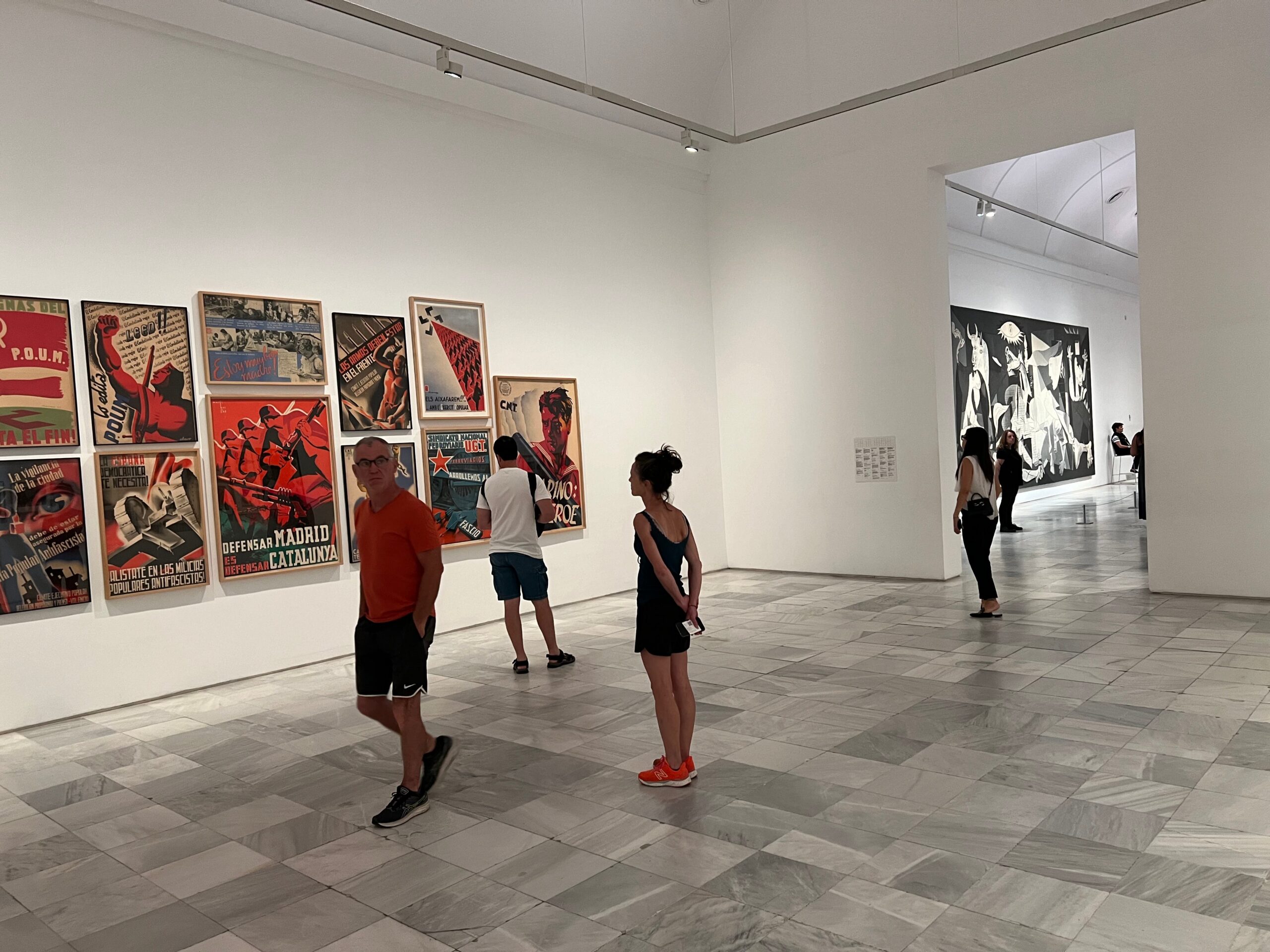
I appreciate the consistency of Euro payment methods; I have not used cash since arriving. I pay my bill and wander back up to Guernica for a fresh second look. In the next room is the art of the anti-fascist Republic. The aesthetic of the posters and flyers is inciting and confident. Liberty and a new world are yours to seize, your birthright as Spaniards. These were not shy people. They saw the threat and named it, unconcerned with the exigencies of academic precision.
Fascism.
There are printed pamphlets and newspapers and periodicals in glass covered displays, along with the posters adorning a large wall. The internecine conflicts, which would hamper if not doom the anti-Franco effort, between Stalinists, Trotskyites, social democrats, government loyalists, unionists, and anarchists are woven through the imagery. I take some photos for sharing with project followers, one capturing a wide view of both the room’s anti-fascist propaganda and the Guernica painting in the adjoining space. I will spend the evening rereading George Orwell’s Homage to Catalonia. The Brit, whose 1984 and Animal Farm are, along with Aldous Huxley’s Brave New World, the most-read indictments of totalitarianism, went to Spain to put his life on the line to join the resistance against Franco. His focus on the destructive infighting and subversion by Soviet agents has been the subject of controversial and diverging analyses. He traveled far to join the fight, got a bullet in his neck for his effort, then was hunted and almost murdered by Stalinist cadres who deemed his POUM militia not sufficiently revolutionary.
This second visit to Guernica allows a closer look at the detail. The mother and baby, the use of bull and horse likenesses. The light from above along with the man holding the gas light. The wanton destruction and terror. I don’t have the art history credentials to understand the esoteric imagery or Cubist forms but there is a visceral impact. In a room nearby is a set of ‘postscripts’, the women of Guernica, a series of related art pieces. Viewing these smaller bits offers context and fullness to what I see in the main room. And that leads me to wander through the museum. Ah, here is Dali’s masturbation painting, along with psychedelic renderings that seem impossible to imagine without hallucinogens. I enjoy and appreciate walking the rooms and take what I can in my own way. I love wandering through grand structures holding grand ideas, libraries and bookstores, cathedrals, museums, monuments.
After my wander, I navigate the towers and halls for a final look at Guernica. This time, I am impressed by the sheer scale, the audacious vision, the translation of political messaging and reportage to a singular creative vision on a very large canvas. My friend Chaun is surprised when I send him photos of my visit. He remembers it as having more color. Yes, Picasso affected that. The grey, black, and white coloring, on a canvas 11 feet 5 inches tall and 25 feet 6 inches across, is meant to evoke the dust and ash left after the bombing and the suffering wrought by violence and chaos.
I want to visit the nearby Prado museum but there is no time. I head back to the hotel to pack and prepare for my train ride to Barcelona.
For more on my books, interviews, and service helping people document their life stories, go to electric-memories.com.