
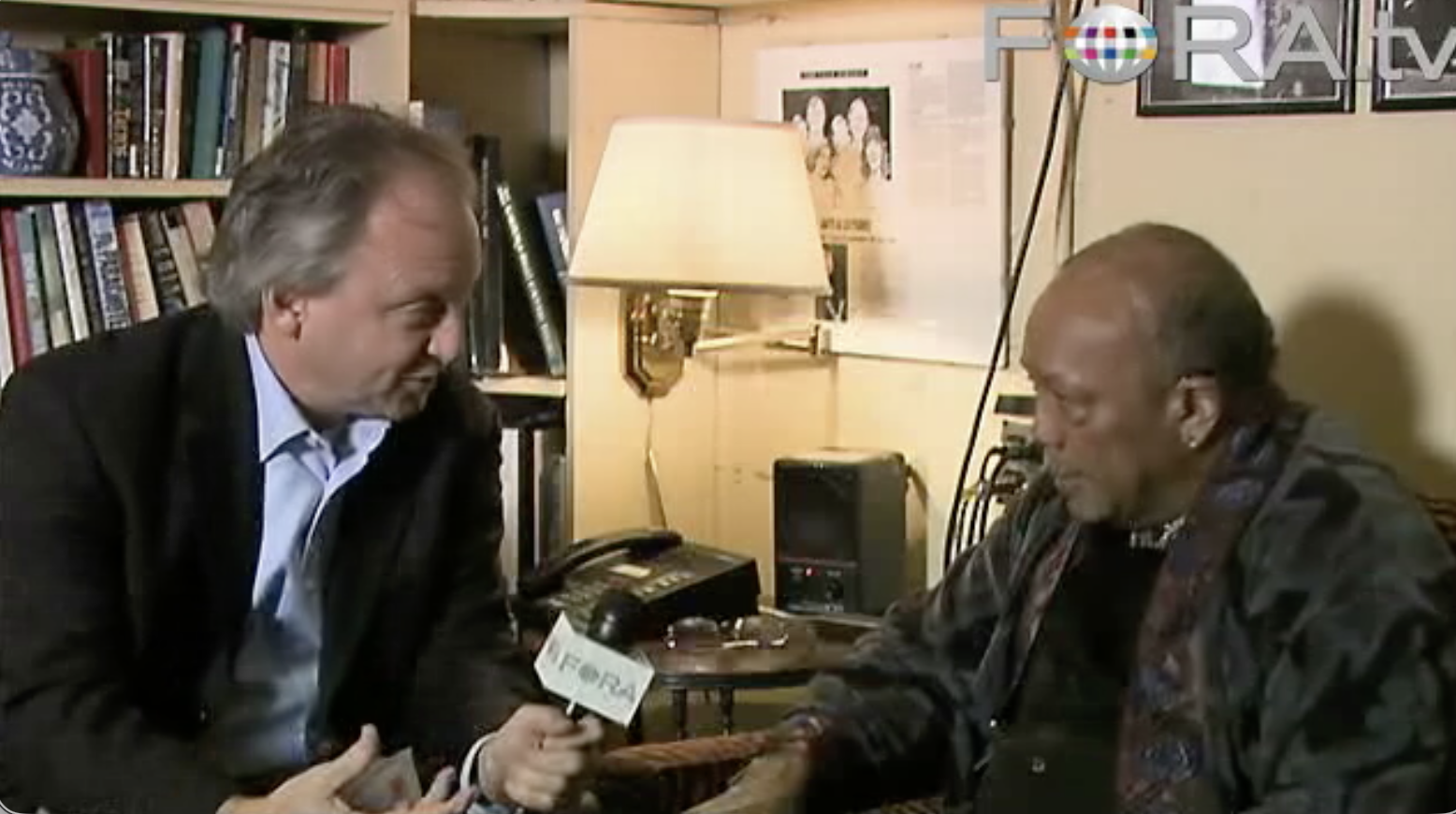
After posting my Robert Thurman interview backstage at City Arts & Lectures, I mentioned several others I’d done. One reader asked me to post my Malcolm Gladwell interview, so I did. Then Stephan Kahlert asked for Quincy Jones. So here he is.
December 16, 2008 — City Arts & Lectures, Herbst Theater, San Francisco.
We had a lovely conversation backstage before the event. I was curious why Quincy returned to Brazil so often. I used to travel there every year with my Brazilian wife, so I asked him.
He flashed a grin. “Bundas.”
Over the coming year I plan to publish a substantial archive of interviews from my years at C-SPAN, FORA.tv, ShowGo.tv, and the interviews that became the foundation of my seven books.
It’s a great privilege to bear witness to life stories and public ideas.
Quincy is interviewed onstage by Rolling Stone journalist Ben Fong-Torres, featured prominently in the movie Almost Famous, and another early interviewee of mine. That excerpt is followed by my backstage interview with Quincy, conducted shortly before the event began.
For more interviews, books, and my life-storytelling project, visit electric-memories.com.
Brian Gruber: Quincy Jones, I was reading your Wikipedia biography, and it describes you as many things. The very first word, though, is impresario. You don’t seem to agree with that description. Why is that?
Quincy Jones: I don’t know. I think of myself primarily as an orchestrator, arranger, and composer. I used to be a trumpet player, too, but after two operations I can’t play anymore. I still play piano, but my first love is writing for four trumpets, four trombones, and five saxophones.
Brian Gruber: In some ways you’re a child of the Depression, having grown up during the 1930s. This is the first time in my life that the word depression is being used to describe the possible future of our economy. At the same time, our president-elect was elected on a message of hope. When you look at the next year—or even the next four years—do you see depression or hope?
Quincy Jones: I see hope.
Our president-elect has a lot of work to do cleaning up the mess that’s already been made. I’ve traveled the world—probably more than almost anyone I know. We used to travel nearly 500,000 miles a year. I just got back from Dubai and Abu Dhabi, and I’ve spent time throughout China, Iraq, and the Middle East. I’ve been traveling there since 1956.
It’s fascinating to learn the languages and understand other cultures without imposing your own culture on them.
My foundations have been working in South Africa for 36 years, Brazil for decades, Cambodia, Quebec, and elsewhere. You realize how connected the world really is.
In many ways, this economic collapse is almost like a symbolic wake-up call from God. It didn’t happen to just one country—it happened to everybody, even Iceland. It shows how connected we all are.
So maybe—just maybe—we should try a little more love instead of hate.
Brian Gruber: You see yourself as something of an ambassador, then. How have you seen America’s image evolve in recent years? Do you think there’s work to be done?
Quincy Jones: There’s a lot more than some work to be done.
In 1956 I traveled with Dizzy Gillespie on the first State Department Goodwill Tour. Congressman Adam Clayton Powell helped make that happen before similar tours by Benny Goodman or even Louis Armstrong.
We traveled to Tehran, Aleppo, Damascus, Beirut, Cyprus, Turkey, and throughout the Middle East. Even back then, in 1956, you could see many of the forces that would shape the future.
If you want to understand the world, you’ve got to get out and see it. You’re not going to get reality from a couple of television channels or newspapers alone.
Brian Gruber: Before we started, you mentioned that you’re working on a film about Carnival in Brazil. Brazil is very close to my heart, and you’ve been going there for many years. Tell me about the project.
Quincy Jones: We want to make it as an IMAX film—the biggest, highest-definition experience possible.
I’ve been thinking about it for four years. A couple of years ago I went down there with the Rolling Stones for their concert on Copacabana Beach. Bono picked me up afterward, and we went to São Paulo, where U2 played two shows. Then I went to Salvador, Bahia, and came back for Carnival.
But this film is really for the benefit of the children living in the favelas.
When I first became involved there in 1956, there were about 3,000 children without families. Today there are hundreds of thousands.
Bahia is doing well. São Paulo has problems. Rio has problems. They’re my friends, and I go every year. These kids perform despite living with incredible violence around them. It’s a serious social problem—not just in Brazil, but all over the world. Some places are worse than others, but it’s a global issue.
Brian Gruber: How has technology changed the way you personally enjoy music?
Quincy Jones: In what sense?
Brian Gruber: How you consume music. Do you listen the same way you always have?
Quincy Jones: I always look outside the box because I know how programmers think.
I think it’s a shame that even the biggest broadcasters don’t really teach young people the essence of the music.
Every country in the world has, to some extent, pushed its indigenous music aside while embracing American music. In Russia they still celebrate Rimsky-Korsakov, Stravinsky, and Shostakovich—but they know our music, too. The same is true in Germany, Japan, and France.
Ironically, jazz became more appreciated overseas than it did here at home. Those countries nurtured the culture instead of neglecting it.
Brian Gruber: So do you listen to music on an iPod or other portable devices? Or is the sound quality simply not good enough for you?
Quincy Jones: I can hear the difference.
Besides, somebody else chooses most of the music that goes onto those devices.
I like discovering things people don’t expect—artists from Cameroon, unusual vocal ensembles, traditional music from around the world. I even used some of those voices during Miles Davis’s last concert, and they fit beautifully.
Our musical world is much broader than what commercial broadcasting usually presents. I try to stay current with everything that’s happening because music is much bigger than what’s fashionable at any given moment.
Brian Gruber: My father was a great lover of big-band music, especially Cab Calloway. You worked with some of the greatest bandleaders of that era—Count Basie, Lionel Hampton, and many others.
Do you see bandleaders today with similar qualities and skills?
Quincy Jones: Absolutely not.
Most people don’t even think in those terms anymore.
There are a few people—John Clayton, Rickey Minor, and a handful of others—but very few.
It’s simply not part of today’s musical culture or the mindset of commercial radio. And that’s unfortunate.
We have to do something about it. We’re trying to bring together the right people to encourage that kind of musical leadership again.
I hope our president-elect succeeds, and I also hope someday America has a Secretary of the Arts.
We’re the only country whose music has been embraced by the entire world, yet we don’t have a cabinet-level advocate for the arts or a true minister of culture. Countries like France understood the importance of that years ago. We should too.
Brian Gruber: On that note, you have an event to get to in just a few minutes.
Quincy Jones, thank you very much for your time.
Quincy Jones: It’s been a pleasure.
Brian Gruber: The pleasure was mine.
Quincy Jones: Obrigado.
Brian Gruber: Obrigado.