
“Stop Stealing the Future: Chronicles of the Ukrainian Resistance” is a series of interviews and field observations recorded during travels across Ukraine during the Russian invasion.
Odesa is Ukraine’s third-most populous city, famous for its 19th-century architecture, Black Sea maritime port, and the iconic Potemkin Stairs.
One hundred years ago, Sergei Eisenstein premiered his film Battleship Potemkin, widely regarded as the most influential film in Russian — and arguably world — cinema history.
The film tells the story of sailors mutinying against their brutal officers. During the 1905 Odesa protests supporting the mutineers, Tsar Nicholas II’s troops fired on civilians. In Eisenstein’s dramatized Potemkin Stairs sequence, a mother is shot, loses her grip on a baby carriage, and her infant hurtles down the staircase to the horror of onlookers—a scene that has inspired countless homages, most famously the train station sequence in The Untouchables.
The 1905 Revolution forced reforms, though the tsar’s promise of a parliament (Duma) and increased civil liberties were soon undermined.
Today, I arrive in Odesa on Ukrainian Independence Day.
Independence, Intent, and the Unfinished War
I begin the day with Valerii Bolhan — editor-in-chief of Intent, head of the Center for Public Investigations, director of Odesa’s Museum of Elections and Propaganda, and a PhD student. Intent is an independent media outlet for the southern regions of Ukraine, providing local news, investigative journalism, and analysis. One more bold, entrepreneurial journalism venture in a country that prizes its emergent free press.
I note the range of his ambitious projects. “You’re busy.”
He nods. “Yes… I have some roles.”
I begin simply: Independence—from what?
Valerii pauses, then reframes the question.
“Only now,” he says, “we begin to understand what independence really means.”
For much of his life—and for much of modern Ukraine—independence was abstract, almost accidental. Ukraine became independent in 1991, but the deeper structures of dependence remained.
“We had an independent state,” he tells me, “but not independent people.”
He describes a childhood caught between identities. In school, Ukrainian language and literature were taught only a few hours per week; everything else was in Russian. Even cultural memory had been thinned out.
“I was maybe the last Young Pioneer (the Soviet answer to the Girl and Boy Scouts of America) in the Soviet Union,” he says with a faint smile. “I had two ties—one red, one blue and yellow—in the same day.”
To understand independence, Valerii insists, you have to understand what came before—and what was erased. He speaks of generations shaped by the Soviet system, some of whom accepted it as normal, stable. Those who resisted—writers, dissidents—were often imprisoned or killed.
“Only now,” he says, “we understand the hard way they lived.”
He lists names: dissidents, poets, Crimean Tatar leaders. Some survived into old age; many did not. Their stories were hidden for decades. Ukraine, he explains, wasn’t just politically controlled—it was systematically diminished.
“There were times,” he says, “when Ukrainian language and culture were present in public life. But after the 1930s, that changed.”
He refers to famine, repression, and industrialization—waves of policy that reshaped the country at enormous human cost. Entire villages disappeared, sometimes literally submerged by Soviet infrastructure projects.
“They built the station,” he says of one hydroelectric project, “but they didn’t care about the people.”
Language, Identity, and Late Awakening
Even decades after independence, the legacy persisted.
“I spoke Russian for many years,” Valerii tells me. “Only after 2014 did I begin to move toward Ukrainian.”
The turning point, like for many Ukrainians, came with war—the annexation of Crimea and the fighting in Donbas.
“And for many people,” he adds, “only after 2022.”
Identity, in Ukraine, has not been static. It has been forged through sometimes violent experience.
So what, after all this history, are Ukrainians fighting for now?
Valerii answers without hesitation.
“Now we have someone killed in almost every family,” he says. “This is our vaccine from Russia.”
He acknowledges that nostalgia for the Soviet past still exists, especially among older generations.
“They say the ice cream was better,” he says, half-smiling. “But there was only one flavor.”
Memory, he suggests, can be selective—and misleading.
What Does Success Look Like?
When I ask what a successful outcome to the war might be, he doesn’t offer slogans or certainty.
“If I don’t need to leave my country,” he says quietly, “that is success. I am afraid,” he continues, “not for myself, but for my family. My wife, my sons… even my cat. We live in this situation like it is normal. But it is not normal.”
Valerii points to a broader context.
“This war is not only about Putin,” he says. “It is about Russian imperial intention.”
Even if leadership changes, the underlying dynamic may persist. That creates a troubling horizon.
“If Russia exists like this,” he says, “we will always have danger.”
Some hope lies in internal pressures within Russia—regional tensions, economic strain—but he does not rely on that as a solution.
What, then, is realistic?
Valerii outlines a possibility that is less heroic but perhaps more achievable: a negotiated peace, even one that involves painful compromises.
“It may not be victory,” he says. “It may be peace.”
He acknowledges the risks—territorial concessions, fragile guarantees, the possibility of future conflict—but sees it as one plausible path forward. Ukraine, he notes, is exhausted. Its soldiers are tired. Its society is strained. And the postwar period may be as unstable as the war itself.
“The first year after the war,” he says, “will be very difficult. We may lose a generation,” he says bluntly, referring to the millions who have chosen to leave the country.
And yet, he holds onto something more personal.
“I have a dream,” he tells me. “My grandchildren will live here.”
Dina Shows Me Her Odesa
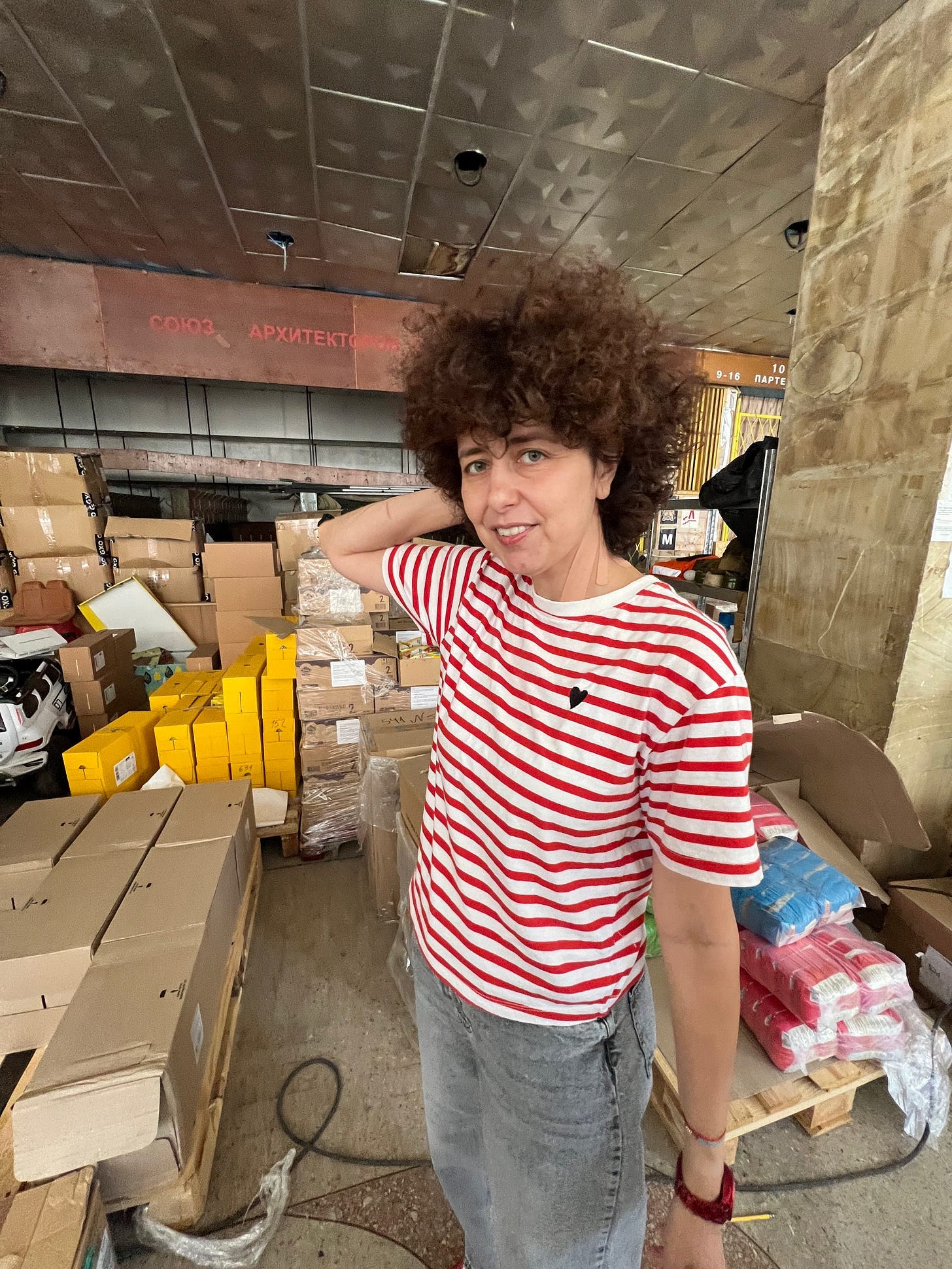
Dina Kazatzker organizes volunteers and activities for Odesa-based Monsters NGO, a frontline volunteer organization delivering large-scale humanitarian aid—food, clothing, and medical supplies—to civilians and communities impacted by the war. In advance of our meeting, I asked Dina if she knew anyone who might be able to lend me a guitar to play on the Potemkin Stairs for my final night in the country. She delivered two to my hotel.
During our tour of the Monsters facilities, Dina received an alert on her phone. In other interviews, a siren didn’t so much as cause a pause for my hosts. This time, she warned it was a ballistic missile alert, so I had my first descent into a basement bomb shelter, where we continued our conversation.
Brian: How many people are you supporting right now?
Dina: Two hundred people receive one kind of help, and another group also gets support—about 600 altogether.
Brian: What goes into the monthly packages?
Dina: Basic staples: pasta, tea, biscuits, canned fish, oil, rice, and sugar. Families with children receive extra items for kids, and we supply diapers as well.
Brian: When there’s an air-raid alert, how do you know what kind of threat it is?
Dina: We monitor a Telegram channel. They post whether it’s ballistic missiles, drones, and so on. Today they warned it might be ballistic.
Brian: How do you decide whether to shelter?
Dina: If it’s ballistic, it’s better to hide. We had colleagues working in a small office we rented because it was too cold at the arena. A nearby military sanatorium was hit, and the blast wave reached their building and shattered windows. After that, we became much more cautious.
Brian: That’s a lot to carry day to day.
Dina: It’s our reality. I’m grateful we can help, though of course it would be better if our work weren’t needed. Even if the war ended tomorrow, people returning from the army would carry trauma—psychological and physical—so our work wouldn’t stop; it would just change. I’m angry about the situation, but I’m not paralyzed by stress. We do what we can.
Brian: Besides food, what else do you provide?
Dina: Medicines and access to diagnostics like MRI scans for people who can’t afford them. In Ukraine, you pay for everything. People are waiting for us to solve these problems. For example, funds on one of our accounts today are barely enough to cover a month of heart medication for one woman who’s waiting on my call so her neighbor can pick it up.
Brian: Do donations include medical equipment?
Dina: Sometimes. Useful items arrive, but we also receive things that are expired or not usable here. We can’t deploy those, and disposing of them properly costs money. Donors mean well, but it’s important to send what local hospitals can actually use.
I’ve already imposed on Dina with the guitar loan. I mention, in passing, that I couldn’t find a laundromat during my Kharkiv stay and wonder if there’s a local boutique where I might pick up a few T-shirts and socks for the final leg of my trip. We stop at Staff Clothing, a popular, minimalist Odesa streetwear shop.
Dina continues her heroic rescue of my final-day needs and takes me to She, a small boutique to shop for a gift someone back home. I muddle through the selections until she approves a pair of earrings featuring the nightingale—Ukraine’s national bird, long celebrated in folklore and song.
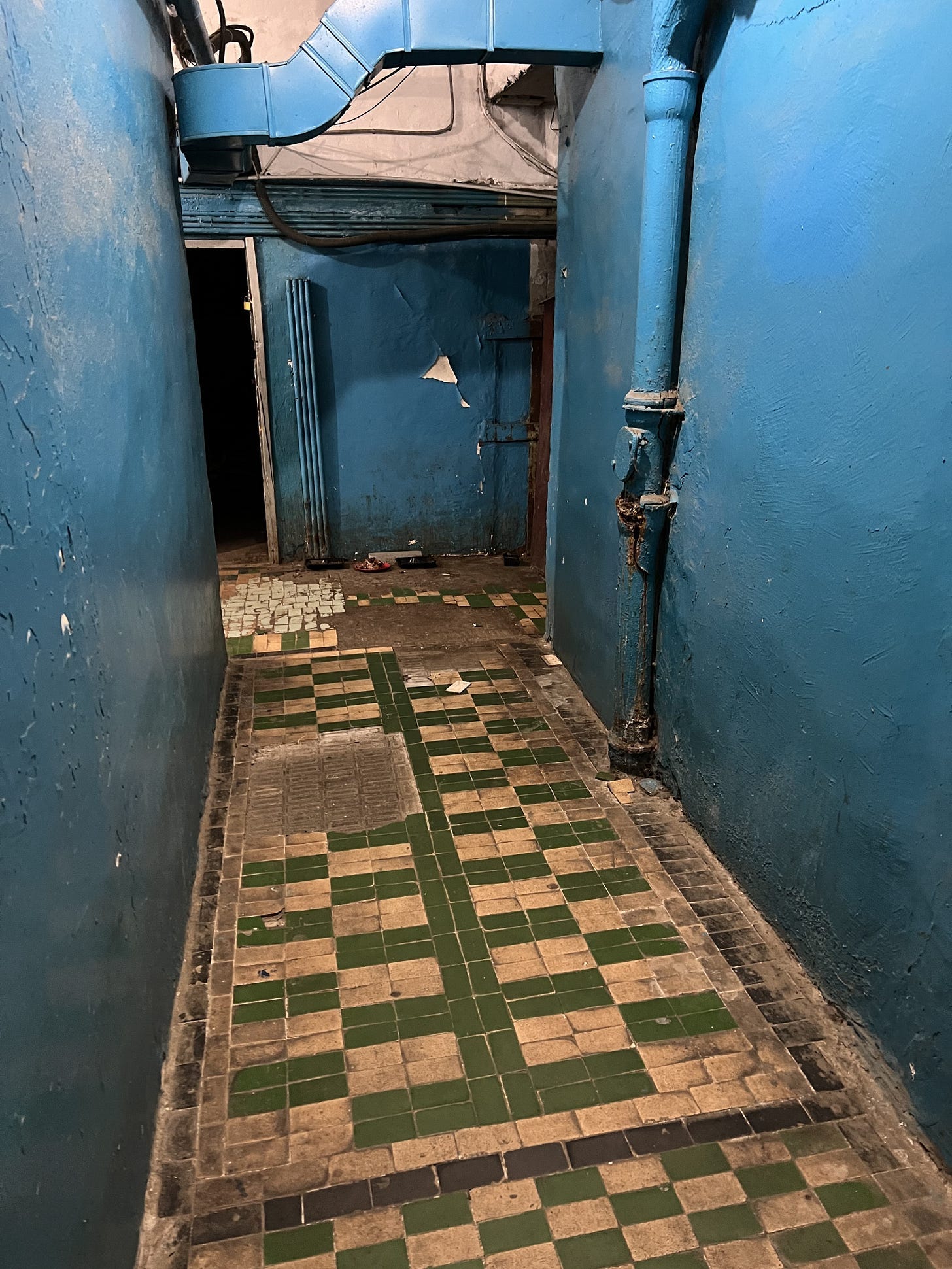
After a stop at a building tied to her work, we visit the Odesa Regional Universal Scientific Library named after M. S. Hrushevsky, a civic space that feels less like a traditional library than a living cultural hub, with books, exhibitions, and quiet conversation sharing the same air. After a visit with the staff, we move on to our final stop.
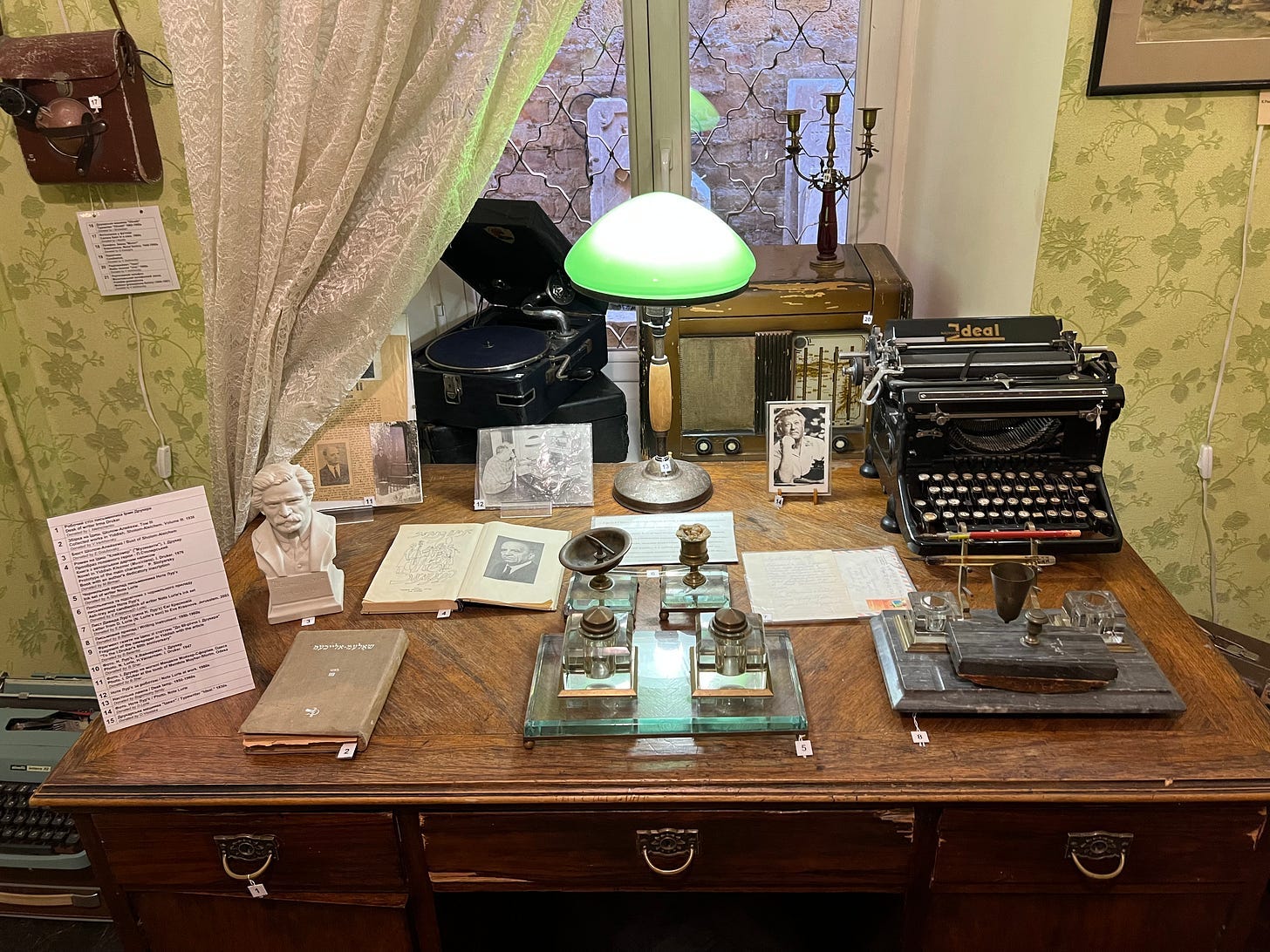
The Museum of the History of the Jews of Odesa is housed in a former apartment. Our host, Zvi-Girsh Blinder, takes us on a private tour through personal histories and the movement of communities across the city over centuries. Drawing on a vast archive of photographs, documents, and everyday objects, the museum traces a vital thread of Odesa’s past—a modest but deeply felt institution preserving a culture that helped shape the city’s identity.
I find myself again drawn into Jewish spaces through chance encounters, as this history runs through Ukraine whether you go looking for it or not.
What Survived
Brian: As you look at the history of pogroms, Soviet Russia, Nazi Germany—Jews seem to be a recurring target of persecution. Where does that come from? Why over the centuries?
Zvi-Girsh: It’s not only Germany, not only the twentieth century. It goes back more than 2,000 years.
It’s xenophobia. People don’t like those who are different—different religion, different customs, different language. And for authorities, it is very useful. When there are internal problems, they can redirect blame. “It’s not our fault—it’s them.” Like Hitler did in Germany.
It’s a very common mechanism.
Dina: In Ukraine now, I don’t really feel antisemitism the way it was maybe 20 years ago, or earlier. We know people talk about it, but in daily life—it’s not something I feel strongly.
Life under Soviet Control
Zvi-Girsh: After the revolution, land was first given to peasants. But by the late 1920s, the Soviet government reversed this. They said independent farmers were not a good idea. So they collectivized everything—made collective farms.
There were also Jewish collective farms, especially in southern Ukraine, Crimea, and other regions. This was part of a larger policy: to control people; to take grain and sell it abroad; to industrialize the country; and to move people from villages into cities.
Brian: Was this also about political control?
Zvi-Girsh: Yes—but not only Ukrainians. It happened in Kazakhstan, in Siberia, among the Cossacks. It was about control everywhere. Breaking independence. Making people dependent on the state.
He points to street hardware I saw throughout Kharkiv.
This image shows the defense of Odesa in 1941. These anti-tank obstacles—“hedgehogs”—were used then.
Brian: And now they’re being used again against the Russians?
Zvi-Girsh: Yes. The same idea.
We walk through the former home, each area’s artifacts described as we go.
This document is a school graduation certificate—written in Ukrainian and Yiddish. In the 1920s and 30s, there was a policy to educate everyone. People were taught in their native languages. So there were schools in Ukrainian, Belarusian, and also Yiddish in places with large Jewish populations. In Odesa, there were schools where all subjects were taught in Yiddish.
Here is something unique: a handwritten textbook of electrodynamics in Yiddish. A professor translated it and taught the subject in Yiddish. Students copied it by hand.
Before World War II, Jews made up a very large part of the population. In 1920, almost half the city was Jewish. By 1989, there were about 65,000 Jews left in Odesa. After that, more emigrated—especially in the early 1990s.
Brian: After World War II, how were Jews treated in the Soviet Union?
Zvi-Girsh: There was state antisemitism—almost throughout Soviet history. From the 1920s, Zionists were persecuted. The idea of Zionism was seen as dangerous because it focused on building a future in Israel, not in the Soviet Union. After World War II, especially in the late 1940s, repression increased.
There was the “campaign against cosmopolitans.” Jews were accused of being disloyal, of having “dual loyalty.” Jewish newspapers were closed. Cultural life was restricted.
In 1952, there was the execution of members of the Jewish Anti-Fascist Committee—writers, intellectuals. It was called the “Night of the Murdered Poets.” Later, even in the 1970s and 80s, Jews who wanted to emigrate or practice religion were harassed by the KGB.
Brian: There’s a strange irony—Nazis accused Jews of being communists, and communists accused Jews of being disloyal.
Zvi-Girsh: Yes—and another irony.
In 1941, Jews fled from the Germans to the Soviet Union—to Russia, to Central Asia. In 2022, Jews fled from Russians—to Germany and Romania.
Same people. Different direction.
Showtime at the Journey’s End
I walked along Primorsky Boulevard, through the heart of Odesa’s old city, toward the Potemkin Stairs, passing street performers at every turn. Then, suddenly, they reveal themselves—cascading down toward the Black Sea.
Built between 1837 and 1841 as a grand entrance from the sea into the city, the stairs were first known as the Giant Staircase, later the Richelieu Steps. Film historians tend to call them simply the Odesa Steps when referencing the iconic scene from Battleship Potemkin. There are 192 steps arranged in ten flights, 21 meters wide at the top, narrowing to 13 at the bottom.
Carrying my borrowed guitar, I hoped to perform the full playlist of American folk songs I had practiced for the trip. I tried to find a travel guitar in Kyiv and Kharkiv, but was frustrated by limited stock and wartime closures. I managed to perform in a Kyiv club. Now I have this private moment on the steps.
I sit midway down on the right edge and start with Bob Dylan’s When the Ship Comes In.
For the chains of the sea
Will have busted in the night
And will be buried at the bottom of the ocean
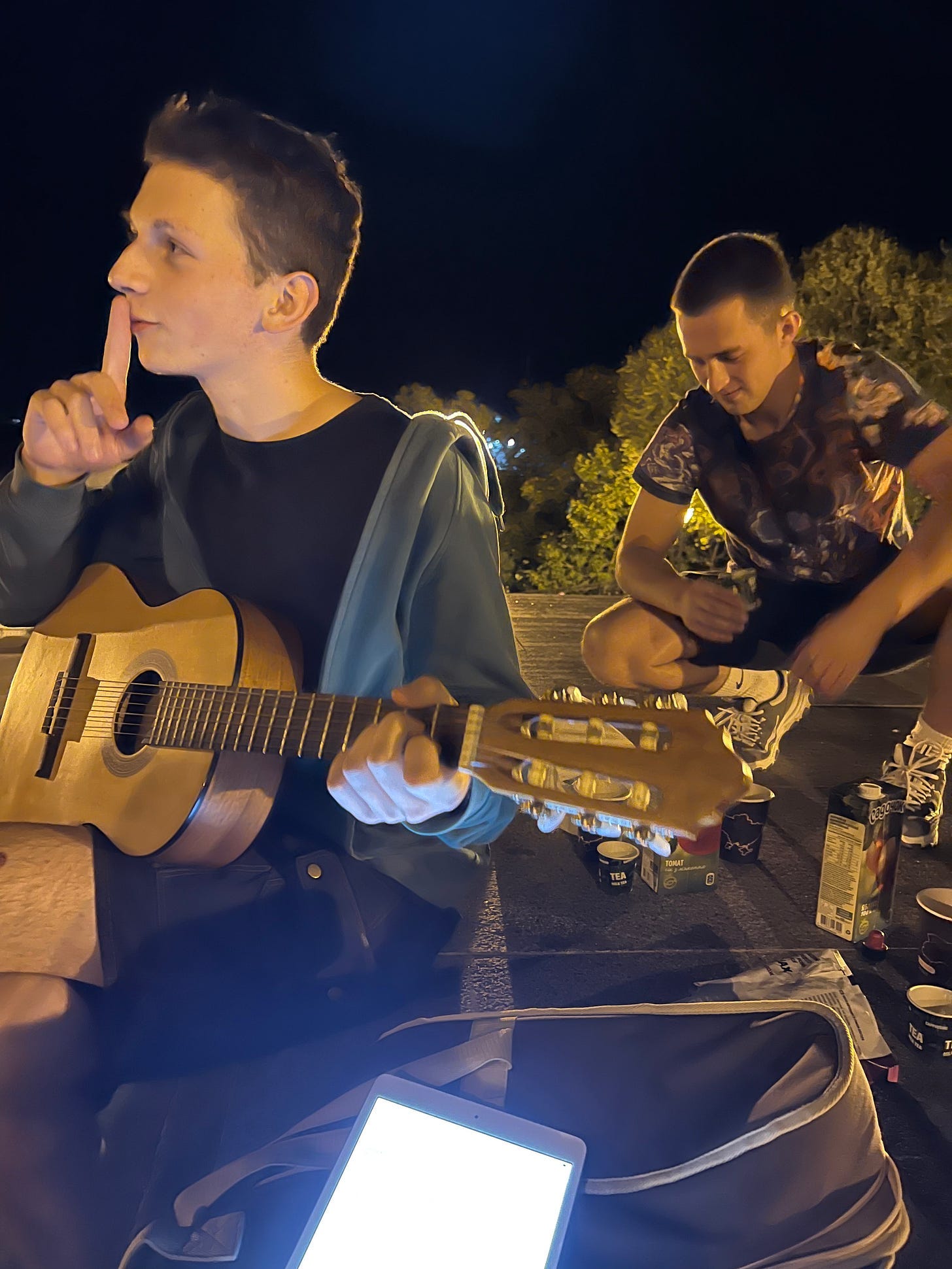
A small crowd gathers and applauds. A young boy asks why I am here and expresses his appreciation. A teenager asks if he can play Dylan’s Knockin’ on Heaven’s Door.
There is music all around. On my right, below a small overpass, an old piano where locals play casually for friends. Above me, a couple give an impromptu concert. The Black Sea, with its rich and violent history, stares back at me.
I play Sam Cooke’s A Change Is Gonna Come, then Phil Ochs’ The Power and the Glory. A teen from my earlier audience approaches.
“Would you like to drink Ukrainian vodka with us?”
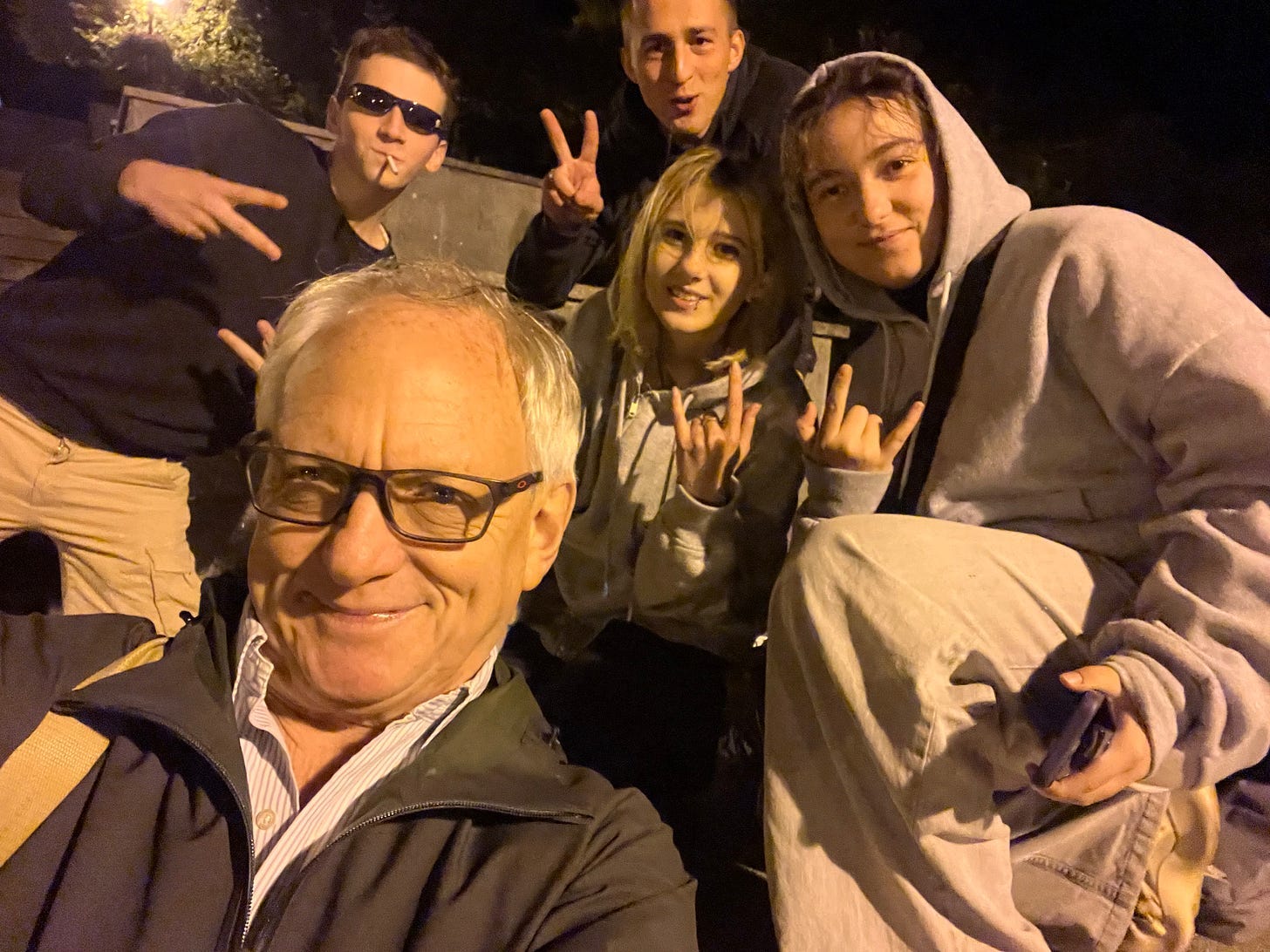
I gather my things and join them—three young men, two young women. They ask what I am doing here, and I tell them. I ask about their lives in Odesa and how the war affects them personally.
Tanya is a student at MGU University. Her father was captured by the Russian military three years ago. She hasn’t heard from him since.
I ask if she is OK. She says yes—she stays with her mother. She has to “stay strong and go on with life.”
“What do you think is the way to peace for Ukraine?”
“Peace will come to Ukraine when Putin dies.”
Lazar adds, “It’s hard to say. Opinions are going different ways. My honest opinion is that people need to deal with other sides and stop this all.”
“Good idea. But how?”
“Presidents should meet and shake hands. But it’s difficult for our country—we are angry. It’s understandable. Many people have died or are suffering. But we need this to end. We need to close our eyes on some things to move forward. It’s hard, it’s painful, but we need to understand the other side—and the other side needs to stop the fire and stop coming to our country illegally.”
Lazar is studying radio and television in a university internship. Months later, he would send photos and write, “I hope we can hang out again sometime. You were one of the first people I met in Odesa, and that meeting really had a big impact on things over time.”
The vodka runs low, so we go to a nearby shop for resupply and Ukrainian hot dogs.
When we return, Lazar asks if I would like to hear Ukrainian songs. I play the chords while he sings the lyrics. Eager to finish the songs I brought, I do a duet with him on Johnny Cash’s The Man in Black. A few try to sing along to Woody Guthrie’s This Land Is Your Land. I finish with Pete Seeger’s God Bless the Grass.
It’s Independence Day—and Tanya’s birthday—ample excuses for more toasts, refills, and another song. I ask what we should give her for a present. A new car? A house? Jewelry?
“I just want to be with people,” she says.
I’m 70, but I find myself remembering what it was like to be 18—carefree, uncertain about the future, open to adventure, curious. They guess my age at 52 and 53, fully satiating my ego. Lazar makes up an impromptu song about me.
I’m curious. “Okay, okay, can I ask you a question? Today is Independence Day. So for you, what does independence mean? Independence from what?”
Lazar says, “It’s a big day in Ukraine. Very big.”
Lidiia answers, “Independence for the country—but also my own independence. As a person.”
They ask what it means to me. I think back on all my encounters these past three weeks, the answers given to similar questions.
“For me, it means you’ve been suffering for a long time—under the czars, the Soviets, now Putin, and your own oligarchs. And everyone I meet wants the same thing: freedom. Of speech. Press. Religion. The rule of law. The right to choose your own future.”
Tanya refills everyone’s cups for another toast.
Midnight curfew approaches. My hotel receptionist warned me: the front door will be locked, so I better not be late. It’s 11:20, and I have a 20-minute walk back through the old city.
After hugs and promises to stay in touch, I begin walking up these grand stairs.
And I think of Gleb, a 12-year-old with a mop of black hair and big glasses.
Earlier, with his proud father standing beside him, he approached me after I performed, speaking with extraordinary confidence and passion.
“I hope you achieve your dreams to create your book about Ukraine’s life, because it’s very… it’s hard to be in Ukraine right now. There are a lot of bombs flying around and a lot of sirens. We don’t know if we’re safe or not. This is not the first time Russia attacks us. But I hope you achieve your dream.
“And we’re gonna win this war.”
I asked if he liked my makeshift performance.
“Yeah,” he said. “I loved it.”
I leave Ukraine in the morning.
He stays.
• • •
Additional chapters and forthcoming PDF and print editions of Stop Stealing the Future can be found in the Substack series archive.