
Art, War, and the Refusal to Leave
“Stop Stealing the Future: Chronicles of the Ukrainian Resistance” is a series of interviews and field observations recorded during travels across Ukraine during the Russian invasion.
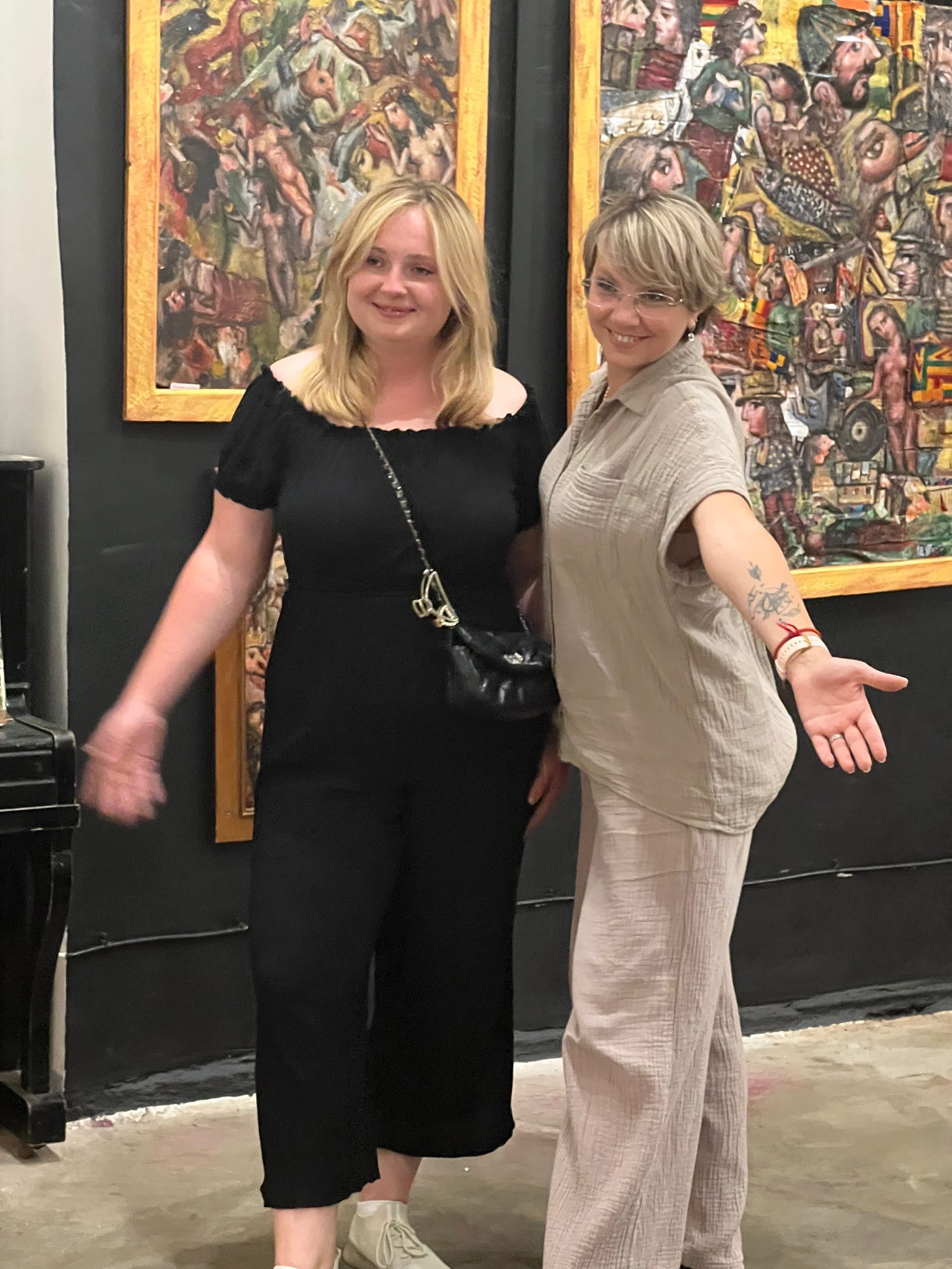
In a bare gallery — concrete floors, paintings clustered tightly along white and black walls — I meet Magran Tata, founder and curator of an artist-run space within Kharkiv’s DRUK cultural and community center.
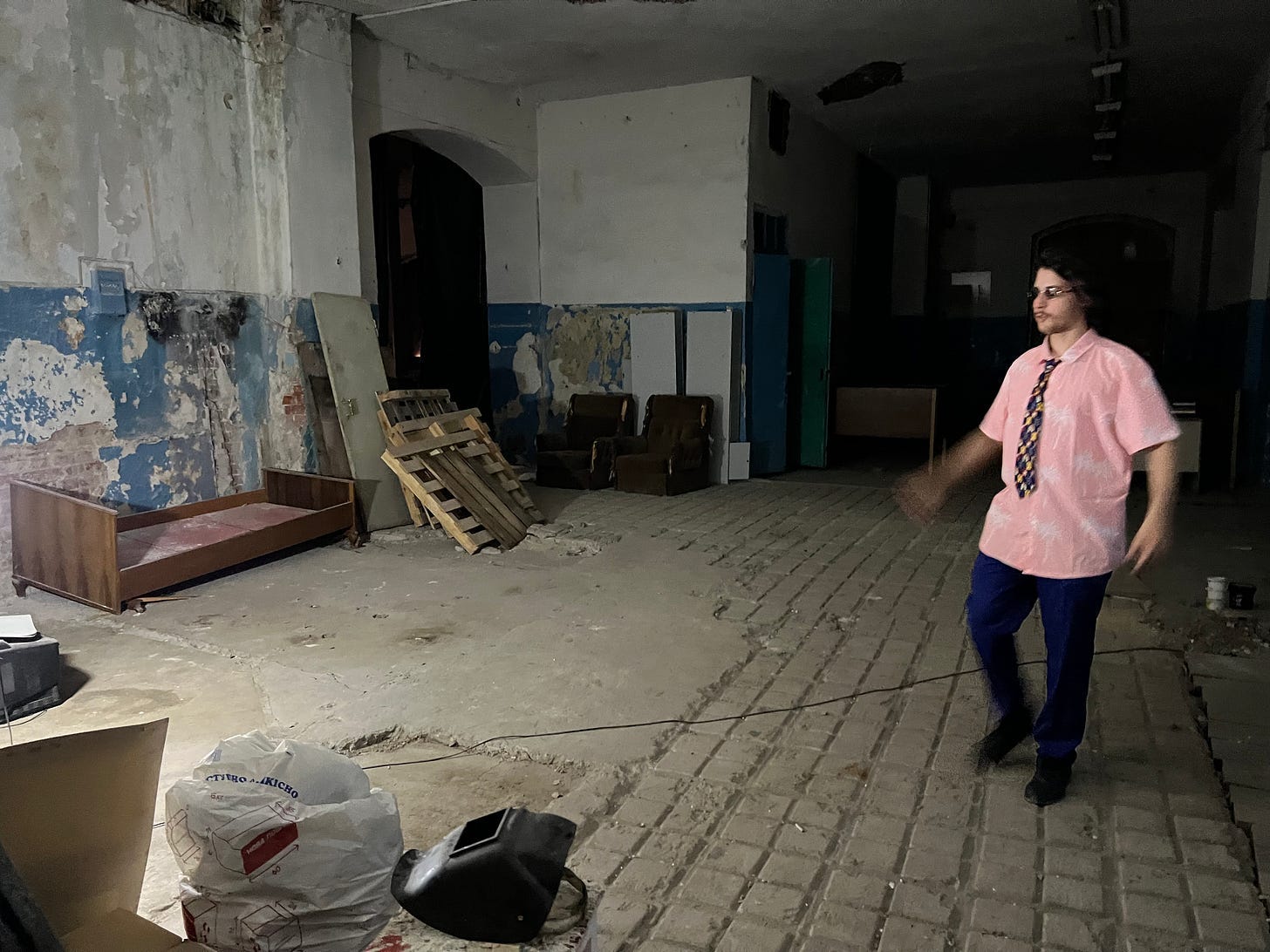
We move through the building as he talks. Past the gallery and into a low-ceilinged storage room, paint peeling in soft blue layers, a single bulb hanging over a clutter of canvases, guitars, and plastic bags. Down to a performance space — drum kit set, amps stacked, microphones waiting. Outside, in a worn brick courtyard, artists and guests gather around low tables, sharing food and drinks. Then back upstairs, where Magran stops every few steps to greet someone — a staff member, an artist, a visitor — the place alive with quiet, constant motion.
DRUK takes its name from the Ukrainian word for “printing,” a nod to the building’s past as a working print factory in a city long known for publishing and intellectual life. That history has been directly targeted — Russian strikes on Kharkiv’s printing infrastructure, making clear that culture itself is part of the war. Out of that damage, DRUK has re-emerged in a different form: not a factory of books, but a living space where artists, musicians, and writers gather, create, and remain visible.
Magran pauses in front of the paintings and turns back to me.
Magran Tata: We’re at the gallery whose name translates loosely as “Creative Fluke” or “Creative Illness.” It’s located on the second floor of DRUK, a multifunctional cultural and social center here in Kharkiv. DRUK hosts different kinds of art residents: a theater, an art gallery, and various creative workshops.
Right now we’re standing in our exhibition space, which opened one month ago. Today is the final day of the show. It’s called “Fragments.” The artist, Lefkov, is seventy-four years old and comes from Drohobych. He’s a very experienced man — he used to teach icon restoration at a university, focusing on Orthodox church paintings, and he’s written several books on that subject.
He reached out to us himself. He called and asked if he could hold an exhibition here. I said, “Send a few samples of your work.” When I saw them, I was blown away. He first sent a catalog and one painting — a portrait of Jesus — and told us we could keep it. His work is very spontaneous. He paints quickly and adds unconventional materials — things like cigarette packaging — directly onto the surface.
The frames are all handmade too. He found the professional framing costs too high, so he started building frames from scratch. Sometimes he paints over old works or uses cardboard as canvas. Behind some paintings, you can see the raw material showing through.
His style? I’d describe it as a cross between religious iconography and surrealism — something between a traditional church aesthetic and the energy of Basquiat. This show is unusual for him, though. Normally, he exhibits carefully restored icons painted on reclaimed wood. But here, he shared deeply personal works created between 2016 and today.
He didn’t provide titles or descriptions. He just told us these are “fragments” — pieces of his heart, not part of any single narrative. He paints several works a day — he’s incredibly prolific. And he’s also a volunteer for the front line. He sells his icons and paintings at auctions to raise money for the army. He travels constantly — east, south, west — wherever he can help.
Brian: What’s it like to manage an art space like this — so close to the Russian border, in a city that was invaded — over the last three years? How has that evolved?
Magran: Actually, this gallery was born because of the war. When the full-scale invasion began, I didn’t know any of the people I now work with. All the big municipal and government art institutions were closed. So I started organizing exhibitions wherever I could — first in coffee shops, then pop-up shows on the streets.
Eventually, I won a small grant — about five to seven hundred dollars — which allowed us to rent a small place downtown for half a year. Then we moved here to DRUK in autumn 2023. Just a few months ago, we celebrated our second anniversary.
We’re a nonprofit gallery. Everyone here has another job, so this is a labor of love. Donations — whether equipment, materials, or money — go toward rent or hosting events. Sometimes we pay visiting lecturers or buy licenses for film screenings.
From the start, our mission has been to promote young artists. In traditional galleries, you might wait years for an exhibition slot — everything’s booked far in advance. We wanted to build an artist-driven space focused on debut exhibitions, giving new voices a chance to be seen.
Why They Stay
Brian: Tell me about the decision of young artists to stay in Kharkiv when so many have left. What motivates them to remain?
Magran: Everyone has personal reasons, but mostly people stay because they love the city — and because there are new possibilities here. So much has to be rebuilt from scratch that there’s space for new ideas, new scenes, and new projects.
Also, most cultural work here has a charitable aspect. Artists often donate a percentage of their earnings from events to help the army or humanitarian efforts. Many travel around Ukraine performing concerts or exhibitions to raise money for different brigades stationed near Kharkiv.
There’s also a strong underground movement. People have re-evaluated their values since the invasion. There’s less focus on materialism, more on human connection and meaning. We often organize group shows combining young and established artists — to exchange experience and inspire one another.
Brian: How has the city’s population shift affected your audience?
Magran: Before the war, roughly one-third of Kharkiv’s population were students — about 300,000 out of a million residents. That’s changed a lot. Many students moved to other cities where they could attend classes in person. All Kharkiv universities are still online, which makes the city less attractive for young people.
At the same time, we’ve gained new residents — people displaced from occupied regions and relatives of soldiers. So the city’s demographic has changed dramatically.
For us, our main audience is still young — mostly 16 to 25-year-olds, students and creative people. Our gallery is always free, with optional donations. We’re rooted in the local community.
From Aleppo to Kharkiv
Brian: You’re an artist, not a soldier. Why is resistance important to you, and how does it affect your life and work?
Magran: Probably because of my background. I’m from Aleppo, Syria. My family moved to Ukraine in 2012. We decided to stay in Kharkiv because we were tired of constant displacement. We wanted to stop running and build something lasting.
That’s one reason I founded this space with friends. We also support independent theaters and performance groups that need a place to rehearse or perform. We’ve hosted acoustic concerts, film premieres — even documentaries made by our visitors. DRUK has become a home for many forms of media — film, theater, visual art — all in one place.
Brian: You were in Aleppo during the civil war?
Magran: Yes, we left when I was ten years old, right as the fighting intensified. The clashes had reached our neighborhood. That experience — seeing destruction and instability — shapes how I view this war too.
Brian: Why do you like Kharkiv?
Magran: Because it’s inclusive. If I don’t say my name, most people don’t realize I’m not Ukrainian. The city is the perfect size — not as overwhelming as Kyiv, not as small as other regional towns. It’s balanced, energetic, and creative. It feels like home.
Brian: To what degree do drone attacks or other violence affect your daily life? Do you still react, or just carry on?
Magran: We carry on. There’s a shelter here in the cultural center — it’s called the “Art Shelter.” You can visit it later and meet our administrator. I’m the founder and curator of the gallery, but DRUK has many teams and residents working across different disciplines. We’ve learned to live with the danger — to adapt and continue creating despite it.
• • •
Additional chapters and forthcoming PDF and print editions of Stop Stealing the Future can be found in the Substack series archive.