
Ruslan
From a street-side drink to the front lines of a city that refuses to fall
“Stop Stealing the Future: Chronicles of the Ukrainian Resistance” is a series of interviews and field observations recorded during travels across Ukraine during the Russian invasion.
I arrive in Kharkiv at sunset, stepping off the train into a station filled with reunions—children running into the arms of fathers, uniformed soldiers embracing lovers. I am reminded of the iconic scene from Reds, as Diane Keaton nervously searches for Warren Beatty arriving on a Soviet train filled with wounded, exhausted, or dead soldiers.
In Lviv, I heard one or two air raid sirens. In Kyiv, one or two a day. Here, they are constant.
Kharkiv is a front-line city, thirty kilometers from the Russian border. The Russian military tried—and failed—to occupy it. It’s an extraordinary bit of history: massive military hardware and troop volume, this close to the border, and they could not take the city.
Many fled using this same train station, once wrecked by Nazi assaults. It’s still hard to grasp that, after Western and Russian military analysts believed Kyiv and the apparatus of government would fall within a week during the 2022 invasion, Russia has gained less than one percent of Ukrainian territory in three years.
Getting an Uber from the station requires patience. The military disrupts GPS signals to confuse incoming drones, so the app tells you to stand in one place while your driver waits somewhere else entirely. It took a dozen WTF Uber experiences before I caught on.
My former Koh Phangan neighbor Liam nominated the Nordian as his Kharkiv hotel choice. He joined the Ukrainian armed forces as a legionnaire and has sent me regular voicemail dispatches, sometimes while under artillery fire. When on leave in Kharkiv, he tells me and a friend that there is a burgeoning art scene here and that we should come out. I said OK. He thought I was kidding.
The Nordian is an… unusual hotel, fronted by an imposing, nondescript metal door, with a rickety birdcage elevator reminiscent of the Angel Heart scene where Mickey Rourke descends straight to hell.
The room is interesting. Small. I bump my head on the sloped ceiling twice. What it lacks in creature comforts, it makes up for in quirky charm.
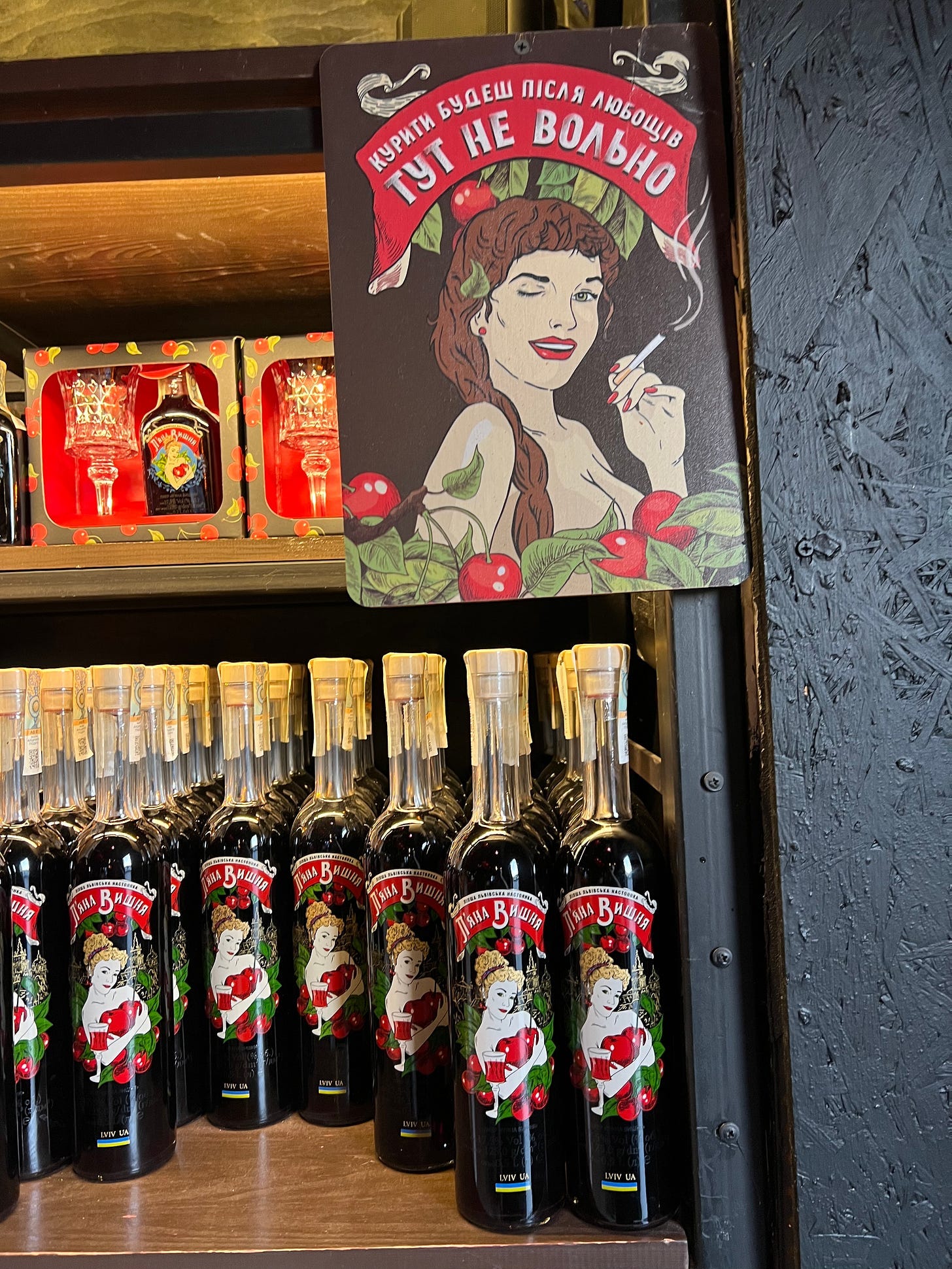
Liam instructs me over Telegram to visit the Drunken Cherry, a short walk from the Nordian, next to a subway stop on a city-center street.
Piana Vyshnia is a favorite hangout for soldiers, couples, and the odd alcoholic busting their way into conversations. One elder, bearded fellow approached me wanting to be interviewed and delivered an extraordinary spontaneous riff on the war.
The shop serves only one drink: a tasty brew of cognac and cherries in paper cups for streetside consumption. Vyshnia originated in Lviv. Every family had their own brew, passed down through generations. My childhood favorite back in New York, Dr. Brown’s Black Cherry Soda, was likely inspired by the drink.
I pan the scene for a short video. A young guy in a small group flashes a peace sign and calls out, “Hey bro.”
I know no Ukrainian and they speak little English, but I wander over and ask: What should Americans understand about this war?
Two of the guys, sensing a performative moment for the assembled women, start to speak—but shyness or language limitations stop them short.
I’m enjoying the spontaneity of the moment, not knowing what to expect or whether my intrusion will offend any of the off-duty soldiers. The USA, after all, has repeatedly betrayed their country since the election of Mister Trump.
One of them steps forward, smiling, energized by the moment.
He thanks America for the weapons, for the support, for the chance to defend their country. And then, from just outside their circle, another fellow insists on sharing his view.
“My name is Ruslan,” he says. “I am in the military. I want to say thank you. You give us opportunity… possibility to fight Russia.”
He is 25. A helicopter pilot. Fresh-faced, closely cut hair. He wants to buy me a drink.
We go inside and order. I buy a Drunken Cherry keychain.
We step outside with paper cups of vyshnia. He is eager to talk. He shows me videos on his phone—views from the cockpit, flashes of combat. He lingers on one clip: the destruction of a friend’s helicopter. He has stepped away from active duty for now to help his family. One parent is ill. He is studying again, working toward an English certification.
Before we part, he makes an offer.
Tomorrow, he will show me Kharkiv.
The next day, he picks me up at Kharkiv National University and drives me to a popular local destination. It is a graveyard for Russian military vehicles. Graffiti is scrawled across the destroyed hardware, much of it vulgar. A shattered drone lies across a bed of rusted artillery shells, its wings broken, its body torn open. Around it: fragments of missiles, twisted metal, scorched machinery.
“These are Russian,” Ruslan says, pointing. “All of this.”
He moves through it easily, reading the wreckage the way someone might read street signs.
“This one came to Kharkiv in 2024. Ukrainian soldiers destroyed it… to save the city.”
Nearby, missiles have been welded into a kind of structure—part monument, part art installation. Rusted metal skulls stare outward from the frame. I sit in one of the makeshift chairs formed from captured or spent Russian weapons.
“I don’t know how to say…” he begins, searching for the word. “Marauders.”
Closed off in metal enclosures are odd assortments of household items: microwaves, a toilet, bottles, clothes.
“Look,” he says. “It’s crazy. Really.”
I ask him why Russian troops took these items from local homes. He seems mystified—and angry. I make the mistake of asking what happened during the Russian occupation.
“They didn’t occupy the city,” he emphasizes. “But it was surrounded. Cadets—military students—first year, second year. Very young. They take guns. First battle.”
He pauses.
“And they destroyed these vehicles.”
We leave the exhibition and drive toward residential neighborhoods near the edge of the city, closer to the Russian border. Apartment blocks rise in long, repetitive lines, reminiscent of the Brooklyn housing projects where I grew up. You get to know your neighbors in places like this—on front stoops, in elevators, out in the open spaces.
At first glance, they feel intact. Then you notice the details: boarded windows, shattered glass, entire sections blown open and patched over. They are occupied largely by pensioners and young families. Ruslan explains that pensions are commonly the equivalent of about $60 per month.
A small group of elderly residents sits at a table under a tree, playing what looks like dominoes. He asks if I want to speak with them.
Of course.
He returns with a sheepish grin.
“They think you’re an American here to buy up the apartments and convert them, so they said you can just go fuck off.”
I don’t blame them.
One building bears a vertical scar through its middle floors—blackened, hollowed, still inhabited. A small playground stands off to one side—bright primary colors, a simple slide, a swing.
Up to half of these units were smashed, destroyed, boarded up, or abandoned. Those who could leave—who had family elsewhere—escaped the Russian assaults. Others could not afford to leave, had nowhere to go, or are simply stubborn.
“This is my home.”
Apartment blocks like these are routine targets of Shahed drones.
Earlier today, five drones hit an apartment building a mile from my hotel, killing an entire family. The drones came from different directions. The strike was not a mistake.
Homes are targeted to terrorize. To weaken resolve.
Back in the car, Ruslan takes me on a tour of neighborhoods ravaged by missiles and drones.
We walk through the central government district. He shows me videos of destruction as we stand in front of buildings—some rebuilt, some still bearing the scars.
I don’t know what to say other than to bear witness.
I ask him to pick a spot for dinner.
We sit outside at a local seafood place. The conversation shifts to his plans, to daily life with his family. He is curious about Thailand. He gives me a patch from his unit—a serious mark of our new friendship—and asks that I send him a photo with it the next time I’m in the United States.
I check in with Ruslan after I leave the country. He sends me news in two WhatsApp texts.
First, a photo of his English certification. He promised me during dinner that he would complete the course.
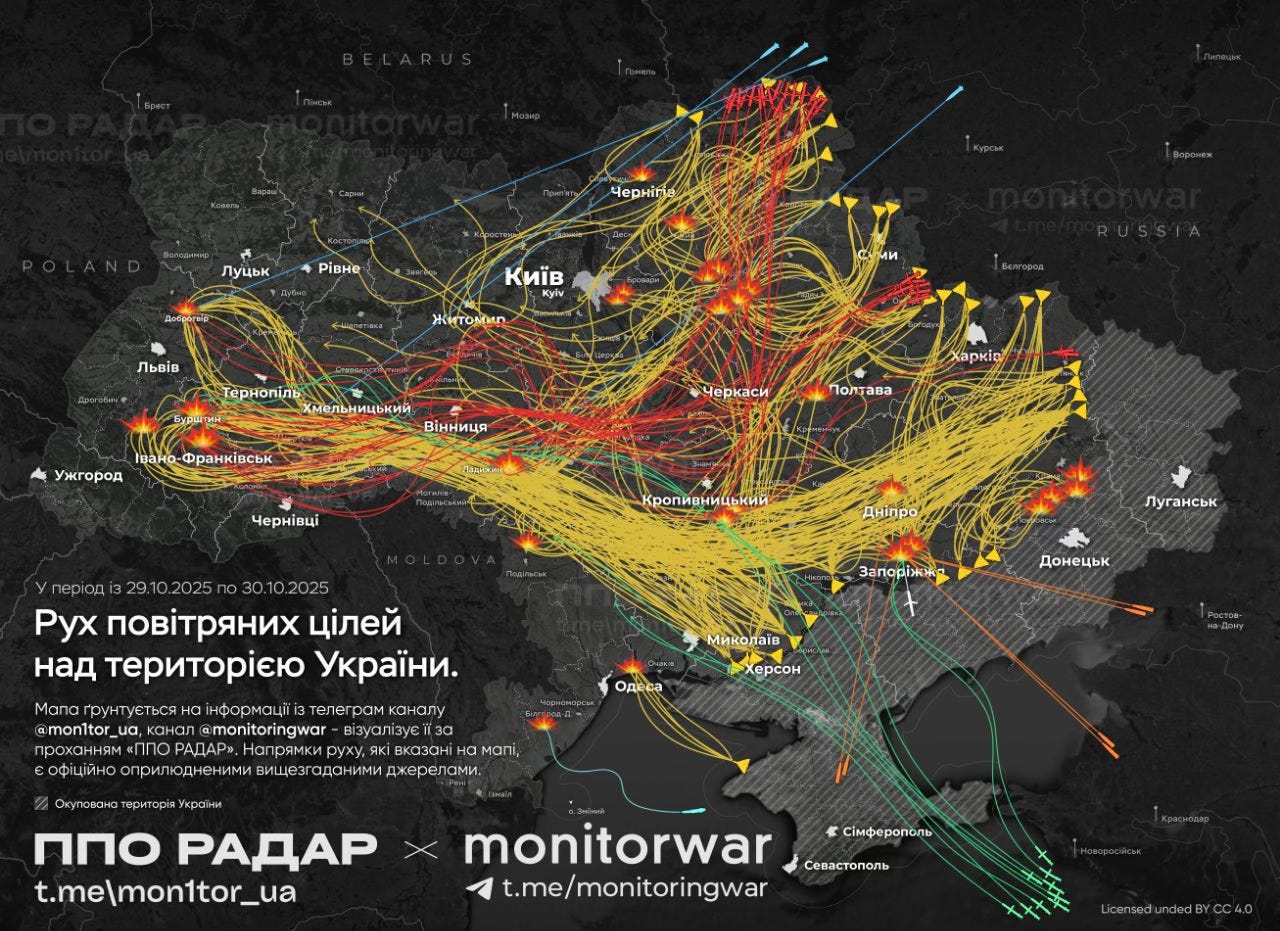
Then, an image of a map: Ukraine covered in arcs and lines and impact points—the visual trace of a single day of Russian attacks.
And later, a picture of him smiling, holding his newly earned commercial pilot’s license—a step toward a future where he carries passengers instead of flying in combat zones.
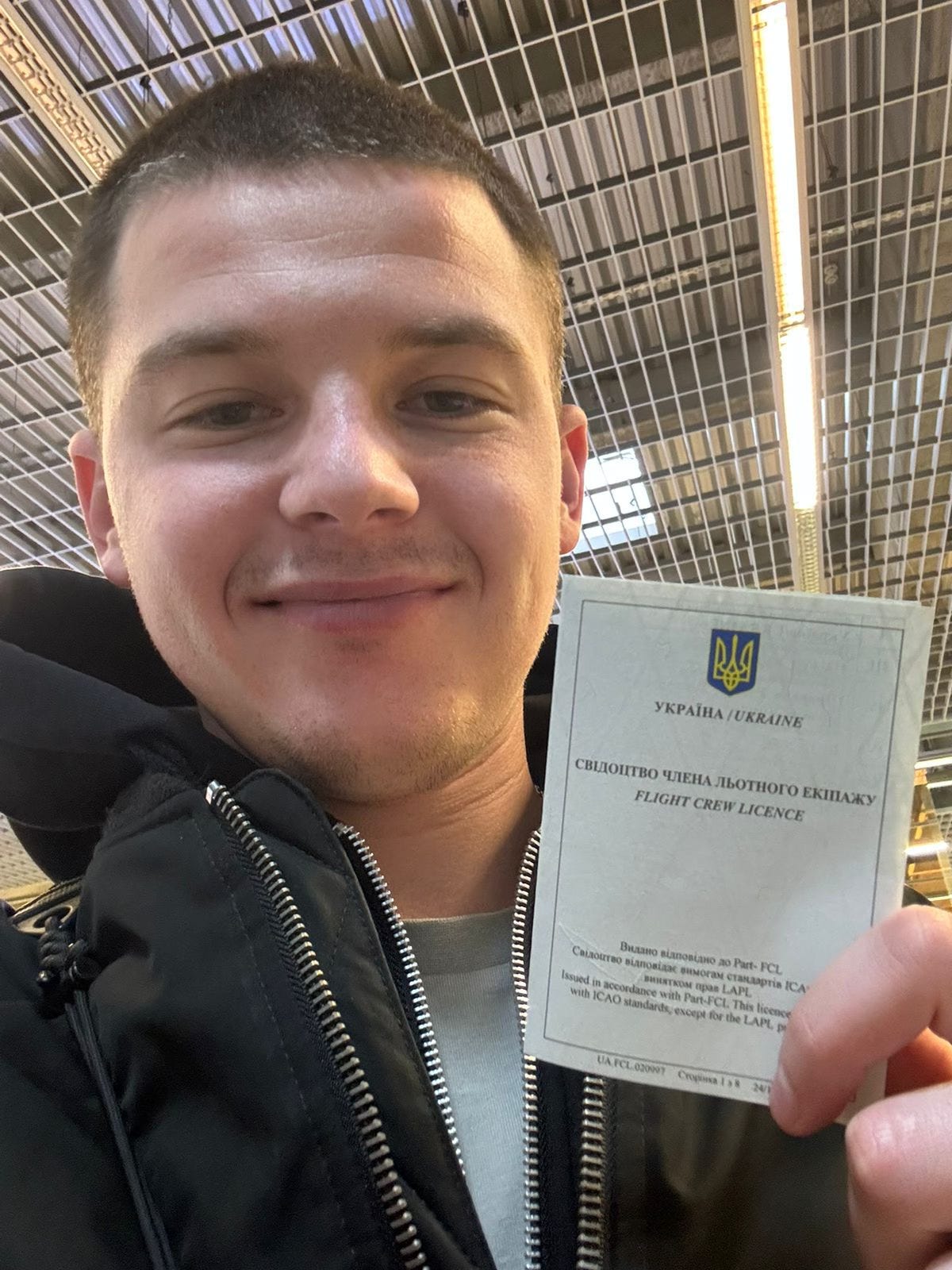
“Hi man 🤝 I took a commercial pilot licence a week ago. It is first step to become a civil pilot. I would like to visit Thailand in short future with my parents)) 😁. How are you, what is new?”
I tell him how proud I am of him. And promise that if he and his family come to Thailand, I’ll give them a holiday they’ll never forget.
• • •
Additional chapters and forthcoming PDF and print editions of Stop Stealing the Future can be found in the Substack series archive.