
“Stop Stealing the Future: Chronicles of the Ukrainian Resistance” is a series of interviews and field observations recorded during travels across Ukraine during the Russian invasion.
The Ants of Kyiv
The building used to serve pizza.
Now it serves a war.
Metal racks rise against the walls. An industrial mixer churns dough in steady rotation. Long stainless tables are dusted with flour. Volunteers — mostly older women in kerchiefs, some younger, a few guys — work in quiet coordination, rolling, cutting, stacking, sealing. Laughter, camaraderie, focus.
Blue-and-yellow flags hang on the wall, some with scrawled inscriptions.
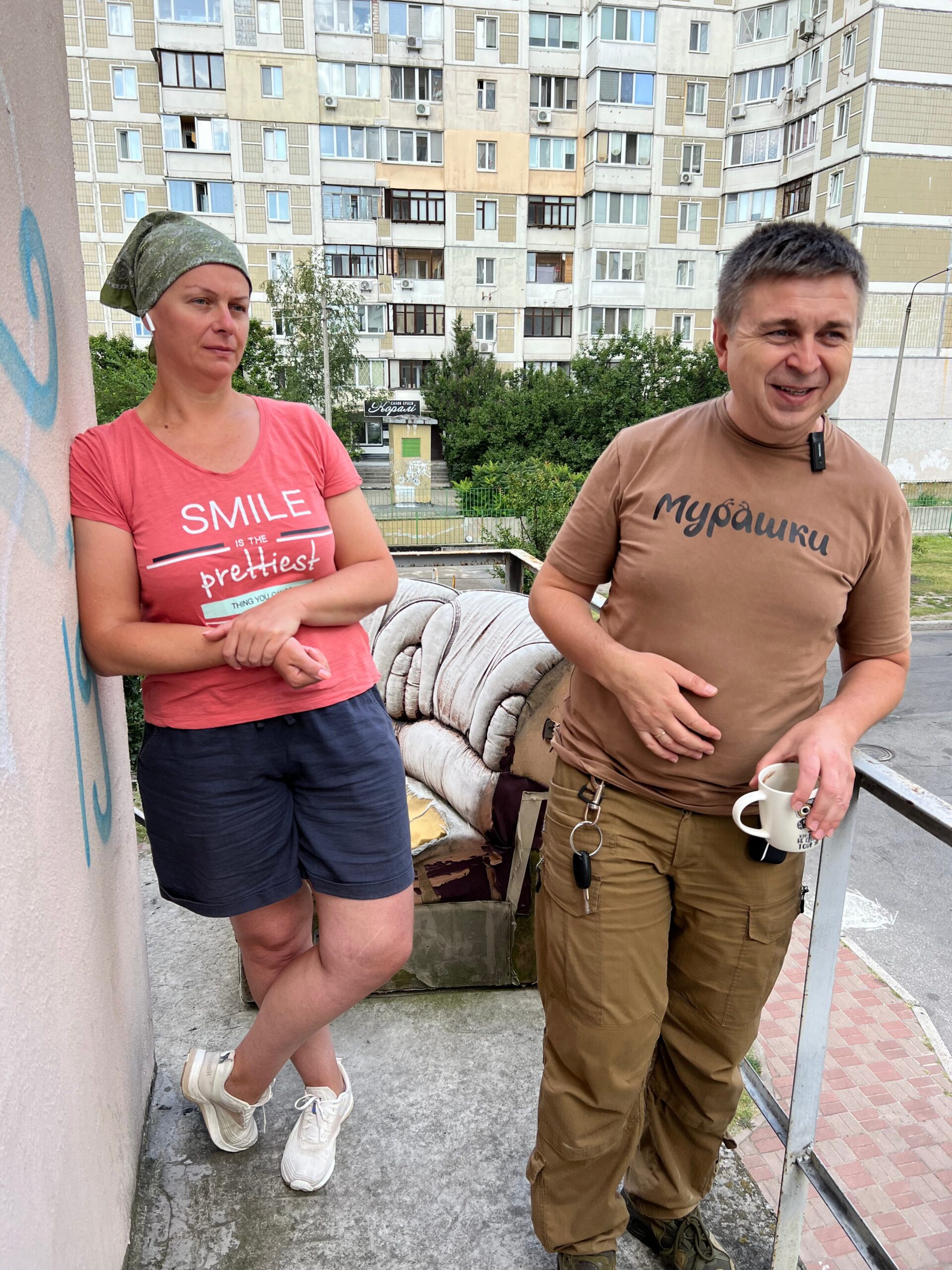
I’m at the production facility for Murashky (translation: ants).
I walk through the kitchen with its founders, Kostyantyn and Oksana Ovcharenko, and my interpreter, Vasylyna Shvets — a young woman who volunteered to interpret all my Kyiv interviews after a Telegram outreach through a Ukrainian contact. In a country under bombardment, generosity arrives quickly, without ceremony.
Murashky was founded on February 25, 2022 — the day after the onset of Russia’s full-scale invasion.
“When the war started,” Kostyantyn tells me, “we did not have the idea that this center would exist. But we understood we had to do everything possible to help the country.”
At first they prepared food in small quantities. Then demand expanded rapidly. Soldiers needed durable, lightweight, long-lasting meals.
Now Murashky produces 30,000 portions per month.
Engineering Survival
They prepare galety — hardtack-style biscuits — and dry rations designed for combat conditions.
“In combat positions,” Kostyantyn explains, “there is no possibility to cook.”
Each ration requires only boiling water. After seven to ten minutes, a meal forms: potato, peas, mushrooms, meat powders, spices. Powdered milk. Dried apples. Dates. Nuts. Beef jerky is sent to snipers, who operate in especially harsh conditions.
He opens plastic containers one by one during an impromptu tour of the basement storage area — dried vegetables, pea powder, spices, fruit. Everything labeled. Everything dated. Each box marked with portion numbers. It’s a remarkable, carefully-structured operation.
Food production is only part of the story.
When the food system stabilized, they studied how to assemble FPV drones. After opening boxes of food ingredients and packaging, he opens one filled with drone parts. It seems incongruous that small mechanical devices assembled here next to soup packets can confound the supposedly grand Russian army.
Murashky is also a logistical hub.
“We try to create a base,” he says, “that helps other organizations — governmental and non-governmental — support Ukraine more effectively. We help small organizations pass legal processes for crossing borders. We help reduce their expenses. We assist with vehicles, animal shelters, medical support.”
The building is a former pizza joint.
Why “Ants”?
“From the beginning,” Kostyantyn says, “we understood that alone we could not do much. We needed to unite. To collaborate with many people. Like ants.”
Ants are organized. Each knows its role. Each small effort builds a collective structure larger than itself.
“Everyone knows what to do,” he says. “Everything is structured.”
The first half of the day is baking and production. The second half is packaging and volunteer training. The atmosphere is industrious but relaxed. People seem to like what they are doing — and who they are doing it with.
Having once managed a large restaurant in Los Angeles, I recognize the discipline. Food production at scale demands obsession with detail, testing, tinkering, and refinement.
Kostyantyn seems to inhabit that operational instinct naturally.
There is patriotic pride in the work, along with the tough satisfaction of getting it right.
Marriage Under War
I ask a question that I ask all married couples I meet in Ukraine: how has the war changed their family life?
Oksana answers quietly, her stoic expression offsetting her colorful orange T-shirt: SMILE is the prettiest thing you can do.
“Our life has really changed. We sleep less. We communicate less with our children. We do not even have enough time to notice that they are growing.”
They notice growth when clothes need replacing.
Before the war, she says, she had a house and a garden in the Luhansk region. Her days revolved around home and children. Their house is now under occupation. Their parents remain under occupation.
The children communicate with grandparents only online. The younger daughter sees her grandmother as a picture and does not fully understand she is real.
War fractures families in ways no map shows.
Despite this, Kostyantyn is resolute.
“We must continue,” he says. “It depends on us — our future and the rebuilding of our country.”
Why Resist?
I ask what motivates them to continue supporting resistance when many argue that peace should come with the acceptance of Russian positions.
The answer is immediate and familiar.
“We want to see our children in a country without war,” he says. “What we are building now is not for today. It is for future generations.”
He adds, “If Russia occupies Ukraine, I am not sure I will be alive.”
He and Oksana grew up in the Soviet Union. They understand that system from experience. She believes Russian control would bring back a similar system of repression.
“They will continue the war,” he says, “but with Ukrainians inside their forces.”
I ask what democracy means to him.
“Democracy is freedom of truth. You can choose what you want. You can do what you want — but with respect for the people around you.”
When I ask about the pathway to peace, his answer is firm:
“The pathway to peace is the failure of Russia. Imperial narratives must end. Even a ceasefire will not change the situation if those narratives remain.”
They were told Ukraine would fall in three days.
“It has been three years,” he says. “We will fight as long as we have strength.”
Anna of Kharkiv
At a production table, Anna cuts and stacks crackers with precise movements.
She is from Kharkiv. I ask her to come outside for a chat on the balcony.
“At the start of the full invasion,” she tells me, “I spent nine days in the subway.”
Nine days underground changed her understanding of safety.
She and her family fled west in three cars, driving five days without knowing their destination. In every town, strangers offered help.
“When I came to Kyiv,” she says, “I understood I had energy to do something.”
She is afraid to go to war. So she volunteers. She bakes. She designs merchandise as an illustrator and donates the proceeds to the army. She volunteers as a designer for Murashky.
“I do what I can.”
Language and the Myth of Protection
Kharkiv is a predominantly Russian-speaking city near the Russian border.
I ask whether she ever felt Russian speakers were persecuted — the justification Russia used for intervention.
She shakes her head.
“All my subjects in school — math, chemistry, history — were in Russian. Ukrainian language was only a few hours per week.”
She speaks Russian. Everyone around her spoke Russian.
“If anything,” she says, “sometimes Ukrainian speakers were pressed.”
In 2014, during the Euromaidan protests, she stood in Kharkiv’s central square. Busloads of men in balaclavas arrived and attempted to raise Russian flags over administrative buildings.
“We were students,” she says. “We had no weapons. We stood with posters.”
They asked police if they would protect them. The police gave no answer.
“I was afraid Kharkiv would become like Donetsk or Crimea.”
Why Join the European Union?
I ask what joining the EU meant to her.
She answers carefully.
“I was afraid of authoritarianism. I have friends from Belarus. I saw what happens when one man stays in power again and again.”
For her, Europe symbolized legal structure — courts, laws, protection.
“I wanted to be protected by my government,” she says. It was not about visas or language policy.
“It was about rights. About not having businesses taken. About not being sent to jail for opinion. About journalists being able to speak.”
A Family at the Front
An older female volunteer offers to talk.
Her family is fully entangled in the war. Her brother is on the front line. Her son-in-law is on the front line. Her nephew defended Azovstal in Mariupol. He survived the siege but disappeared after the explosion at Olenivka prison. He is believed to have survived the blast, but his whereabouts are unknown.
His father—her brother—continues fighting. For her, volunteering is not abstract solidarity.
“Ukraine is fighting for independence,” she says. “We have been independent for centuries. We must be free from oppression.”
She references the Cossacks — free people defending their land.
“We follow their example.”
Beyond Food
Murashky solicits and utilizes foreign volunteers. One of them, Greg, introduced me to the group. Visitors are encouraged to share their Ukraine experiences abroad. The staff also helps organizations navigate bureaucratic processes to move aid across borders legally and efficiently.
“When soldiers feel support,” Kostyantyn says, “it gives them motivation to go further.”
He gives me a military patch from Kharkiv, describing the imagery of the insignia — a symbol of resistance from a front-line city. I tell him I’ll journey there in a few days, inserting the patch in my wallet, where it remains.
The University That Escaped Mariupol
A campus destroyed, a faculty scattered, and the rebuilding of a university in exile
Mariupol State University no longer exists in the city whose name it bears.
The Russian siege of Mariupol in the spring of 2022 reduced much of the port city to rubble. Residential neighborhoods, hospitals, schools, cultural institutions, and factories were bombed or shelled in relentless waves of artillery and air strikes. Among the most widely known atrocities of the siege was the destruction of the Mariupol Drama Theater, where hundreds of civilians had taken shelter. Satellite images later revealed that the word children had been written in large white letters outside the building in an attempt to warn aircraft that civilians were inside.
The theater was destroyed anyway.
Mariupol State University, one of the intellectual centers of southeastern Ukraine, was also caught in the devastation. Before the invasion it enrolled more than five thousand students and served as an academic hub for the region. Its faculty taught languages, international relations, journalism, political science, education, and technology to a student body drawn from across the Donbas and the Azov coast.
Today the university survives.
But it survives in exile.
After the destruction of Mariupol and the occupation of the city by Russian forces, the university’s faculty and administration evacuated what they could and slowly reassembled the institution in Kyiv. Professors and students scattered across Ukraine and Europe before gradually reconnecting and rebuilding the university in the Ukrainian capital.
As with all my Ukraine interviews, I came to connect with university rector Mykola Trofymenko through a cascade of contacts. While gathering interviews for an Electric Memories life story project on Koh Phangan, I met German university administrator Oliver Janoschka, who introduced me to Dr. Svitlana Shytikova, EU Erasmus+ Program Office Coordinator in Ukraine, who in turn opened a wide range of doors for me.
“If you are interested in resilient education,” Svitlana suggested, “the rector of Mariupol State University will be the right person to talk to. He evacuated his team and students from Mariupol during the occupation.”
The campus of the Kyiv National University of Construction and Architecture houses the relocated Mariupol State University. A simple plaque at the entrance marks the presence of an institution that once stood hundreds of kilometers to the east.
Oksana Derevianko, Head of the Information and Public Relations Department, and lead specialist Maksym Kladitin greeted me outside the entrance and escorted me to the meeting space.
Inside, the building contains classrooms, offices, exhibition spaces, and meeting rooms. Students move through the corridors between lectures. Faculty members hold seminars. Posters advertise research projects and international exchanges.
It feels like an ordinary university building. And yet the walls carry the memory of a devastated city.
The Gathering
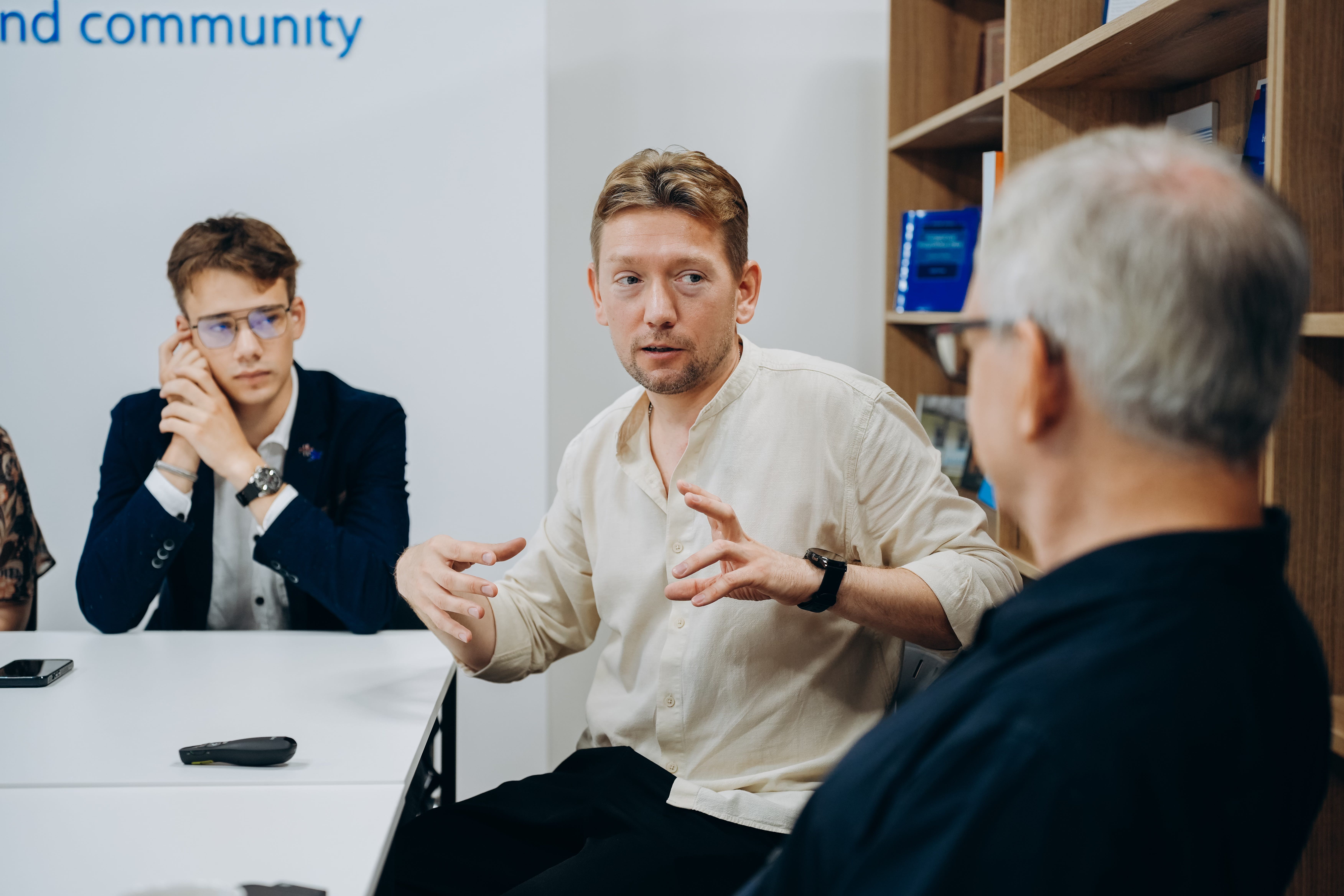
Mykola and Oksana organized a group of faculty members, administrators, and students in a conference room to speak with me about the university’s evacuation and rebirth.
They sat around a makeshift horseshoe-shaped table beneath a bright blue wall bearing the university’s emblem.
Among those present were:
• Olena Pedchenko, Head of the Department of English Philology and Applied Studies
• Vyacheslav Kudlay, Head of the Department of Information Activities
• Iryna Sikorska, Director of the Center for International Education
• Serhiy Pakhomenko, Associate Professor of Political Science and International Relations and wife Natalia
• Mykyta Horbashevskyi, Chair of the Mariupol University Student Council
• Alina Gubska, a graduate of the university
• Zoya Kravets, a current student
The conversation began with the earliest days of the invasion and the chaos that followed.
Communication inside Mariupol collapsed almost immediately.
Phones stopped working. Electricity disappeared. Internet connections vanished. Faculty members could no longer reach each other.
One administrator described the moment with blunt simplicity.
“There were no signs,” she said. “There was only chaos, uncertainty, fear.”
People scattered in every direction.
“Everyone was almost on their own,” she explained. “There were no connections. People escaped as they could.”
Some fled west across Ukraine. Others crossed into occupied territories and eventually reached Europe. Some left through Russia before finding their way to other countries. Others stayed in Mariupol, hoping the siege would end quickly.
For weeks the fate of colleagues remained unknown.
“We called everyone we could reach,” another faculty member said. “Where are you? Are you safe? What are you planning to do?”
Gradually, fragments of the academic community began reconnecting.
Saving the University
In the middle of the chaos, one decision proved crucial.
The rector managed to evacuate the institution’s servers and digital infrastructure.
“Our rector personally preserved the servers and the software systems of the university,” one administrator explained. “That was extremely important.”
The servers were temporarily relocated to another university in Lviv, allowing academic platforms and student records to remain operational even as the physical campus in Mariupol was destroyed.
For months the faculty assumed the war might end quickly.
“We thought maybe three months,” one professor recalled. “We were counting the days.”
But as the siege continued and Mariupol fell under Russian occupation, it became clear that returning soon might be impossible.
The university faced a stark choice.
Mourn the destruction of the institution — or rebuild it elsewhere.
One administrator described the turning point.
“When we received support to renovate this building in Kyiv, we understood that we must not only mourn our past,” she said. “We must create something new. We must have a future.”
European partners and Ukrainian authorities helped fund the renovation of the Kyiv facility. International academic partners offered exchanges, grants, and research collaborations.
Slowly the rebirthed university began to take shape.
Language and Identity
During the discussion, I asked about one of the most persistent narratives used by the Kremlin to justify the invasion — the claim that Russian-speaking Ukrainians needed protection from Kyiv.
The response from the faculty was immediate.
“We were Russian-speaking,” one professor said. “But we considered ourselves Ukrainian. This is something often misunderstood in the West. Eastern Ukrainian identity does not correlate with language competence.”
Many residents of eastern Ukraine speak Russian in daily life but identify strongly as Ukrainian citizens.
“This was the mistake of Mr. Putin,” he said. “He believed that if people speak Russian, they must be Russians. That is a completely false idea.”
Another faculty member offered a personal example.
“I defended my dissertation on Russian literature in 2019.”
Russian literature had long been taught as part of global cultural heritage.
“Until 2014 we studied Russian literature like world literature.”
The notion that Russian language or culture were under threat in Mariupol before the invasion was, in their view, entirely fabricated.
“There was no pressure against Russian-speaking people,” one professor said. “No such problem existed.”
Propaganda and Information Warfare
The conversation then shifted to the role of propaganda during the siege.
Even after electricity and communication networks collapsed, rumors and narratives continued circulating through word of mouth.
“Even when there was no electricity and no mobile connection,” one faculty member said, “propaganda continued. People repeated that Kyiv had fallen, that Ukraine no longer existed.”
Without reliable information sources, even educated individuals could begin doubting reality.
“If you are inside that information field,” she said, “you start to believe it.”
Russia’s disinformation campaigns have also had a profound impact internationally.
Pakhomenko argued that the roots of the conflict go deeper than propaganda alone.
According to him, Russian imperial thinking has remained remarkably consistent across centuries.
“The Russian Empire, the Soviet Union, and today’s Russia share a common mentality,” he said.
An imperial mentality.
“In this worldview,” he explained, “countries like Ukraine, Georgia, Estonia, or Kazakhstan are not truly independent states. They are seen as historical lands of Russia.”
Communist ideology once masked that imperial instinct.
“When the Soviet Union collapsed, the ideology changed,” he said. “But the imperial mindset remained.”
Losses
At one point the conversation turned toward the human cost of the siege.
The university maintains a small memorial display honoring students and staff who were killed.
But the full scale of the loss remains unclear.
“We know that some students were killed,” one administrator said.
Many others simply disappeared.
“We still do not know the fate of more than two hundred of our students.”
Another professor described the story of one young student who left the dormitory early in the siege, believing another building might be safer.
“She went with a friend to another house,” the professor said.
Shortly after arriving there, she was killed.
“The dormitory itself was later destroyed as well,” the professor added quietly.
The Student Tour
After the meeting ended, several students offered me a wander around the building.
They led me through corridors lined with exhibition displays.
One exhibit honors writers and intellectuals from eastern Ukraine under the title “People of the Great Steppe.”
Tall banners describe poets, journalists, and cultural figures connected to the Donbas region.
The display carries an implicit message: the cultural life of eastern Ukraine did not disappear when its cities were occupied.
It travels with the people who preserve it.
Another room contains photographs of the original Mariupol campus — a warm stone building framed by trees along a quiet street.
Nearby, a glass case contains a miniature model of the Mariupol Drama Theater.
The building appears peaceful in the model. It was reduced to rubble during the siege.
Other displays contain university memorabilia salvaged or recreated after the evacuation — academic certificates, photographs, small symbolic gifts exchanged with international partners.
One exhibit describes a symbolic gift presented by the First Lady of Lithuania during the opening of a Mariupol University center in Vilnius.
The university has since opened additional centers in Lithuania and Poland, extending its academic network across Europe.
The Shelter Classroom
The students then led me downstairs.
At first the room looked like an ordinary classroom.
Rows of chairs. White walls. A projector.
But a sign near the door read:
Shelter.
When air raid sirens sound, students and faculty gather here.
“Sometimes we continue classes here,” one student explained.
Another added with a small shrug.
“At the beginning it felt strange to study like this,” she said. “Now it feels normal.”
War has a way of reshaping normal life. I felt a mixture of admiration and dread that these kids had to study in this environment. I’m a half century removed from my academic life but the lightness of spirit and lust for life felt familiar.
Nearby another room contained a backup generator — a practical necessity in a country where Russian missile strikes frequently target electrical infrastructure.
A Summer Lunch with Vyacheslav
Vyacheslav Kudlay invited me for a stroll down the street to Chernomorka, a neighborhood seafood bistro. It was a delightful summer afternoon for an unhurried outdoor lunch. We ate well.
He described how the university has changed since relocating to Kyiv. Before the invasion, Mariupol State University enrolled more than five thousand students. Today the number is just over two thousand. He suggests the institution has adopted a new mission.
“We want to become a civic university,” expanding the university’s traditional role. More than 50,000 Ukrainians across the country have enrolled in the free online English language training. The university also operates professional training programs for public servants and a new Veterans Business School designed to help returning soldiers transition into civilian careers.
Psychological trauma programs are integrated into teacher training. The university has also built partnerships with European institutions, allowing students to spend semesters studying abroad.
“Our students must be connected to Europe,” he said.
Meanwhile plans are underway to develop a larger campus in Kyiv — a long-term project that could eventually include preschool, school, and university education within one integrated educational complex.
Architecture students have already produced design proposals for the future campus.
A University Without a City
Despite these new initiatives, Mariupol remains central to the university’s identity.
Faculty members still speak of returning someday.
“When Mariupol is Ukrainian again,” one student told me, “we will reopen the university there.”
Until then the institution serves another role, a kind of ambassador for the city.
“We represent Mariupol now.”
• • •
Truth, War, and Marriage
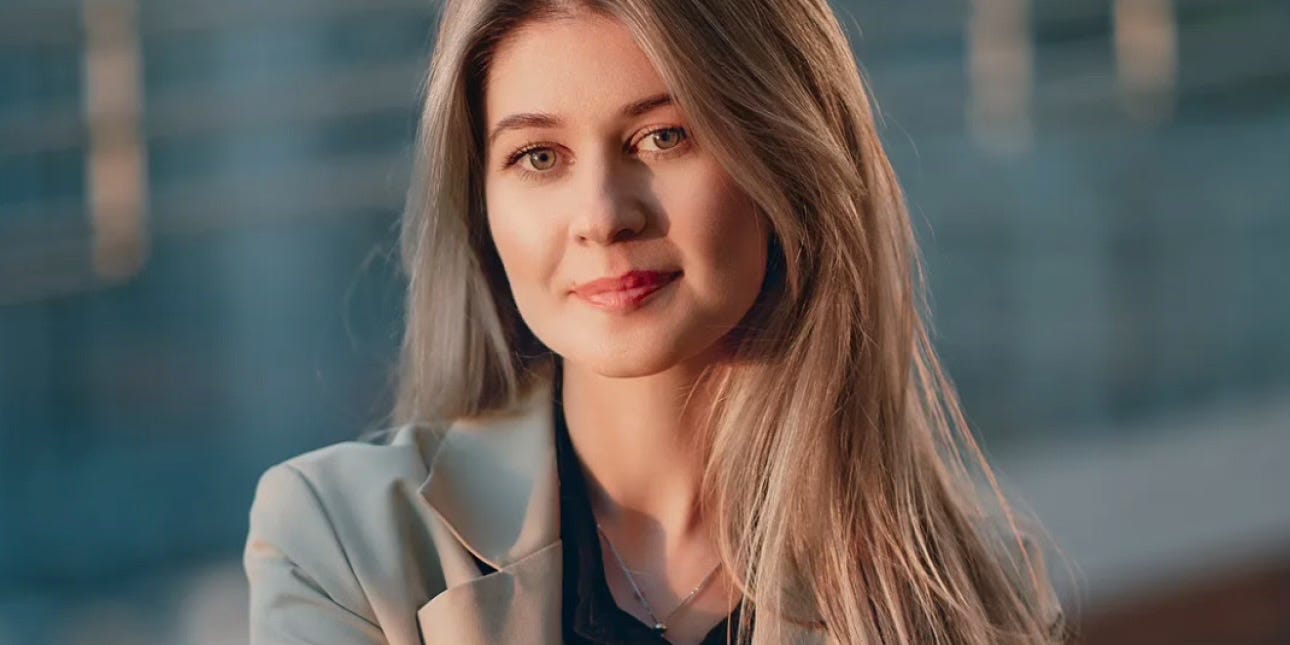
Anastasia Rodenkova and Vladislav Varoponov are deeply engaged in Ukraine’s information front: she leads two influential independent media outlets, while he analyzes Ukraine’s relationship with the United States and the West. They share an office. They’re also married. Our conversation ranged from journalism and disinformation to something more personal — what it means to sustain love, work, and partnership during years of invasion and resistance.
Anastasia: I’m Anastasia Rodenkova, a journalist and media manager. I founded Rubryka, the first Ukrainian solutions-journalism outlet. I’m originally from Sloviansk in eastern Ukraine — one of the first towns occupied by Russia in 2014. Because of that personal connection, I also lead Eastern Variant, the main independent media outlet for the Donetsk and Luhansk regions. So I oversee two outlets — one national, one local.
Now, I also head the Media Network Recovery Window, a coalition focused on reconstruction and rebuilding, made up of other local media outlets. We’re based in Kyiv, and I’m very happy you’re here, Brian.
Brian: Thank you. Vlad, your turn.
Vladislav: My name is Vladislav Varoponov — Vlad for short. I’m a political analyst, journalist, and editor. Two years ago I founded a think tank specializing in American Studies in Ukraine — the only one that analyzes how U.S. policy and politics affect Ukraine.
Before that, I wrote analysis for Ukrainian and European audiences, and then decided to scale that expertise domestically. We launched the U.S.–Ukraine Media School to train over 100 Ukrainian journalists on how to cover U.S. elections and bilateral relations.
Since March 2025, I’ve been chief editor of two government-run media outlets — The Gaze and New UA TV English. I mostly edit articles now rather than write, but I enjoy it. It’s important to provide deeper context to foreign audiences and explain how Ukraine connects with the West.
Anastasia: And because Brian focuses on stories of love, I should mention — we’re husband and wife.
Brian: Ah, perfect segue. Is sustaining a relationship during wartime different from any other time?
Vladislav: Of course. In the first weeks and months of the full-scale invasion, everything was uncertain. We helped and relied on each other constantly, often working around the clock. It was exhausting, but that mutual support was essential.
Anastasia: Yes, after three years of nonstop invasion and constant pressure, meaningful relationships are what give you strength.
Brian: Ukraine once lived under a Soviet media system. How has journalism evolved since then?
Anastasia: It changed dramatically. We inherited propaganda-style media dominated by oligarch ownership — a toxic system. But after the Revolution of Dignity, many bold, young media startups emerged. People felt empowered to broadcast their own truth, and there was real demand for it.
My outlet Rubryka was founded in 2018 and built on solutions journalism — not only exposing problems but reporting on how people solve them. Even in wartime, that gives people a sense of agency. For example, when Kyiv’s largest children’s hospital was bombed last July, our reporters showed how ordinary citizens mobilized to help.
We cover not just attacks, but how communities rebuild and recover. That’s the heart of our work.
Brian: How do you practice journalism in an age of disinformation and propaganda?
Anastasia: By building trust — the most important connection between media and audience. Rubryka gets over two million monthly views, with donors and community supporters. We show who we are behind the stories.
But it’s very hard now. Independent media struggle with resources while fighting global disinformation and Russia’s authoritarian propaganda.
Vladislav: I’d add that journalism in Ukraine carries a special meaning. Over the last twenty years, journalists have gained trust not just through their work, but through personal commitment to the country.
Think of Georgiy Gongadze, founder of Ukrainska Pravda, murdered for exposing corruption — his death nearly toppled a president. Journalists like Mustafa Nayyem helped ignite the 2013 Maidan protests. Many later became MPs or anti-corruption activists.
Today, Ukrainians don’t need basic explanations. They want context, scenarios, and deep analysis — especially about foreign policy, since we rely heavily on our partners. Journalism now bridges Ukraine with the world.
Brian: When you visited the U.S., what did you think of Americans’ understanding of the war?
Vladislav: There’s always room to improve, but generally people we met understood what’s right and wrong in this war. What’s missing is more personal contact — exchanges that humanize Ukrainians and reduce the time spent correcting misconceptions, like why we can’t hold elections during war or why occupied territories can’t be “traded.”
Anastasia: Yes, and three years into full-scale invasion, war fatigue is real — abroad and at home. It’s painful to see global attention fading. People ask for “solutions” — how will it end? But there are no easy recipes. We face a powerful enemy waging war on our existence.
We all want peace, we pray for peace — but we fear occupation even more. I’m from the Donetsk region; I know what it feels like when your hometown is taken, your family silenced. That’s why any talk of “exchanging territories” is so painful. Ukrainians want victory — not out of vengeance, but because what’s happening is profoundly unjust.
Brian: We talked a little about the evolution of Ukrainian media. You came from the eastern part of the country, now occupied by Russia. Can you share your personal insights on the difference between the environment for personal expression here in Kyiv versus Moscow or the occupied territories? For many people that might seem subtle, but I imagine for you it’s an important distinction.
Anastasia: I want to share the story of my closest colleague from eastern Ukraine, from the media outlet I lead. She spent almost an entire month in Mariupol—from the start of the full-scale aggression until she managed to escape. It’s a dramatic story. We completely lost contact because the Russians immediately create an information blockade. They want to control your cognitive space, so they cut internet, telephone—everything.
It’s a miracle she’s alive. As a journalist, she had to burn her press card and personal items. We deleted all mentions of her name from our website and social media, because she had to pass through a “filtration camp.”
Brian: What is a filtration camp?
Anastasia: It’s where they check your identity. If you’re a journalist, they treat you like a soldier—an enemy. Especially if you’re affiliated with Ukrainian media. Thanks to Reporters Without Borders, we helped her escape. During that time, she was hiding, spending days in a shelter with no communication. She desperately needed information. Russians spread lies that Kharkiv and Kyiv were already destroyed like Mariupol. When you can’t verify information, you start to believe it. That’s what happens in occupied territories—they trap people in an alternate reality.
Brian: You said something intriguing—that for the Russian government, a journalist is as dangerous as a soldier. Why?
Anastasia: Russia weaponizes information. There are no objective media outlets in the occupied territories. You may know of Viktoria Roshchyna, a Ukrainian journalist who went to report there—she was tortured to death. That’s why our team is now relocated; journalists are captured immediately if they enter occupied areas.
When you can’t verify information, you start to believe it. That’s what happens in occupied territories—they trap people in an alternate reality.
Vladislav: I’d add to Anastasia’s point. During the 2014 aggression in eastern Ukraine and Crimea, Russia justified everything by claiming they were “helping.” Any journalist who could show photos or videos of what Russians were actually doing—especially in filtration camps—would destroy their narrative.
It’s crucial for us in Kyiv not to lose contact with occupied territories. The war is dynamic—every night, something changes. For example, my home city Mykolaiv was brutally attacked through the summer of 2022. Russians wanted to capture the south, but Mykolaiv stopped them after they took Kherson. My grandmother refused to leave, so I worried every day.
We must stay connected with people in threatened areas. Eventually the Ukrainian army will liberate these places, and we’ll have to rebuild relationships with the same people. Staying in touch—sharing true information—is essential.
Brian: If you could speak directly to Americans, what do you want them to understand about Ukraine, this war, and Ukraine’s role in resisting an autocratic power?
Anastasia: Ukraine is fighting for the ability to tell the truth. A strong civil society is our backbone. This war is not just for territory—it’s for the right to live freely and speak truthfully.
Russians use propaganda to say we’re defeated, to create psychological pressure, even in so-called liberal media. But despite how hard it is, our spirit remains high. We fight with the world’s support, and we can’t afford to lose.
When government bodies try to control independent institutions, people protest. These are the values we fight for—a democratic, civilized country where independent media can speak without punishment.
Vladislav: My message to Americans is this: it’s not the time to turn away. This war is about all of us. It may seem far away, but it’s deeply connected to our shared values—freedom, dignity, truth.
The image of Western civilization, of what we all admire, is being tested in Ukraine. Ukrainians are among the most pro-American, courageous, hardworking, and creative people in Europe. We rely on American understanding and support. But it’s mutual—you need us, too. Because our fight for truth and freedom defines the world we all live in.
• • •
Additional chapters and forthcoming PDF and print editions of Stop Stealing the Future can be found in the Substack series archive.