
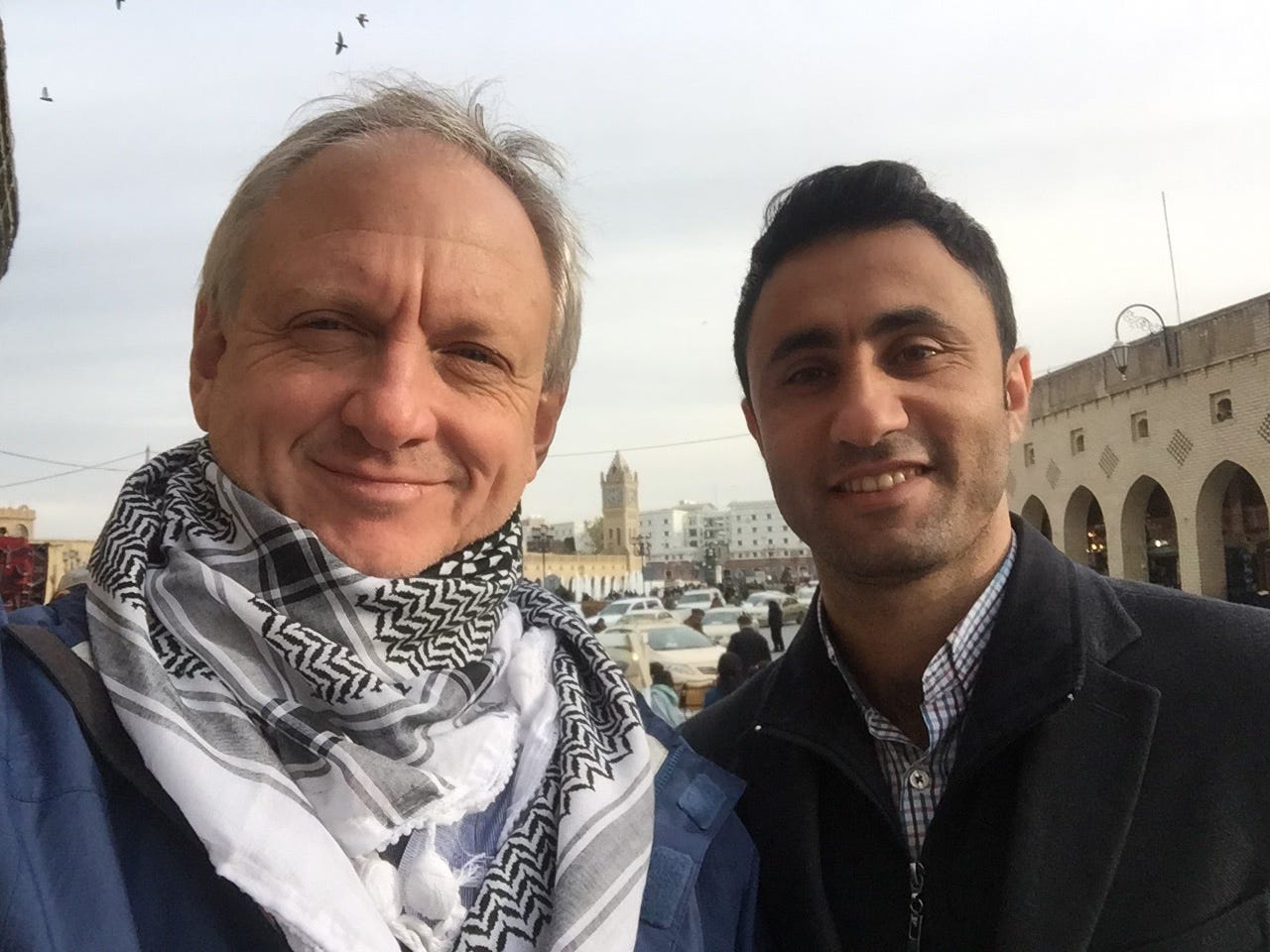
As I head to Pattaya to encounter and interview sailors from the USS Abraham Lincoln following its nine-month deployment in the region, I’m resurfacing this chapter from WAR: The Afterparty. It offers a detailed look back at the scope and consequences of the Iraq debacle, a reminder worth considering as U.S. voters weigh the costs of another Middle East quagmire.
Chapter Eight: Iraq
There Is No State
In David Lean’s classic film, Lawrence of Arabia, British Captain T. E. Lawrence inspires an Arab revolt against the Ottoman Empire with a promise of post-war independence.
In just a few days of meetings in early January 1916, two midlevel diplomats, (Britain’s) Mark Sykes and (France’s) François Georges-Picot cobbled together a future map of the Middle East that bore absolutely no relation to the one envisioned by (Arab leader) Emir Hussein. Instead, French imperial avarice fueled British imperial competition, so that the truly independent Arab nation was now to be largely limited to the desert wastelands of Arabia, with the French taking direct control of greater Syria, and the British taking outright all of Iraq.[i]
The Imperial War Museum in London is fronted by massive cannon. The day I visited, the building offered an exhibit on the work of British soldiers in Afghanistan and a larger one on the nation at war during World War I. The motivation to continue a conflict that killed 17 million, wounding 20 million more, is obscure. Begun on the basis of imperial whims, perceived slights and colonial ambitions, motivating British families to send millions more sons into the now-evident horrors of trench warfare required an appealing outcome, a prize. Crippling reparations were a start, but a real prize would be securing German and Ottoman colonies. Along with the literal fuel for a global naval empire: oil. One expansive museum exhibit displays the reach of the British Empire in 1914, occupying a quarter of the known surface of the world from India, Australia and Canada to large areas of Africa, the West Indies and the Far East. More from Scott Anderson’s recent book Lawrence in Arabia,
. . . it would be May 1916 before anyone in Cairo saw a copy of Sykes-Picot, and by then it was a fait accompli, a secret pact agreed to by the cabinets of Britain, France, and Russia. As T. E. Lawrence would recall, the reaction among the stunned Cairo military intelligence staff upon finally reading the agreement had been a collective urge to vomit.[ii]
After World War I, Great Britain and France created Iraq out of whole cloth from three Ottoman provinces: Kurdish Mosul, Sunni-administered Baghdad and Shi’ite-dominated Basra. British administrator Gertrude Bell was warned that she was defying four millennia of history in trying to create a new entity out of the three. She committed suicide in 1926, her best efforts frustrated.
__________
The short old man screams, “America destroyed my country!!” as the dulled straight-edge razor draws blood on my lip a second time. Several men have now gathered in the refugee camp shack, discussing politics with me and my new friend, Samir. The barber fled from his home and shop in Mosul, Iraq’s second-largest city, an hour’s drive from here, when ISIS jihadis took control in June of 2014. “Why you fucked our country?” the man insists, Samir laughing as he translates from Arabic.
ISIS (the Islamic State in Iraq and Syria, also called ISIL, the Islamic State in Syria and the Levant) morphed from the insurgent group al-Qaeda in Iraq (”The Organisation of Jihad’s Base in Mesopotamia”), which announced its allegiance to Osama bin Laden et al after the United States invasion in 2003. They are often called Islamic State, though locals use the Arabic term Daesh, taken by the group as derogatory (“We’ll cut off your hands if you call us Daesh” being a sign of annoyance).
The refugee camp is a short five-minute drive from my hotel. It has a jumble of sponsor logos out front: a Mennonite church, the United Nations, several NGO’s. The residents we meet are all Christian with many self-identifying as Assyrian Chaldean or ‘eastern rites’ Catholics. The sect predates the birth of Islam and many members speak Aramaic, the supposed language of Jesus of Nazareth.
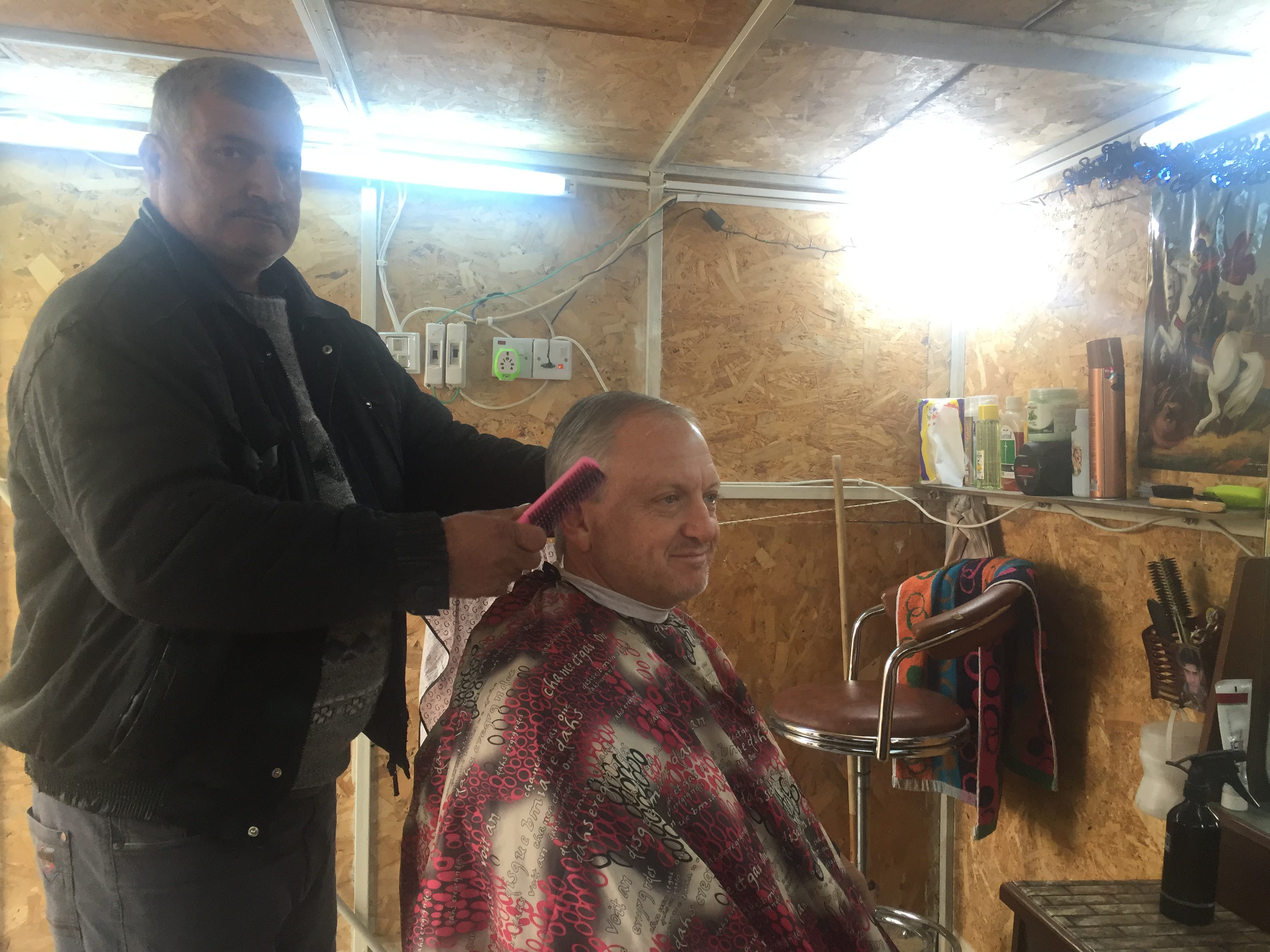
Samir and I found our way to the barber shack after chatting up the camp security guard, getting permission to wander the camp. The stories we hear are a mix of hopelessness and determination. When asked about their prospects, camp residents talk about relocation to Australia or Europe. That simply won’t happen for everyone, much less most, at this camp of 5,500. The real hope? Retake Mosul and destroy Daesh.
When I tried to get into Iraq in late 2014, Daesh was marauding through the northern provinces and visas were unavailable. Now, Erbil and most of Iraqi Kurdistan are relatively secure, and U.S. passport holders can visit easily.
I connected with Samir Anwar Barznjy two days before my arrival in Iraq via the Couchsurfing web site; as with Kabul, there were slim pickings on Expedia and Airbnb. Samir, a 31-year old surgeon and entrepreneur, cannot host me, but sends an email instructing exactly how my entry to Iraq will go. He will pick me up at the Erbil airport. He will find me a hotel. He will take me out for dinner and he will line up interviews.
Samir is Kurdish and doesn’t think of himself as Iraqi. His people have aspired to independence for decades, from the post-WWI British mandate and installed monarchy, to the 14 July Revolution, the Ba’ath Party takeover and Saddam Hussein’s rise to power, then the 1991 Kuwait/ Gulf War, no-fly zones, insurrections and declarations of autonomy. I use the term “Iraqi Kurdistan.” Over dinner, some days later, a friendly and well-mannered young Syrian says he prefers “Kurdistan in Iraq.”
At the barber shop, I implore, “Just a little . . . a trim.” An old radio plays traditional music as men study my hair, gesturing and exchanging opinions in Arabic. I ask the barber how he came to be at this camp. The news comes on, reported by an earnest sounding female.
Eight years ago, in 2007, I got a message from some people, with a bullet inside an envelope, and it said, leave Mosul or we will kill you. They asked $2,000 to stay. In the time of Saddam, no one cared whether I was Muslim or Christian.
Who were those people? He doesn’t know. When Daesh came, he finally left. He clicks on an electric razor. The news ends, and the station goes to music, the driving beat reverberating through the shop.
I turn to the old man who verbally assaulted me. “Is it possible Daesh exists without the American invasion?” The old man gives a long, impassioned answer, which Samir summarizes as, simply, “If Saddam is still there, there is no Daesh.”
The barber continues my shave. I know he’ll cut my hair short whatever I say. The gear is modest, the scissors need sharpening, but it is a satisfying transaction. This man, months ago, was a respected artisan in his city. I try to pay him 2,000 dinars, the two bucks he quoted earlier, but he refuses my money. I insist and he waves me away. I force 5,000 dinars in his hand and we agree I will visit him in Mosul when he is able to return to his home.
Walking the camp’s makeshift streets, we ask a group of three women if they are willing to talk. Smiling shyly, they accede, but are pre-empted by an old fellow with rough dental work and a days-old beard who interjects himself into the conversation. “I am selling clothes for . . .” the women laugh as Sadala Babal struggles to describe his craft, “. . . for ladies.”
“Were there people who welcomed Daesh in your town?” I ask. “What would happen if you stayed?” A loud truck rambles by.
It was an all-Christian town. Obviously you don’t want to be there. We knew they were coming, in four hours. If we stayed there (he runs a finger across his throat), they would slaughter us. They want to take the ladies for themselves, the same that happened in Sinjar.
Five thousand Yazidis, a minority religious sect, were killed in Sinjar by Daesh in 2014 when given a choice of conversion or execution. Forty thousand more were trapped on a mountain, escaping with the help of American airstrikes. The U.S., UK and Australia made emergency airdrops and provided weapons to Kurdish Peshmerga fighters defending the Yazidis. Peshmerga means “before death” or “one who confronts death.” Every Peshmerga I’ve met is well-mannered, even gentle in demeanor. They are also considered by many to be the fiercest fighters in the region and repeatedly guarantee that, given heavy weapons and proper materiel and training, they will exterminate Daesh.
I’m struck by the difference between the austere, fundamentalist Salafist form of Islam imposed by Daesh and the liberal, Kurdish Erbil, where women freely choose to go uncovered, wear a simple scarf or don a traditional hijab.
Were Christians always subject to repression by Muslims in the region? “No,” says an adult male refugee. “We were living together like brothers. Nobody asked if you were Shia, Sunni or Christian.” I mention that some Christians in the U.S. believe that Daesh is proof that Islam is a violent religion, that the Koran encourages the killing of non-Muslims. The man reacts emotionally, “Why should the world be against Muslims? We were born and raised with Muslims; whether Daesh are Muslims or not, we don’t know. There are good and bad Muslims. And good and bad Christians. We are all human beings.”
I ask, what does Daesh want? “Only these options,” he answers. “Convert, pay money, leave or be killed.”
We wander over to a mother with three kids, who play on the muddy road, carefree. We ask why they fled. Several men gather as we speak.
“Daesh would have taken all of us, the same as what happened to Yazidis in Sinjar.” Samir says the woman gave a short answer, but “you know what she means.” They believe they would have been sold as sex slaves to Daesh fighters. “We don’t have any hope. Iraq is not a place to live. All our lives, we lived in that town.”
Samir translates, “Was it good for the United States to overthrow Saddam Hussein?” The woman says, “Why not good?” A man behind me counters, “Iraq is now in a thousand pieces.”
Several men argue in Arabic. One explains.
Saddam Hussein made a lot of mistakes, was very bad to people here, but in spite of that he stayed in power. Under Saddam, Daesh would never have happened. He was very tough but he was a good guy for Iraq, because these people need someone to overcome them by power; at that time nobody would have the power to talk to us (Christians) in a bad way. We were free at that time, and Saddam was equal for everybody.
After laughter and barbs in Arabic and Kurdish, one man steps forward with a final word. “Our first priority is to go back to our home town, but if we cannot, then go to Europe or Australia or the United States.” He switches from Arabic to English, “We want to go out of Iraq.”
We say our goodbyes, with inshallahs and good wishes. A little boy hears me say thank you and mimics, playfully, “Thaaank youuuuuu!!!”
——————
A mandatory stop of any first time visitor to Erbil is the Citadel. Iraq’s Tigris-Euphrates river valley is known as the “Cradle of Civilization.” The world’s first system of writing, first use of the wheel and first city-states all happened here. The Citadel is widely considered the oldest continuously inhabited town in the world, dating back to the 5th millennium BCE. As you walk the ancient streets, you’re warned to respect the privacy of the few remaining residents left to maintain the “oldest city ever” mantle for tourism and posterity. A short walk down the hill is the souk or bazaar, a winding maze of tea, food and clothing shops, where you can buy everything from socks and scarves to tailor-made suits. I got lost in its winding alleyways, but had a lot of fun losing my way.
Erbil and greater Kurdistan have seen centuries of occupation and war, culminating in the 1920 League of Nations mandate giving Britain control of the newly-formed “State of Iraq.” The British install a puppet monarch, King Faisal I, and Sunni Arab elites are appointed to government and ministry offices. Independence is granted in 1932. In 1958, the monarchy is overthrown in a coup d’état called the 14 July Revolution. The Ba’ath Party overthrows the government in 1968 and General Saddam Hussein becomes president in July of 1979.
“He was popular in the beginning,” an Iraqi woman tells me. “Handsome, educated, worldly, strong. Then he became a monster.”
——————
I’m sitting in the lobby of the Karlovy Vary Hotel between Yuisef Matti, an ex-Catholic priest, and hotel owner Laheeb Dawood Hanna. Directly across the street is yet another refugee camp, this one smaller, with a seemingly endless volleyball game occurring in full view of passersby. Ravid, a former sports writer, sells dried fruits and coffee and a potpourri of supplies at the camp entrance. He had two stores in a town between here and Mosul before fleeing from Daesh.
Mr. Hanna is explaining how Iran started the catastrophic war with Iraq in 1980 and Yuisef keeps interrupting him, begging to differ. Iraq started it, “That’s a known fact.” Hanna, a quiet but intense man with a gray mustache, insists.
“The Shia in Basra always wanted to belong to Iran. They attacked a Ba’ath Party facility. Saddam doesn’t want to wait like Abdel Nassar waited (referring to Egypt’s loss of military initiative in its six-day war with Israel in 1967).” Hanna presents a scenario with bits of obscure proof, insisting that Iran’s new leader Ayatollah Khomeini had been instigating and arming Shi’ite and Kurdish rebels, and that Iranian jets attacked several days before Iraq’s launch of the longest conventional war of the 20th century.
The war devastated both countries, with estimates of a million dead and hundreds of billions of dollars in damage, much of it to oil fields and cities. Samir and I will travel later in the week to Halabja, a town near the Iranian border, which the Iraqi air force bombarded with chemical weapons in 1988, killing five thousand, injuring ten thousand more. The United States blocked United Nations condemnation of the attack, fearing an Iranian military victory. A few years later, during the 1991 Gulf War and subsequent 2003 invasion, the act of “bombing the Kurds with chemical weapons” would become a solemn moral justification for the removal of Iraq’s leader from power.
The United States provided intelligence for the Iraqi military, aware that chemical weapons would be used to stop Iranian offensives and that, without them, Iran’s brutal “human wave” assaults might win the day. The Reagan administration violated federal law and its own vows not to negotiate with terrorists by covertly selling arms to Iran to win the release of hostages in Lebanon, with the cash going to the Nicaraguan Contra rebels fighting the Sandinista government.[iii]
When the war ended in August 1988, Iraq’s economy was in tatters. Kuwait had loaned Iraq $14 billion during the conflict and Saddam Hussein asked that the debt be forgiven on the grounds that he was protecting his Arab neighbor from a hostile Iran. Worse yet, in his view, Kuwait was far exceeding its OPEC (Organization of the Petroleum Exporting Countries) quotas, driving down the price of oil. Iraq’s Foreign Minister Tariq Aziz calculated that every $1 drop in the price of a barrel resulted in a loss of $1 billion in annual revenue. Iraq also accused Kuwait of “slant drilling,” in effect stealing oil across their border from the Rumaila oil field while Iraq’s production was crippled during the war.
In the summer of 1990, 100,000 Iraqi troops deployed on the Kuwaiti border. On August 2, 1990, Iraq invaded Kuwait. “Critics of United States policy toward Iraq in the period before the invasion of Kuwait . . . accused the (George H.W.) Bush Administration of failing to give Baghdad adequate warning of the consequences of military action against Kuwait.”[iv]
A week before the invasion, on July 24, 1990, U. S. State Department spokesperson Margaret Tutwiler told the press, ‘’We do not have any defense treaties with Kuwait, and there are no special defense or security commitments to Kuwait.’’[v]
The next day, Iraq’s president Saddam Hussein called the U.S. Ambassador, April Glaspie, to his Presidential Palace in Baghdad.
In a transcript of that meeting subsequently released by the Iraqi government, Ambassador Glaspie is quoted as saying,
I have direct instructions from President Bush to improve our relations with Iraq. We have considerable sympathy for your quest for higher oil prices, the immediate cause of your confrontation with Kuwait.[vi] . . . We know you need funds. We understand that, and our opinion is that you should have the opportunity to rebuild your country. We can see that you have deployed massive numbers of troops in the south. Normally that would be none of our business, but when this happens in the context of your threats against Kuwait, then it would be reasonable for us to be concerned. For this reason, I have received an instruction to ask you, in the spirit of friendship—not confrontation—regarding your intentions: Why are your troops massed so very close to Kuwait’s borders?[vii]
In the Iraqi transcript, Hussein’s response is he’s “made every effort to reach a settlement on our dispute with Kuwait. There is to be a meeting in two days; I am prepared to give negotiations only this one more brief chance. (Pause.) When we (the Iraqis) meet (with the Kuwaitis) and we see there is hope, then nothing will happen. But if we are unable to find a solution, then it will be natural that Iraq will not accept death.”[viii]
According to the Iraqi transcript, Ambassador Glaspie says,
“We have no opinion on your Arab-Arab conflicts, such as your dispute with Kuwait. Secretary [of State James] Baker has directed me to emphasize the instruction, first given to Iraq in the 1960s, that the Kuwait issue is not associated with America.” [ix]
One month later, after obtaining the Iraqi transcript of the Glaspie-Hussein meeting, British journalists confront the ambassador as she leaves the U.S. Embassy in Baghdad. One asks if the transcript, which he holds up, is correct. She doesn’t respond, although she always maintained it had been inaccurate.
Second journalist:
You knew Saddam was going to invade, but you didn’t warn him not to. You didn’t tell him America would defend Kuwait. You told him the opposite – that America was not associated with Kuwait.
First journalist adds a question.
You encouraged this aggression – his invasion. What were you thinking?
Ambassador Glaspie:
Obviously, I didn’t think, and nobody else did, that the Iraqis were going to take all of Kuwait.
First journalist:
You thought he was just going to take some of it? But, how could you? Saddam told you that, if negotiations failed, he would give up his Iran (Shatt al-Arab waterway) goal for the whole of Iraq, “in the shape we wish it to be.” You know that includes Kuwait, which the Iraqis have always viewed as an historic part of their country. America green-lighted the invasion. At a minimum, you admit signaling Saddam that some aggression was okay — that the U.S. would not oppose a grab of the al-Rumeilah oil field, the disputed border strip and the Gulf Islands (including Bubiyan) – the territories claimed by Iraq?
Ambassador Glaspie says nothing as a limousine door closes behind her and the car drives off. [x]
In appearances before the Senate Foreign Relations Committee and a House Foreign Affairs subcommittee,[xi] Glaspie says what she’d actually told Hussein was to “keep your hands off this country,” and that the Iraqi transcript included only “one part of my sentence. The other part of my sentence was, ‘but we insist that you settle your disputes with Kuwait nonviolently.’ And he told me he would do so.” But Representative Lee Hamilton asked a key question: “Did you ever tell Saddam Hussein, ‘Mr. President, if you go across that line into Kuwait, we’re going to fight’?” Glaspie replied, “No, I did not.”[xii]
In March 1991, Ambassador Glaspie, speaking publicly for the first time about the Iraqi transcript, said that “’the transcript omitted important sentences,’ such as her insisting that any disputes be settled without violence. She said Mr. Hussein was ‘too stupid’ to realize that Washington meant business.”[xiii]
In hindsight, U.S. policy had a crucial flaw, According to Ambassador Glaspie. “Our mistake was, like every government in the world, we foolishly did not realize he was stupid.”[xiv]
——————
Tea is served at the Karlovy Vary. Yuisef asks me if I want a cigarette. I decline and state my preference that he doesn’t smoke. “We’re not in America,” he laughs.
Salim Kako, a former member of the Kurdish Parliament, representing the Assyrian Democratic Movement, extends the discussion about Saddam Hussein. “In Iraq, no one was able to object.”
Yuisef repeats an Iraqi trope I hear several times during my stay, “When everyone is oppressed, it’s justice. He persecuted everyone, even his own family. He even killed two sons-in-law.”
Yuisef and Salim have similarly dour assessments of Islam, believing that the Islamic State is a true representation of the religion. Since the time of the Islamic theologian al-Ghazali in the 11th century, Yuisef claims, all the reformers have been killed. “Islam is in need of a reformation.” I am told one verse in the Koran says, don’t ask, you may lose your faith.
Mr. Hanna was 40 years old, a Christian engineer in Shi’ite Basra, during the 1991 Gulf War.
My thought was, how to help my country, whether Saddam Hussein is good or not so good.
Americans had little sympathy for Iraqis killed during either conflict, as body counts were resisted and prohibited. Waging war is easier when victims are faceless.
Saddam was very, very bad. In 1979, I finished university, served in the Army for nine years, six months. Lost 10 years of my life, eight in the Iran war. Lost many family members.
He has first-hand experience of faith-based homicide in the years following the 2003 invasion.
Shia killed my brother-in-law because he was Christian. They wanted to clean the area of all but loyal Shia.
And of increasing discrimination during the final years of Saddam’s rule.
We had to have an ID, they asked your religion: Muslim and non-Muslim. Christians couldn’t buy land in some cities; they could refuse you if you did not have an Arabic name. You couldn’t give land to your son or daughter.
Through it all, the Iran-Iraq war, the Gulf War, the 2003 invasion, he tried to remain patriotic.
I love Iraq more than my Christianity. My family worked for Iraq for generations. My grandfather joined street protests against the English, when people were hung, sent to prison.
Hanna believes there were positives to the years of British political and military influence. The Ottomans, he claims, took money for 400 years and did nothing. “The English controlled Iraq for one-tenth of that, but built a country for us. We had a king, ministers, universities, hospitals, seaport and an army.” There were good civil administration systems and learning that came from the British, he says, which are now almost completely lost. “The original people retired. After 2003, the universities are not like before. There is less equality. The time of Saddam was better.”
A common refrain among Iraqis: Saddam was a monster. We are glad he is gone. But at least we had a state. Now, there is no state.
——————
The United States rallied a coalition of 34 nations with the moral authority of United Nations resolutions and pushed Iraq out of Kuwait in a few short weeks. The Gulf War, code named “Operation Desert Storm,” commenced on the 17th of January 1991, ending on the 28th of February. When Iraqi security forces slaughtered tens of thousands of rebelling Shia and Kurds, the U.S. and allies France and Great Britain established a no-fly zone to block Iraqi air attacks. The Kurds established a de facto regional administration in the north, creating their own parliament and Peshmerga-led army. In the end, Iraq agreed to destroy its weapons of mass destruction stockpiles and development programs. If it did not, it would be subject to sanctions. Thus followed a deadly decade-long game of cat-and-mouse inspections, U.S. air attacks and expanding sanctions.
Chuck Sudetic of Mother Jones visited Basra, the center of Shi’ite resistance against Saddam, to view first-hand the effect of a decade of sanctions on Iraq for a November/December 2001 feature entitled, “The Betrayal of Basra.”
For 10 years, the United States has been the staunchest advocate of maintaining a tight blockade on Iraq’s access to foreign goods and its oil revenues. These restrictions have failed to loosen Saddam’s grip on power . . . What the sanctions have done, however, is kill. And they have killed more civilians than all the chemical, biological, or nuclear weapons used in human history.
According to an estimate by Amatzia Baram, an Iraq analyst at the University of Haifa in Israel, between 1991 and 1997 half a million Iraqis died of malnutrition, preventable disease, lack of medicine, and other factors attributable to the sanctions; most were elderly people or children. The United Nations Children’s Fund puts the death toll during the same period at more than 1 million of Iraq’s 23 million people.
——————
Kurds and Shia hoped that George W. Bush’s father would have “completed his mission” to liberate Iraq in 1991 and 1992, especially as they launched uprisings in the north and south. Why didn’t the clearly dominant U.S.- led coalition forces take the fight to Baghdad?
Bruce Collins interviewed Richard Cheney on C-SPAN in 1994. Cheney served under President George H.W. Bush as Secretary of Defense during Operation Desert Storm, the military intervention that drove Iraq out of Kuwait. He would eventually serve as Vice President under Bush’s son George W., from 2001 to 2009, and become a chief advocate for the invasion of Iraq. Collins asks Cheney if he thinks U.S. forces should have moved into Baghdad.[xv]
Cheney: No.
Collins: Why not?
Cheney: Because if we’d gone to Baghdad we would have been all alone. There wouldn’t have been anybody else with us. It would have been a U.S. occupation of Iraq. None of the Arab forces that were willing to fight with us in Kuwait were willing to invade Iraq. Once you got to Iraq and took it over, and took down Saddam Hussein’s government, then what are you going to put in its place? That’s a very volatile part of the world, and if you take down the central government in Iraq, you can easily end up seeing pieces of Iraq fly off . . . It’s a quagmire.
——————
On September 11, 2001, 2,996 people died when 15 Saudis, one Egyptian, one Lebanese and two from the United Arab Emirates (UAE), armed with box cutters, piloted two planes into the World Trade Center, one into the Pentagon, and one into a Pennsylvania field. Within hours, President George W. Bush insisted that Saddam would be taken down.
From the beginning, there was intentional obfuscation between two kinds of weapons of mass destruction. Chemical and biological weapons have been used to kill hundreds, even thousands of combatants or civilians but are notoriously difficult to weaponize, especially for Iraq to deliver successfully against American citizens. Putting aside the fact that the United States and European powers, who suddenly got anti-chemical weapon religion, sold Iraq the components and dual-use technologies to deliver them against Iranian troops and Kurdish civilians. Nuclear weapons represent a real existential threat, and the trail of evidence for illicit procurement of materials was discredited early.
U.S.- led coalition forces flew 120,000 sorties dropping 88,500 tons of bombs on Iraq, 265,000 weapons in all, in the month of combat operations during the 1991 Gulf War, destroying much of that country’s military and civilian infrastructure. In 2003, 41,000 bombs were dropped in 27,000 sorties during the initial “shock and awe” campaign. Those were not theoretical weapons, nor was the mass destruction hypothetical.
——————
On July 23, 2002, Sir Richard Dearlove, Britain’s head of foreign intelligence, reported back to Prime Minister Tony Blair and senior officials on his meetings in Washington. According to the secret “Downing Street Memo,” made public in May of 2005, Sir Richard told his colleagues, “Military action was now seen as inevitable. Bush wanted to remove Saddam, through military action, justified by the conjunction of terrorism and WMD. But the intelligence and facts were being fixed around the policy. The NSC had no patience with the UN route, and no enthusiasm for publishing material on the Iraqi regime’s record. There was little discussion in Washington of the aftermath after military action.”[xvi]
__________
President George W. Bush spoke about the mission at an event in Cincinnati, Ohio, October 7, 2002, five months before the invasion.[xvii]
On September 11, 2001, America felt its vulnerability even to threats that gather on the other side of the Earth. We resolved then, and we are resolved today, to confront every threat from any source that could bring sudden terror and suffering to America . . .
We know that Iraq and the al-Qaida terrorist network share a common enemy, the United States of America. We know that Iraq and al-Qaida have had high-level contacts that go back a decade.
Some al-Qaida leaders who fled Afghanistan went to Iraq. These include one very senior al-Qaida leader who received medical treatment in Baghdad this year and who has been associated with planning for chemical and biological attacks . . .
We’ve learned that Iraq has trained al-Qaida members in bomb-making and poisons and deadly gases. And we know that after September 11, Saddam Hussein’s regime gleefully celebrated the terrorist attacks on America . . .
Knowing these realities, America must not ignore the threat gathering against us. Facing clear evidence of peril, we cannot wait for the final proof, the smoking gun that could come in the form of a mushroom cloud.
——————
Samir takes me back to Amazon, a popular Erbil cafe with rich desserts and wall-to-wall hookah smokers. I generally gag at indoor cigarette smoke, but join him for the occasional round of shisha (fruit-flavored tobacco covered with foil, roasted with charcoal in a glass-bottomed water pipe). A young guy comes around regularly with red-hot coals and tongs to stoke our meter-high hookah. Each smoker has a mouthpiece that comes on and off when the pipe hose is passed. Samir tells me the liquid in the hookah is milk, not water, for a smoother inhale.
We are joined after dinner by his cousin, Peshmerga Commander Kurdo Barznjy. He looks more film star than Daesh fighter, with a stylishly-cut gray sport coat, long sleeve black polo shirt, upmarket glasses and a closely-cut head of hair. He says he is 40 but looks younger. He is confident, warm and friendly and in excellent physical condition.
The United States spent tens of billions of dollars training and equipping the Iraqi army. That army vastly outnumbered Daesh fighters and had far superior gear. Then why did the Iraqi army collapse during the assault on Mosul, just west of Erbil?
No one in the Iraqi army has sympathy for their country. It’s not “my country.” If you compare with Peshmerga, it’s my country, we shed a lot of blood and have a lot of martyrs. They (Iraqi soldiers) joined to take the money, they had no jobs. And where there is a fight, they fade away. Iraq does not exist anymore. You have an army that is Sunni and Shia and no one has sympathy for the other regions, so why fight?
Samir adds, the Shia-dominated Army is fighting well in Shia territories. “Shia say, why should they fight for the Sunni territories?”
I point out that many countries have armies composed of mixed ethnic groups and he challenges me to name one in the Arab world.
Not in an Arab country, never. Never happen. The reality of the Arabs is they cannot accept each other.
So is the Iraqi army able to defeat Daesh in its borders? Kurdo laughs at me.
Sleep and have nice dreams if you think the Iraqi army will defeat Daesh. If America does not want to deceive itself, they need to separate Shia from Sunni, like you did in Berlin, if you want the Middle East to be safe. In the Arab community, democracy will never succeed. They don’t want to give power away in elections, they need someone like Saddam Hussein, Mubarak, Gaddafi.
Should Sunni provinces be conceded to Daesh? Kurdo believes that Sunnis will not accept Daesh in the long term.
You are deceiving yourself if you think Daesh will then rule the Sunni areas.
What will happen after Sunnis are in control of their land. Will they turn on Daesh?
The Sunni have been oppressed by Shia. When Daesh came, it’s like someone was about to throw you in the sea; you want to grab hold of anything to get out of the water. When they saw Daesh coming, they could be free from Shia militia and the Iraqi army. But most Arab Sunnis want to have a life and many things are not allowed under Daesh control. It’s like living in a jungle, in darkness. It is an unrealistic view to keep Iraq united. One hundred years ago, they made a country by force.
Samir asks if I would like to meet the man sitting at the next table. Barzan Said Kaka is the ex-mayor of Makhmour, a town Daesh occupied for several days in 2015 before being pushed out by Peshmerga. Barzan is dressed in business clothes and is frequently interrupted by his playful children, intrusions which clearly delight him. He slides over to our table, insisting he needs a translator, yet speaks English throughout our encounter.
I was there that night when they came to Makhmour. The Peshmerga was not ready to fight. A Daesh leader called Omar said in an interview that Christians and Jews can stay, but no Kurds. Ideologically, they cannot stay. Christians saw how they killed them so they really cannot stay. A Christian was asked, how many times did you pray, the Christian didn’t know, so they killed him.
Our national way is to live with each other and accept each other. Kurdish people have kept their language and culture. We have very open minds, we have more than 1,000 years living with Christians, Jews, a natural ability to accept democracy. The Arabs destroyed cultures in Egypt, North Africa. We have a great opportunity to build a new history for this area and our nation.
One hundred years ago, (the) Sykes-Picot (agreement) divided this area. Saudi wants to sell its ideas, we want to learn from other ideas. We want to benefit from new technology, not build an empire. Saudis donate money to build mosques, to impose their religion on children, teach them to fight. The West gave the Arab world everything when the Saudis and Yemenis just had donkeys, but now they think they are better than other people. I don’t belong to any religion. I just believe in God. If you don’t understand their “true Islam,” if you don’t agree, then they want you to convert, or pay money, or be killed.
Democracy has to wait for a big revolution inside of Islam, similar to the Christian reformation, when they removed power from the church and gave it back to the people. The idea of America is not your economy. Many people who come to America already have money. It’s freedom and democracy.
——————
Fakhradin Jaafar meets us at the top floor restaurant of the Mariana Hotel. Born in Erbil in 1976, he owns an auto repair garage. He’s Peshmerga, KDP (Kurdistan Democratic Party), which he loves, and he says he is ready to fight. Jaafar’s brother is a commander at an Iraqi Army base on the front lines.
When Kurds created an autonomous region after the Gulf War in 1991, aided by the no-fly zone, they established their own army, staffed by Peshmerga. When they became part of the new post-Saddam Iraq after 2003, they agreed to allow the Iraqi Army back in, with the condition that only Kurdish soldiers be allowed in Kurdistan.
Over the river, a half hour’s drive, midway between Erbil and Mosul is Jaafar’s brother’s front-line base. He asks if we would like to visit, then calls his brother. If the major commanding the base approves, he reports, we can go Friday morning. The next day, the visit is approved, and the trip is scheduled.
I ask Fakhradin why he thinks the United States invaded Iraq? “Simply, they came for themselves.” I ask him to explain.
There are many places in the world where there is no democracy. Why does America not go to solve those situations? Why not Palestine? Clearly, they came for oil. America is the greatest power in the world, like the father of the world. Why just go places where they have their interests?
In 1991, America did a good thing for us, the no-fly zone. It was good for us that they destroyed Saddam Hussein as he used to kill and punish Kurds, destroying our villages. But they left a mess for the rest of Iraq.
If America wants to fix a thing, it can do it. But America finds the problems, manages them but does not treat them. So they can go on longer, and sell weapons.
Are you overestimating America’s effectiveness, I ask, mentioning mixed results in Vietnam, Afghanistan, Iraq? Are you sure America can do as it likes when it likes?
I saw proof that it can do everything. When it came to Iraq, the Americans came across Kurdistan, we saw modern cars and weapons. If we have them in our young Peshmerga, we can succeed in the control of all of Iraq. America doesn’t want to do it.
Daesh attacked Makhmour, south of Erbil. Peshmerga didn’t have enough weapons. After that, when we got some American weapons, and cars, we could push them back.
The U.S. has tried to work with allies in the region. Does it just need the right allies?
We have been oppressed by the Arabs for many years. Again our enemy is Arabs and we definitely can overcome that with more support from America.
How should America behave differently?
By helping the refugees. (He pauses). Thank you for taking out Saddam. But you did it for the oil.
————
From George Packer’s highly praised The Assassins’ Gate: America in Iraq:
In February (2003), General Eric K. Shinseki, the Army chief of staff, appeared before the Senate Armed Services Committee and was asked about troop requirements. He did his best not to answer the question directly, for he must have understood the consequences. Finally, Shinseki said that, based on his experience of peacekeeping in the Balkans, postwar Iraq would require “something on the order of several hundred thousand soldiers.”
This estimate prompted Paul Wolfowitz to get on the phone with White, the Army secretary. “He was agitated that we in the Army didn’t get it,” White said. “He didn’t give arguments or reasons. Their view was almost theological in nature—that it was going to go the way they said it was going to go.”
A few days later, Wolfowitz appeared before the House Budget Committee and pronounced General Shinseki’s estimate “wildly off the mark.” The (Department of Defense) deputy secretary explained, “It’s hard to conceive that it would take more forces to provide stability in post-Saddam Iraq than it would take to conduct the war itself and to secure the surrender of Saddam’s security forces and his army. Hard to imagine.”[xviii]
By April, the Office of Management and Budget had asked Congress for only $2.5 billion for postwar reconstruction. When Bush’s economic adviser Lawrence Lindsay candidly predicted that the war could cost as much as $200 billion — a figure that would turn out to be low — the administration’s only public dissenter besides General Shinseki was quickly reprimanded and eventually fired.[xix]
——————
The tea never stops coming for guests and visitors in the Karlovy Vary hotel lobby. Mr. Hanna pops in and out as business requires. Hanna is proud of his Assyrian Chaldean heritage. “We ruled Mesopotamia and the Middle East for over 1,000 years, from 1,500 BC to 500 A.D. Lebanon, Syria, Iraq, sometimes Egypt. Northern Iraq is the motherland for Chaldeans.” He thinks Americans could never understand, as we lack history.
He also believes that the United States purposely wanted to destroy Iraq.
“Why did they abolish the military? They crushed the Sunnis, which was unfair. America knew the Shia wanted a lot of revenge, and would do so when they had the chance. (Iraqi Prime Minister) Maliki bombed Fallujah after U.S. troops left. He was worse than Saddam Hussein. America knew that Iraq was going to collapse and would be destroyed. There was a hidden agenda. I don’t know what it was.”
Ex-priest Yuisef says the motivation for the invasion was like that of French communist author and philosopher Roger Garaudy, who converted to Islam out of love for his Muslim wife.
He was asked, “Will you continue to eat pork?” “Sure,” he answered.
“Do you fast for Ramadan?” He said, “No.”
“Drink wine?” “Of course, I am a Frenchman.”
“Then why convert?” “For the color of her eyes”
The U.S. acted in Iraq for the sake of Israel’s eyes.
Hanna agrees. “AIPAC (the American Israel Public Affairs Committee lobbying group) always controls the direction of America.”
——————
The ride from Erbil to the Iraqi Army base where Fakhradin’s brother serves takes less than an hour. Samir closely controls what sounds float out of the car radio while Fakhradin provides ongoing narration from the rear as we pass each military checkpoint. He points to a small village visible from my right side window. The former residents were no longer interested in being in the middle of periodic skirmishes.
That town is ISIS, abandoned, empty. Twenty days ago, Daesh came through these homes and Peshmerga fought them with the air force, and they retreated.
As we approach the Tigris River’s Greater Zab tributary, separating Erbil’s suburbs from Mosul’s provincial towns, Fakhradin points out a bridge blown up by Daesh and the smaller one which we will cross, built by Peshmerga.
Samir is in a jovial mood. “We are now past the last Peshmerga checkpoint,” he smiles, adding, “We thought we would bring you as a small gift for ISIS.” Funny.
“This is group number five in Iraqi Army, but they are all Kurdish,” Samir translates as we pass through Army security. Captain Shamsadin, Fakhradin’s brother, greets us in the base parking lot, a collection of buildings spread over a few hundred meters. Fakhradin wears Peshmerga fatigues, the others standard Army issue.
Shamsadin was born in 1979, the year of Saddam Hussein’s ascent to power, and attended the military academy in Kurdistan. After graduation, he joined a Kurdish group in the Iraqi army, becoming Peshmerga when Kurdistan fought for its autonomy from the Iraqi government in 1991. He fought with Peshmerga and U.S. forces in Mosul and Baghdad for the “liberation in 2003.” When the post-Saddam Iraqi Army was formed, he officially rejoined its Kurdish unit.
I confess to Samir that the distinction is confusing. Samir explains,
Iraqi Army Kurds report to Kurdish leaders. And they have told the Iraqi army, you are not permitted to enter Kurdistan. If you do, bad things will happen.
(Shamsadin’s provocative comment is removed from the book at his request.)
I ask the Captain what was going through his mind when the U.S. invaded Iraq.
In the beginning, most Iraqi people think it will be a good thing for the U.S. to destroy Saddam, the Army and the Ba’athist Party. It was positive for us Kurds, negative for the south and middle of Iraq. Religious men found that some American soldiers had bad attitudes toward the people of Iraq, they used bad language, they hit people, took them away.
Samir adds that there were many reports of sexual harassment by U.S. soldiers, in addition to widely publicized incidents of torture of prisoners by U.S. guards in Iraqi prisons.
Did Shamsadin have mixed feelings fighting with a foreign army against Iraqis?
No, we used to fight Saddam, a dictator who used to oppress my people, destroyed our villages and killed our people with chemical bombardments.
What about the decision to fire the Army and members of the Ba’ath party?
My personal view is that it was a bad thing. Even the military forces did not like Saddam Hussein. When U.S. troops came, they did not fight and handed themselves over to U.S. soldiers. They liked democracy. Why did they send these soldiers home?
We move to Shamsadin’s bedroom to talk further. A uniformed soldier serves tea in a paper cup; it’s very sweet and very hot. A pile of books is stacked by the bed; an automatic weapon leans against the wall. The room sports two portable heaters, one gas-fired, one electric, two metal lockers, a small white fridge and a TV. A rug covers part of the tiled floor. There are two clocks, one wall-mounted, another propped up on the fridge. I’m guessing the green can of Pringles is sour cream and onion.
Shamsadin continues.
Most soldiers did not fight America. When they lost connection with high-level officers, they left the military bases and went back home. Only two groups fought: at Baghdad International Airport, relatives of Saddam Hussein. And special forces at Saddam residences. Only these two groups.
To what degree are Islamic State officers, leaders and soldiers connected to that event?
The captain folds his arms. His temperament is serene, polite, even gentle. Everyone I meet on the base seems relaxed and confident.
The number one reason for the creation of a terror group was, in Iraq in 2003, high-level colonels were sent home, lost their jobs and money and lost their dignity, became taxi drivers, sold things on the road. Because of this, they joined the terror groups and many years after that they created Daesh. The number one reason for terrorist group is sending these solders home.
In Mosul, most of the wealthy were in the Army. After losing money, job, dignity, they sought an alternative to be back in a higher position. A lot of them went to the military academy, they were military engineers, so they were very experienced.
What was your experience in fighting ISIS in Mosul?
One week before ISIS came to Mosul, we had news that there is a group well-trained in Syria and they wanted to occupy Mosul province. They will come to break out 4,500 terrorists in prisons. They occupied two quarters, I was there fighting. If not for armored vehicles, we would have been killed. These groups, when they came, had new models of HILUX trucks. While Iraqi army had old-fashioned Hummers from the Americans. They’re called Egyptian Hummers. Not good because the weather is too hot for the vehicles. A lot were broken. We were obliged to use these old-fashioned Hummers because they were armored and terrorist groups used bombs. There were 1,500 Daesh fighters. The Iraqi army had much more than that, including army, civil police, anti-terror groups.
Later over shisha and tea, Samir relates the story that Kurdish President Barzani called Iraqi Prime Minister Maliki, and told him we must do something to protect Mosul before Daesh attacks it. Barzani was Peshmerga since he was 13 years old, fighting in the mountains with his father (Mullah Mustafa Barzani, founder of the Kurdistan Democratic Party, or KDP, in 1946). Maliki replied that you have nothing to do with Mosul. Take care of Kurdistan and leave Mosul for us. He called him again, three months later. Same answer.
Why could they not hold Mosul? I’ve heard said Maliki ordered his leaders to abandon his troops. Shamsadin says he also wondered, was this Maliki’s order, how to find the exact cause?
When Daesh came to Mosul, they occupied only one or two quarters; then there was a meeting with high level officials in the Iraqi Army and they said at 4 a.m. they will go to attack Daesh and we will take them out. All of a sudden, at 2 a.m., the two most high-level leaders fled Mosul. After that, the low level leaders fled, then the others.
This is usual for Iraq. When Saddam Hussein was captured, a lot of small groups were fighting. But when they relayed that he was captured, they left their guns and did nothing. In Mosul, the same thing. Two commanders, left, then the others; one of the groups of the Iraqi army stayed and fought, and were brave, but only one group.
“Those were the Kurdish troops,” Samir interjects.
Fakhradin asks his brother for something. The captain pulls a roller suitcase from under the bed. He pulls out what looks like an ammo clip and gives it to his brother. It turns out to be a mobile device charger which Fakhradin uses to recharge his brother’s phone.
It is also unbelievable and strange for us. We were ready to fight and all of a sudden they fled. We didn’t believe it when we first heard.
In this region there is one group of Iraqi army which is totally Kurdish. Usually, little collaboration, but when Daesh came to Mosul, only this group remained and they joined Peshmerga to fight. Because of this, they can keep the territories (the area between Erbil and Mosul we drove through).
Here on the front line, you see them first hand, you fought them. What is the solution for defeating the Islamic State?
Fakhradin raises the wooden slat blinders and puts aside the yellow daisy curtains, allowing sunlight to stream into the room. The lower left windowpane is cracked. A tree and a sand-colored building are visible, perhaps 50 meters away.
You, as an American, you know better than us, Sunni and Shia will never collaborate with each other. Maybe they talk on TV or in newspapers, but only talk, and nothing will happen in reality. Iraqi people have lost their dignity, this is the main reason Shia and Sunni will never unite. Even if you want to try to keep it united, any simple thing may make it explode, so it will be only temporary.
This civil war that happened in 2007 in the middle and south of Iraq, a lot of people died and were injured and left a lot of scars in their minds and they will never forget this. So they will never unite. A lot of collaboration between great countries against Daesh, but as we know there is only one in reality, Peshmerga, that on the ground in reality fights Daesh. A lot of countries that says we are allies but in reality they don’t fight. Maybe they are helping Daesh in other ways.
If you and Syrian Kurds get all you need, the Islamic State is finished?
With the support of air force, it will be like a piece of cake.
Shamsadin excuses himself to make a phone call. He says the area commander would like to meet me.
The four of us head to lunch in one of the barracks. Plate after plate is put in front of us, chicken, beans in a tomato-base sauce, vegetables, Kurdish flatbread, hot tea and soft drinks. As soon as I polish off one bowl, another is put in front of me. “I can’t . . .” is ignored.
After lunch, Samir and the captain casually mention that it’s time for Friday afternoon prayers and we walk back to Shamsadin’s bedroom/ office/ meeting room. A green prayer mat is unrolled next to the bed, and, one at a time, they perform their prayers. I am curious how comfortable they seem with this Jewish American civilian stranger sitting and watching.
When prayers are completed, we load into a car for a short ride of a few hundred meters to the sandbag and gun-laden line of defense. The constant refrain of Kurds that their weapons are old, that they are under-equipped is plainly true. We tour the bunkers as accounts of a recent attack is related. Shamsadin pointed to places where Daesh fighters penetrated the perimeter, and where U.S. air strikes incinerated 85 of them. A building with a “Motopool” sign in English and Kurdish has Arabic graffiti sprayed across the front wall. Samir translates: “Only For Vehicles of the Islamic State.” Not anymore.
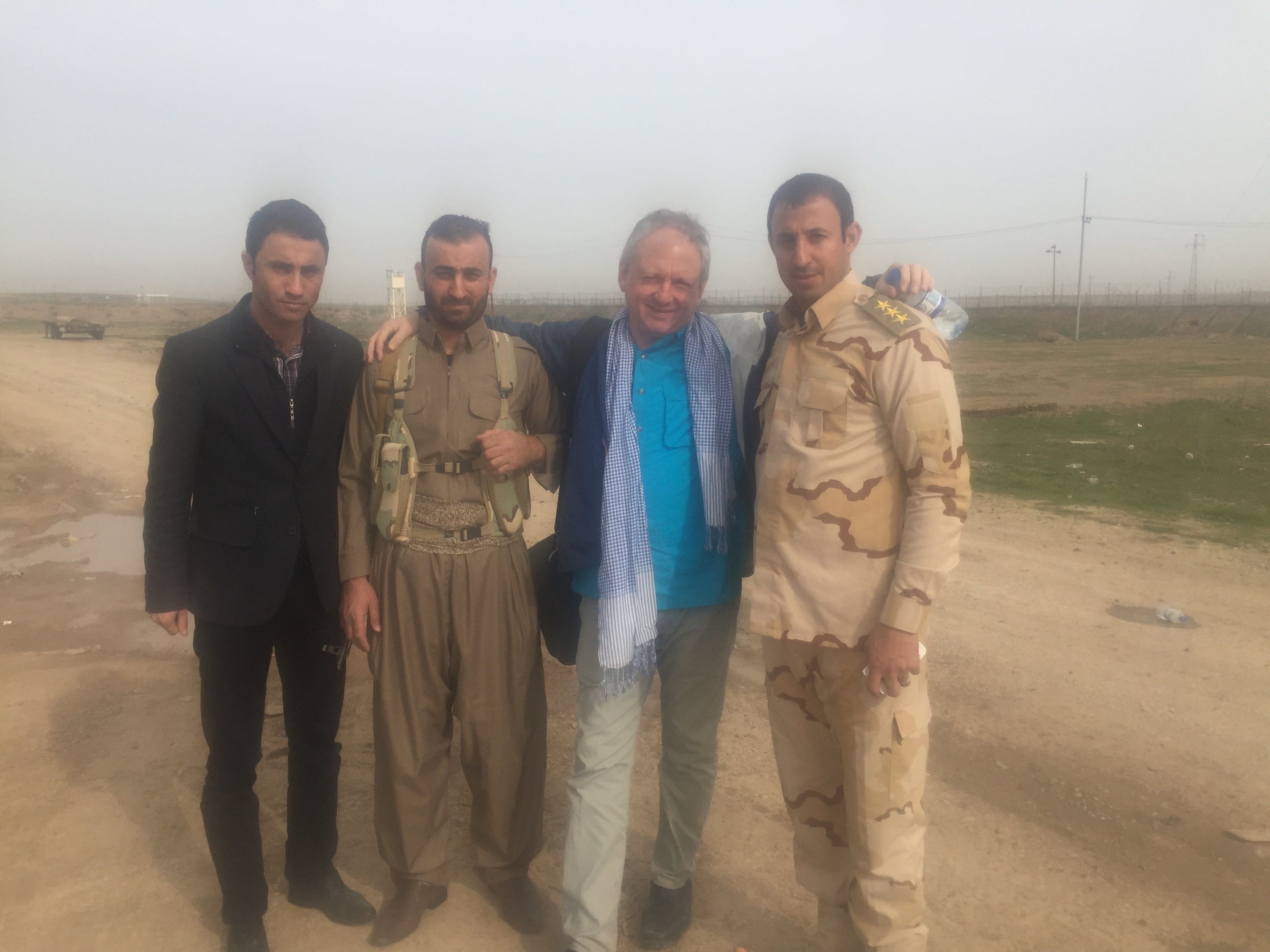
“With binoculars, we can see the Daesh flags there,” Samir translates guidance from a soldier. A small column of white smoke appears, perhaps two kilometers to our right. A second appears, closer, this time 10 o’clock to our left. Samir asks if I know what that is. I have no idea, maybe small fires, maybe even the results of an air strike. “ISIS,” he says. “Let’s go.”
Iraqi Army Major Luqman Chaw Sheen meets us outside of a larger building housing his office. Chaw Sheen translates as “Blue Eyes,” a nickname, not a family name. He is the Commander of the front line base. He is older and more war-weary than his younger charges.
He understands why many Sunnis have embraced Daesh.
If I am a Sunni who doesn’t want Daesh, what do I do? What is my alternative? Daesh is their only answer. The way to destroy or weaken Daesh is for Sunni people to fight them.
A lot of Sunni IDP (internally displaced persons) live in Kurdistan provinces and they fled Daesh. The problem is that when Iraq was ruled by Sunni, they were very bad toward the Shia and Kurds. Now all political rules are under Shia, they have in their mind to get revenge against Sunni. And they will continue to the end.
A lot of former Iraqi officers joined Daesh with a lot of jihadis from Pakistan, Afghanistan. They have been deceived by religion. Seventy percent of Iraqi officers were from Mosul. They are experts in making rockets and bombs. They say you cannot find this experience now in the Iraqi army.
——————
President George W. Bush announced the successful end of Iraq combat operations on May 1, 2003, aboard the USS Abraham Lincoln, 42 days after the invasion. Speaking in front of a massive banner proclaiming, “Mission Accomplished,” he told the assembled sailors and global media,
Admiral Kelly, Captain Card, officers and sailors of the USS Abraham Lincoln, my fellow Americans, major combat operations in Iraq have ended. In the battle of Iraq, the United States and our allies have prevailed . . . The Battle of Iraq is one victory in a war on terror that began on September the 11th, 2001 and still goes on . . . The war on terror is not over, yet it is not endless. We do not know the day of final victory, but we have seen the turning of the tide. No act of the terrorists will change our purpose, or weaken our resolve, or alter their fate. Their cause is lost. Free nations will press on to victory.[xx]
__________
Throughout the occupation, an anonymous young Iraqi woman calling herself “Riverbend” gained international notoriety with her Baghdad Burning blog, sharing her experience of her country’s collapse. “Let’s talk war, politics and occupation … I’ll meet you ‘round the bend my friend, where hearts can heal and souls can mend . . .”
December 21, 2006
A day in the life of the average Iraqi has been reduced to identifying corpses, avoiding car bombs and attempting to keep track of which family members have been detained, which ones have been exiled and which ones have been abducted.
2006 has been, decidedly, the worst year yet. No – really. The magnitude of this war and occupation is only now hitting the country full force . . .
That is Iraq right now. The Americans have done a fine job of working to break it apart. This last year has nearly everyone convinced that that was the plan right from the start. There were too many blunders for them to actually have been, simply, blunders. The ‘mistakes’ were too catastrophic. The people the Bush administration chose to support and promote were openly and publicly terrible – from the conman and embezzler Chalabi, to the terrorist Jaffari, to the militia man Maliki. The decisions, like disbanding the Iraqi army, abolishing the original constitution, and allowing militias to take over Iraqi security were too damaging to be anything but intentional.
The question now is, but why? I really have been asking myself that these last few days. What does America possibly gain by damaging Iraq to this extent? I’m certain only raving idiots still believe this war and occupation were about WMD or an actual fear of Saddam.
Al Qaeda? That’s laughable. Bush has effectively created more terrorists in Iraq these last 4 years than Osama could have created in 10 different terrorist camps in the distant hills of Afghanistan. Our children now play games of ‘sniper’ and ‘jihadi,’ pretending that one hit an American soldier between the eyes and this one overturned a Humvee.[xxi]
February 20, 2007
And yet, as the situation continues to deteriorate both for Iraqis inside and outside of Iraq, and for Americans inside Iraq, Americans in America are still debating on the state of the war and occupation – are they winning or losing? Is it better or worse?
Let me clear it up for any moron with lingering doubts: It’s worse. It’s over. You lost. You lost the day your tanks rolled into Baghdad to the cheers of your imported, American-trained monkeys. You lost every single family whose home your soldiers violated. You lost every sane, red-blooded Iraqi when the Abu Ghraib pictures came out and verified your atrocities behind prison walls as well as the ones we see in our streets. You lost when you brought murderers, looters, gangsters and militia heads to power and hailed them as Iraq’s first democratic government. You lost when a gruesome execution was dubbed your biggest accomplishment. You lost the respect and reputation you once had. You lost more than 3,000 troops. That is what you lost America. I hope the oil, at least, made it worthwhile.[xxii]
Baghdad Burning, final post.
April 9, 2013 marks ten years since the fall of Baghdad. Ten years since the invasion. Since the lives of millions of Iraqis changed forever. It’s difficult to believe . . .
Looking back . . ., what have our occupiers and their Iraqi governments given us in ten years? What have our puppets achieved in this last decade? What have we learned . . .
We learned that you can be floating on a sea of oil, but your people can be destitute. Your city can be an open sewer; your women and children can be eating out of trash dumps and begging for money in foreign lands . . .
We learned that it’s not that difficult to make billions disappear.
We are learning that those amenities we took for granted before 2003, you know – the luxuries – electricity, clean water from faucets, walkable streets, safe schools – those are for deserving populations. Those are for people who don’t allow occupiers into their country . . .
Those who didn’t know it in 2003 are learning (much too late) that an occupation is not the portal to freedom and democracy. The occupiers do not have your best interests at heart . . .
What about George Bush, Condi, Wolfowitz, and Powell? Will they ever be held accountable for the devastation and the death they wrought in Iraq? Saddam was held accountable for 300,000 Iraqis . . . Surely someone should be held accountable for the million or so?
Finally, after all is said and done, we shouldn’t forget what this was about – making America safer . . . And are you safer Americans? If you are, why is it that we hear more and more about attacks on your embassies and diplomats? Why is it that you are constantly warned to not go to this country or that one? Is it better now, ten years down the line? Do you feel safer, with hundreds of thousands of Iraqis out of the way (granted half of them were women and children, but children grow up, right?)
__________
On March, 2013, with the benefit of a decade of hindsight, Michael B. Kelley and Geoffrey Ingersoll of Business Insider publish “BY THE NUMBERS: The Staggering Cost of the Iraq War.”[xxiii] Their sources include news reports, and two authoritative analyses of the human and financial costs of the 2003 invasion and its aftermath, The Brookings Institution ‘s Iraq Index, and the Costs of War Project conducted by The Watson Institute for International and Public Affairs at Brown University.
189,000: Direct war deaths, which doesn’t include the hundreds of thousands more that died due to war-related hardships.
4,488: U.S. service personnel killed directly.
32,223: Troops injured (not including PTSD).
134,000: Civilians killed directly.
655,000: Persons who have died in Iraq since the invasion that would not have died if the invasion had not occurred.
150: Reporters killed.
2.8 million: Persons who remain either internally displaced or have fled the country.
$1.7 trillion: Amount in war expenses spent by the U.S. Treasury Department as through Fiscal Year 2013.
$350,000: Cost to deploy one American military member.
$490 billion: Amount in war benefits owed to war veterans.
$7 trillion: Projected interest payments due by 2053 (because the war was paid for with borrowed money).
$20 billion: Amount paid to KBR, contractor responsible for equipment and services. (KBR was a subsidiary of Halliburton before its sale in 2007, the company for which Richard Cheney served as CEO after his service as Secretary of Defense and before his stint as Vice President.)
$3 billion: Amount of KBR payments Pentagon auditors considered “questionable.”
$60 billion: Amount paid for reconstruction (much of it considered a waste due to corruption and shoddy work).
$12 billion: Cost per month of the war by 2008.
$20 billion: Annual air conditioning cost.
Missing: $546 million in spare parts; 190,000 guns, including 110,000 AK-47s.
$150 billion: Amount oil companies are expected to invest in oil development over the next decade.
$75 billion: Approximate amount expected to go to American subcontracting companies, largest of all Halliburton.
0: Nuclear Weapons of Mass Destruction found (some chems found, but mostly remnants of abandoned development programs and destroyed stockpiles).
——————
Salim Kako and I go into the conference room at the end of the Karlovy Vary Hotel lobby for some privacy. The lobby is inviting but sometimes noisy. Kako, former member of the Kurdish Parliament, sits across a small table from me. He continues the discussion begun with Yuisef in the lobby.
There is little respect for the central government in Baghdad here in Erbil. There is no Iraqi government. They are not able to control anyplace in Iraq, even the green zone. Two weeks ago, they can’t secure a town 60 kilometers from Baghdad for a prime minister visit.
The big problem in Iraq is refugees, more than half a million refugees. The government didn’t do anything for them. If they say they will send $1 million, $100,000 will arrive. We don’t know how or why. The corruption is at the top.
Saddam ran a dictatorship. But there was law, a constitution. Now there is no state. For Sunnis, there is no security, no jobs, no development. The government didn’t pay retirement compensation so they became criminals through al-Qaeda or ISIS, which pays them.
What are the key outcomes of the U.S. intervention for Iraq?
One, we are free from Saddam’s dictatorship. Two, Iraq is destroyed from every side. Humanity, construction, industry, agriculture. Every day, there is kidnapping of teachers, priests.
Salim lists two reasons why the U.S. invaded.
First security. There is security of the world. Security of the Middle East. And security of Israel. The West will not tolerate a strong country in the Middle East. The war was about power and money. And no one is able to talk about Israel.
Second, the war was about energy, specifically oil and natural gas.
——————
Sherwan Wasman is an analyst with the Ministry of Interior for the Kurdistan Regional Government, working with the Joint Crisis Coordination Center. Born in Erbil in 1985, he studied for his Masters in International Relations at the University of Kurdistan, in association with Leicester University in the UK. His dissertation was on military strategy and conflict.
I met him by way of Samir at the Mariana in Erbil.
What memories do you have of the first (1991) Gulf War as a young boy?
I remember smoke. The rain was contaminated by the smoke. Oil wells (in Kuwait) were being burned by Iraqi forces. It took eight months to fully control the fires. There was an oil and water mixture in the rain. The drops looked like a rainbow to a kid.
Sherwan’s dad is a Peshmerga fighter from 1963-2004, retiring after the arrival of U.S. troops. His dad comes home once a month to be with his wife, see his kids.
Dad always told mom to open the door, so if anything was suspicious, he could run. We kids learned to call our uncle “Dad” and dad “Uncle.” Notebooks and pens would appear for us in elementary school, I was told my father sent them to me. “He knows you are in school, so he sent supplies.”
Sanctions are hard on the family. One kilogram of sugar cost 100 dinar, while monthly income was 250. They mixed candy with tea because it was much cheaper. “Rice – you could barely find rice.” Civil war broke out between Kurd parties, making things worse. “Some Peshmerga mutinied and said we will not fight our brothers.”
People aren’t paid for six months. When they simply couldn’t survive or take care of their kids, they walk through mountains across the border to Turkey or Iran, in freezing weather. “People starved,” Sherwan recalls. Robbery increased and people hired bodyguards to protect themselves. “You could barely travel at night because of kidnappers and robbers.” Sherwan doesn’t assign blame to the United States. “It was the fault of Saddam; we were rich in oil.”
He reflects on the years of Shia/ Sunni strife after the 2003 invasion.
Sunnis in Mosul say it is better to live under Daesh than Shia militia. On TV and social media, Sunni leaders say they prefer Daesh. What Daesh does, the Shia militia did worse. When Shia recaptured Sunni areas, they were killing nine and 10 year-old boys.
Daesh holds territory, has an economy, a state. Economics play a crucial role. Most officers were sent back home during de-Ba’athification.
De-Ba’athification is introduced in Iraq shortly after the April 2003 fall of the Ba’athist regime. Its objective is to use legal and administrative measures to prevent the Ba’ath Party from returning to power.
“Ba’athism is a secular Arab nationalist political ideology that was first developed in Syria during the 1940s, a time when Syria was still governed under the French mandate. The party’s ideology, which is shared by several political groups in the Arab world, is vague and heavily nationalistic, emphasizing a goal of Arab nationalism under the motto of ‘Unity, Freedom, Socialism.’”[xxiv]
(The Sunni officials) don’t have any role in the new government, especially the military. When you are jobless and you were an officer, a general, what are you going to do? Sunnis step-by-step found out they have nothing to say in the new cabinet. After the U.S. left, the Sunni were marginalized, their seats reduced in Parliament. Family members are assassinated and tortured. Shia areas have 24-hour electricity, fully-secured. Mosul has 12 hours of electricity, bad public services. If any group comes to fight Maliki, they will support them.
Sherwan has a solution. “Break Iraq into three parts. Forget about Sunni and Shia, Kurds and Arabs don’t like each other. “
Sherwan wrote his master’s dissertation on military strategy. How could a badly outnumbered Daesh win Mosul?
There are 245,000 Peshmerga. The Iraqi army is about triple that. The Iraqi army is afraid of Daesh. They are well-trained and equipped but have zero morale.
You have to arm and train a Sunni brigade to liberate ISIS territory. They welcome Peshmerga, but not Shia militia. Iran doesn’t want Sunni armed, so they might not like the idea. And the Sunni were disarmed by the U.S.
Is religious devotion a factor in loyalty to Daesh? “They use the name of Allah just to mobilize public opinion. Killing hostages is a crime in Islam. Never allowed.”
——————-
Wahid Tayad is a 40-year-old member of the Barzani tribe from Amedi, a town near the Turkish border. He joined the Peshmerga at 16 and recently served as a consultant for Kurdistan’s council of ministers. He wears a long sleeve black shirt, keys dangling from dark trousers. Physically fit, articulate, forceful in tone, he is used to selling ideas and persuading people. At one point, he picks up a sharp knife and uses it for effect throughout the interview, thrusting, twisting and counting with it.
Iran-Iraq War hostilities ended on August 20, 1988.[xxv] On August 9th, Iraqi aircraft attacked the area between the Peshmerga and the town of Amedi,[xxvi] in the northern Duhouk province[xxvii] of Iraqi Kurdistan. Five of the rockets held chemical weapons. At night, Wahid and his friends went down to the town to see what was going on. People were holding tissues on their faces, tears coming down from burnt faces. Doctors in the government-run hospital were told not to tell anyone that the symptoms were from chemical weapons.
Riding back on two horses, Wahid’s and his friend’s eyes started to water and thought “something is wrong here.” They smelled rotten apples. They tried to keep walking. Wahid had a flashlight and they found metal fragments from the rocket. After a few minutes, he suffered from a sore throat and shortness of breath, and gargled with water. For 500 meters, all around them, everything was burned.
The attacks were part of the Anfal campaign, named after a Koranic sura or chapter, that destroyed over 4,000 (out of 4,655) Kurdish villages, at least 30 Assyrian villages and displaced more than a million people. Wahid’s estimate of 180,000 dead, 8,000 from Barzan territory is consistent with that of Iraqi prosecutors.
Was an attempt made to bring the Anfal genocide to the attention of the world and, if so, what was the reaction? Wahid was matter-of-fact.
We had no communication with the outside world, we were limited to the region, surrounded by enemies. To whom we were able to talk? Iran was helping Halabja for themselves, to attack Saddam.
A purple sunset explodes across the 6th-floor Mariana Hotel restaurant windows. I note the cosmopolitan openness of the staff and patrons around us.
If you go back in history to the 1930s, (Mustafa) Barzani was the leader of Kurdish community and Assyrians, Yazidis, Turkmen were living together in peace. A lot of ethnic groups live here in peace, there are churches in the place. All this history indicates Kurdish are unique in democracy.
The city is also believed to have been the home of the Magi priests of Assyria, including the three wise men of the New Testament of the Christian Bible who made a pilgrimage to Jerusalem to see the Christ-child shortly after his birth.
We don’t kill or attack others; Daesh uses the name of Islam to attack other people. If Islam is this, we are not Muslims. We teach our children to love other people and live in peace with other religions. We never educate people in our mosques to hate and kill people.
What’s the cause of the expansion of the Islamic State and what’s the solution?
Daesh is the result of the mismanagement of Iraq, especially (Nouri al-) Maliki (Iraqi Prime Minister 2006-2014). Sunnis were treated badly and they were seeking an alternative.
Was it incompetence, corruption or hatred of Sunnis and lust for revenge?
All three. I have most accurate information about Mosul. Maliki in one month killed 300 Sunni community leaders including 70 mullahs. Iraq is a small version of Iran. In the next few years, they will lose their language for Farsi.
Before he departs, Wahid takes out and shows me a picture of himself from 1991, bearded with a rifle, when the Kurds forced the Iraqi army out of their land. In it, he has the pensive demeanor of a literature or a philosophy student.
It is proven that Arab Sunni cannot live with Shia in one country. Why should I be proud to be Iraqi? Since 1920, King Faisal, Saddam Hussein, they oppressed Kurds, from the time of my grandfather, to my father, to my son. I have never seen Baghdad. I will not go to Baghdad because it is not my capital.
——————
I offer to share the driving to Halabja, never really insisting on taking the wheel. After months in Southeast Asia, the northern Iraq winter is getting to me, and the temperature drops as we navigate the stunning mountains and lakes on the route past Koya, Dukan and Sulaymaniyah. Samir remains a joyous, steadfast driver.
After a four-hour road trip, Sirwan meets us on the boulevard leading into the town. We walk up to his house where, after a brief greeting, his wife, Shirin Jalal, stays busy behind the scenes preparing a very large lunch. She wears a black head and neck scarf and a full-length deep purple dress with small shapes forming a pattern, numerous gold bracelets on her right hand. Dress here in the country is more conservative than what I see in Erbil.
Sirwan takes command of the remote for the widescreen HDTV on the wall to our right, switching channels, this time from football to a Turkish soap opera.
The electricity goes out as we chat but, as in Erbil, comes back on quickly. Their daughter doesn’t join us for lunch, but their little boy comes in to play with his dad for a while. Shirin finally joins us as we finish our meal, sitting on the wall to my left on a floor cushion. She expresses her hope that we enjoyed our meal and serves hot tea.
Sirwan, sitting cross-legged and barefoot across from me, adds that I am always welcome in their home. He says they felt very happy when the United States came because they were living under a dictatorship. It was good for the Kurds, not good for the Arabs. The majority of Sunnis help Daesh because Shia groups were very bad and that is why they searched for an alternative. The Sunni population will accept anyone who helps them against anyone who tries to oppress them.
I say they claim they are bringing a caliphate, with true Islam to the world. As Samir begins to translate, Sirwan cuts him off and says, with hands gesturing and Shirin interjecting her own comments, “Those Muslims do not represent us, they are not Muslims. In Islam you are not allowed to kill anyone without justification.”
What are their most vivid memories from the time of the chemical attacks by Iraqi war planes in 1988? Shirin answers first.
In ’88, I was 13 years old. Three days before the chemical attack, they sent missiles and rockets to Halabja. There were Iranian forces here. City people tried to go to Sulaymaniyah but the Iraqi forces didn’t let them get out. A lot of Peshmerga forces were allied with Iranian soldiers against Iraq.
Sirwan picks up the story.
I can never forget, at the time of the bombardment, a four-year-old child. Her mother was out while other family were in the basement. Planes attacked the house and killed the family members. The child stayed alive. Before the mother came back, a man found the child and asked people to help. The mother cried, “Please help my baby.” They could not return to the home until 1991. When they came back, there were only bones of the family underground.
Shirin continues.
I saw Peshmerga fighting, using simple guns while Iraqi forces had aircraft. I saw one of Peshmerga die before me. When they used chemical weapons, the Iranian solders had the masks, and they were laughing at us while we were running. Iranian forces were not in the city center. We saw a man with his daughter, their house destroyed, half of them under the house, the other half out, shouting for help but no one was able to help them. In 1991 when we came back, we found their bones in the same place, half under and half out. On the road, on the way to leaving, there were a lot of bodies and victims. People were not able to use cars because of all the dead bodies. They left the car to push the bodies away just to open the road.
Sirwan, also 13 at the time of the use of chemical weapons in Halabja describes the effects of chemical weapons.
Skin burns, death, others were psychological, affecting the nervous system. People would laugh and then fall down and die. There were two types of chemicals, one smelled like garlic, the other smelled like rotten apples.
How did the world react? Shirin responds.
Iran sent planes to transport injured people back there for treatment. Victims were transported to the United States and Norway. The International Red Crescent helped. No one else helped.
The Iraqi army leader was Shia. He made an agreement with the Iranian forces, they transported him to Iran and he left the soldiers with no leader. Many Iraqis died and Iranians controlled Halabja, Saddam wanted revenge.
Have there been after effects? Food or water contamination?
After three years, people got sick after their feet sank in the mud. They went to doctor and were still not getting better. Till now a lot of people have shortness of breath, one boy uses oxygen in the home.
I have a question of you? Will America help the Kurds? We are surrounded by enemies. Turkey, Iran, the Arabs are against us, even Syria. We are just like in a prison surrounded by enemies. America is our only hope.
Shirin doesn’t wait for an answer.
We wonder, why no countries talked about the chemical attacks in 1988? It took three years. We shed a lot of blood. The only thing that heals our wounds is our independence.
They left their homes empty from 1988-91. After three months, Shirin’s father came back to get some of their home effects. He put on a pair of his shoes, and they burned his feet. “A family whose house was hit, till now, if you want to grow anything, it cannot grow.”
After lunch, Sirwan takes us to the Halabja memorial. Outside amidst rows of gravestones are mass graves. The crest of a nearby mountain seems covered on one side by white markers. Outside the museum is a bronze sculpture of a man on top of a young girl, trying to shield her with his body. Perhaps 20 meters away is a sculpture of a journalist photographing the scene. This, I’m told, is the iconic image of the bombardment. The actual photo taken is enshrined in glass inside.
The 100-foot memorial structure contains a circular wall into which each victim’s named is carved. Photos and video show a teenage boy relating his harrowing tale of being left for dead in a truck. Samir talks to a man standing behind us in our walking tour of the exhibit and realizes he is the teen in the photos.
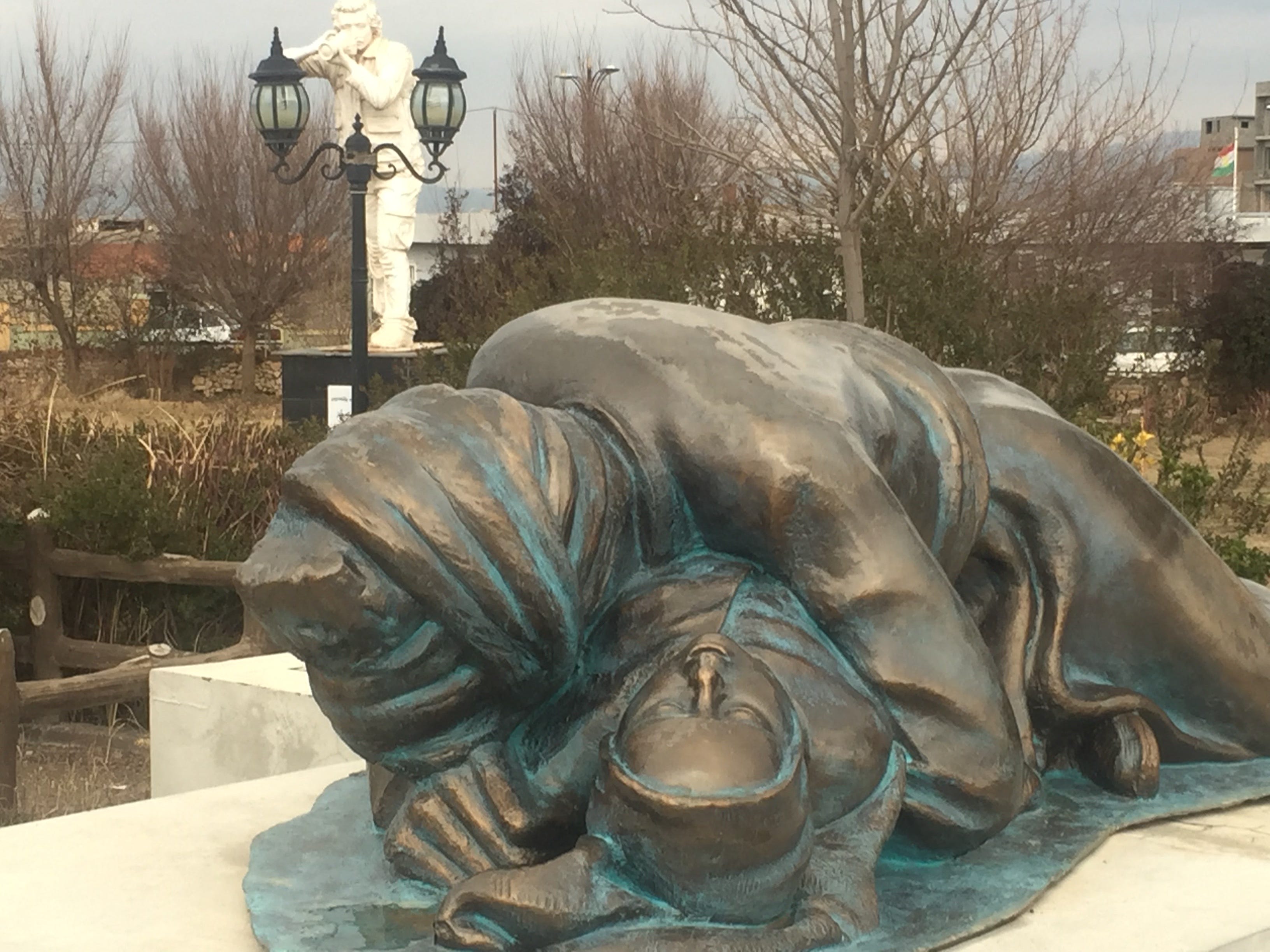
Omed Ali tells us how he and his young friend were near death after the bombardment, without food and drink for two days. “They came to collect us as they thought I was dead. I moved and they realized I was not dead.”
Your brothers and sisters died?
All of the family were murdered, except my father, who was not in Halabja. When the Iranian army destroyed the Iraqi army here, the Iraqi government had been searching for a reason to kill the Kurdish people, so they did for revenge.
For the first six months I could not see, I was blind, I had problems breathing. Still now I cannot see well and have difficulty breathing. My wife was here, injured like me; in three pregnancies, we cannot get a child.
Omed, the handsome teenage boy in the pictures, tells me his name means “hope.” Shaking his head, he says, “It was big tragedy, 5,000 died and 10,000 injured by the Iraqi government. Anyone who has a peaceful mind should stand against these actions and never forget.”
——————
Ala Ali’s father was Turkish, her mother a Kurd. Though Muslim, her parents put her in Catholic school at six years old, which was confusing as her mother was a teacher in a respected Kurdish school. “She didn’t explain it to me as a child. But I learned how to deal with people as human. I never experienced people as a Yazidi or Christian or Muslim.”
Ala is a researcher and peace activist, with more than 17 years of experience working on civil society projects related to conflict in Iraq. She is a specialist in conflict analysis studies, peace-building strategies and organizational democracy, with a Master of Arts in Conflict Transformation from the Eastern Mennonite University Center for Justice and Peace in the United States.
Ala was referred to me by two separate sources, both fans of her work studying security, religion and gender in Anbar and Nineveh provinces. I asked Ala when the pursuit of peace became a personal passion.
I needed it on an inner personal level and in the community. In elementary school, in Saddam’s time, we were not allowed to read books that we wanted to read. My father, who was very sensitive, avoided political books and was afraid for us. Reading is very important for the minds of teenagers and children, and our understanding was isolated, very limited, knowing nothing about the rest of the world.
When I talk to my son, I was talking like him when I was 30, 35; he is 19. Media was controlled, there was one channel dominated by Saddam. We were blind. We knew nothing.
The 2003 invasion was a scary moment for us. We just wanted a change, as the situation was really, really bad. We wanted to be rid of Saddam at any price.
What was your sense at the time of the purpose of the intervention?
Stupidness. Not a good understanding of the nature of the culture, the context of Iraq. The mission was not accomplished, because what the U.S. expected, it would not find. They introduced corruption into civil society in Iraq and spoiled it for years. And don’t tell me it doesn’t affect American society. It does. Americans lost; they gained nothing. They could have done WMD in a diplomatic, political way. Americans knew nothing about Iraq.
Ala believes that ISIS will disappear in a year, but something worse may come.
ISIS is the result of injustice, Sunni pain regarding how they were treated by the government and the structural violence in their daily lives. I interviewed a former senior Saddam officer. If I was a key officer in the military, I had many soldiers. Now, my children have no food to eat. They join immediately when ISIS comes.
It’s a business for a small group of people. They go to any fragile community or society. They talk about dignity. Terrorist groups use dignity like magic to gain people’s affiliation. I interviewed victims who lost their dignity or were humiliated: we are human, if you lose your dignity or are in need, or see your children needing food and you cannot feed them, you can do anything. ISIS uses this.
Is it too late for national reconciliation?
It’s better to have it than not. The government doesn’t know about transitional justice. Military intervention is useful, but it is not a forever solution. We need a restructuring of our political, economic, social system. This region is about to die. We need a strong civil society, we need youth and women involved in the political process, political education, studies, research, education. ISIS will stay forever if we don’t have justice in Iraq.
Are you hopeful?
If they (the Iraqi government) continue like this, there is no hope. But there is if they can change. We have to push for change. It will not be a paradise but at least it will not get worse. I live here, I have my brother, sister, children, family, so what will be the result if I don’t do anything?
In 2006, I went to my father and said I don’t know if we are Sunni or Shia. And my father said, “Don’t think about it, we are human.”
I’m a human. I have humanitarian values. Justice is my value. People have a right to live as humans, with dignity.
——————
My meeting with Professor Faris Nadhmi is quickly being sabotaged. Already a few minutes late, my laptop battery is dying. He graciously concedes a quick dash to my room upstairs for my AC plug.
The lobby is noisy and so we meet in the Karlovy Vary conference room, but it’s freezing and the plug does not fit the wall socket. We ask a hotel employee to solve both. Nadhmi remains gracious throughout, speaking gently, perhaps motivated to share his story.
An oft-published academic with a Ph.D. in social psychology, he shares two papers with me, one that I have read online, on the politicization of Islam. I ask if he is Shia or Sunni. It seems a tiresome question to him; he identifies with neither and considers himself a secularist. I comment that the prevailing mythology is that Sunni, Shia and Kurds could never live together and needed the iron rule of Saddam to keep the country together.
There is no one Shia or Sunni. “Demographic” Shia — conservatives, liberals, artists, communists, normal people on the streets — don’t think about whether they are Shia, it’s inherited. They are the major part. The “political Shia,” the parties, opposed to Saddam inside or outside the country, they are a limited percent, with certain objectives to overthrow the regime, to manipulate the idea of Shi-ism to try to reach power. Third are “religious Shia,” leaders like Sistani. They have their own schools, they specialize in fatwa, what is OK or possible or accepted, or forbidden as well.
Before 2003, the majority or pervasive type was the first one. The second and third tried to exist, didn’t have real influence or affection in the society. Same for Sunni. The Saddam theory that he kept a lid on ethnic tensions is completely invalidated by that.
You must have been at risk as a professor at that time.
We were so careful, so reflective, diplomatic as to how we used words. Many academics were in danger or disappeared. Most of us, we knew the game. It was not easy; but it was possible. By culture, by manners, by poetry, we opposed and hated the regime so much.
Nadhmi was a psychology instructor at the University of Baghdad in 2003 when the U.S. “shock and awe” campaign began.
Anything that would happen to overthrow Saddam would be OK for us. Maybe we were naive, but nobody could stand it anymore. Everything was destroyed — dignity, social relations. We thought the U.S., after the Cold War, as a new project in the world, may carry to us a new opportunity for freedom and justice and human rights. We were waiting for something. Any new regime would be more merciful than what Saddam and the Ba’ath regime did. Most people were optimists. Maybe they decided to postpone their dignity. When I was in university, students didn’t think of sects and identities or sub-identities. I didn’t know if my colleague was Christian or Muslim, or from Basra or Al-Anbar. Identity of the country was the main idea, one identity called Iraq, good or bad.
Tell me more about your experience as an academic and a psychologist during the invasion.
In the center of Baghdad, people love and have a friendly feeling toward America, another attitude toward its political administration and troops. April 9 is the date of the American coup in Baghdad. On the 11th, we went to the university to see what happened. American troops are everywhere. Looting had started. We tried to restart our lives, tried to save the libraries and protect equipment. After two to three weeks, people came to establish groups. After 40 years, it was the first time they could establish NGO’s (Non-Governmental Organizations), even with no experience. Every day, there would be an organization for liberal poetry, for liberal teachers. They start to use that word liberal because they were thirsty for freedom. Every day, there would be a new group in the hall, they were so enthusiastic, they wanted to prove themselves. No one talked about religious goals or ideas or beliefs. Everything was secularist or liberal. That lasted for two months.
We felt that U.S. troops were not so comfortable about the civil movement. At that point, I updated my point of view. If they are coming for liberty, please look at what Iraqi people are doing now. They still have civil values.
Perhaps the U.S. troops didn’t understand these newly forming groups because they didn’t know the language.
No. Arabic translators were everywhere.
There were two big ideas in the U.S. administration. First one: Bring freedom, justice and security to Iraq. Second one: Paul Bremer (who led the U.S. occupational authority of Iraq following the invasion) decided that Iraq should not follow liberal values; it should follow the sectarian option, to re-establish Iraq on sectarian and ethnic lines. I was in Baghdad all my life and through the occupation. In June, the Iraqi Governance Assembly was established, 25 members according to ethnicities: 13 Shia, 7 Sunna, 3 Kurdish, 1 Christian, 1 Turkomen. In the period between 9 April and 15 July, the future is decided. Shia and Sunni leaders were worried; many of them were abroad. They thought America would not let them come back easily. Mohammad Bakir Hakim of the Islamic Revolutionary Council, who had some troops who fought against Saddam during the Iraq-Iran War, entered Basra from Iran in May. He thought they would not let him reach Baghdad. Supported by militias, he moved city to city with a high level of security, secretly. Nothing happened; day by day come Islamic leaders who nobody in Iraq know. The U.S. blocked liberal movement and encouraged the leaders of political Islam to enter Baghdad and establish their parties; they occupied many buildings affiliated to the state, ministries and directories.
Then the U.S. let the terrorists come from everywhere, easily. A green light to Iran, Syria, Saudi Arabia. Brainwashed. The borders between Iraq and Syria which are now controlled by ISIS, had camps of terrorists inside Syria. They gathered, trained, prepared to enter Iraq without any objection. In the beginning, they were al-Qaeda. Many people were reporting it at that time, as there are social relationships between the western bank of Iraq and the eastern bank of Syria. From Tunisia, Sudan, Afghanistan, they said the new regime should be overthrown. Another front was Iran, another Saudi Arabia.
I ask why this was happening, but Professor Nadhmi speaks to outcomes, preferring to focus on what he designates “phenomenology.”
Twelve years after the invasion and occupation, it’s clear, a good period of time to evaluate the outcomes. Dividing, destroying the Iraqi national identity, to multiple sub-identities according to Shia and Sunni sects, Arab and Kurd. This is the latent, socio-psychological perspective. It happened, it was executed successfully. Anyone who observes objectively, smashing the identity has been achieved. Doesn’t mean it has been killed, just weakened.
Let’s say that was not intentional. Later, there were three or four chances to reform this, to update. But they didn’t do that. In (2012), Prime Minister Maliki gathered deputies in the parliament to have a vote of confidence. At that moment, Allawi, head of the National List, Muqtada al-Sadr, Barzani and others met in Erbil to say they have “no confidence” in Maliki. They gathered the required number of more than 50 percent for a vote.[xxviii]
At the final moment, the U.S. Ambassador (James Jeffrey) met (Kurdish leader Jalal) Talabani, for three hours; this is well-known in Iraq. He said no way, you should give him a vote of confidence. To the end of his term for three to four years. Talabani said I cannot do that, this is not my question, the other parties signed. He agreed to reverse the vote of his 11 deputies and the percent went down and Maliki survives.
At that point, I was completely sure that there was no misconception. Those next three to four years were the most dramatic in Iraqi history because they brought us to the ISIS fight.
The 2010 election winner was Allawi, 91 seats, Maliki 89 seats. The American Ambassador said, Allawi, the liberal leader is the winner, but we should look to Shi’ite religious leaders, we should not allow Allawi to be the leader.
When people have no legal or political system, they can agree to adopt anything. There was a political vacuum. After 34 years of Saddam Hussein, there is no political culture, a negative political culture, a kind of helplessness, incapable of thinking as normal people.
Where this is a political vacuum, anyone can fill that; people search for a kind of authority to feel secure. The humiliation by the Shia Army against the Sunni people; they are rejected, secluded from political decisions. All these factors and conditions result in the deterioration of political legitimacy of the government in Baghdad.
People are then prepared for a new kind of authority. Maliki’s regime did his best to let demographic Sunni be enemies of the Baghdad government. Here in Erbil, there are tens of thousands of refugees from Ramadi and Fallujah right now. You can meet well-educated, peaceful Sunnis who were forcibly displaced from their towns and cities due to the ISIS invasion.
If you ask them about ISIS, they can give you horrible stories. Incredible, unimaginable. What they confront there and how they risked their lives and the lives of their children to leave their homes, through the desert, to reach another part of Iraq. Clean, well educated, smart, mosque-going, normal, civilized people, saying, “We are Muslims, we are not Daesh, we are not Islamic Party, we hate the Islamic Party; we don’t accept any kind of political Islam. We just want to go to pray on Friday and educate our sons and daughters, live as normal people and go back to our homes.”
Living in thousands of small houses, three to four families in each house. Starting to work and integrate with the community, opening restaurants, car repair, sewing clothes, a kind of integration.
What about those who support ISIS?
From lower classes, less educated, so there is a financial factor. Tribal complexities due to certain coalitions forced some tribes to be closer to ISIS. Sometimes blood relations, ex-officers of Iraqi army could belong to that tribe. During these 13 years due to logistics, politics, certain tribes are enemies. Like the Haditha Al-Jughayfa tribes, fighting al-Qaeda and ISIS for two years.
The U.S. administration established the power of political Islam in July 2003. This power was corrupted, selected by parties, most of which were corrupted. They arrived from out of the country, were paranoid, with no political strategy. They are sociopaths, they cannot empathize with people.
There was no real attempt to reform this power. After 10 years, what are the expected outcomes? Political Islam produced another political Islam in opposition, because the national identity which can resist extremist trends has been divided and destroyed.
The climate of extremism has become something usual. Rational thinking almost disappeared in Iraq. The logical relation between cause and effect disappeared. Anything could happen, anywhere, according to no rules. Normlessness. Anomia (a state of society characterized by a breakdown of social and legal norms and values).
What do you expect in this circumstance? Any outlaw groups could be established, a religious basis, or mafia basis, or any other classification. If you destroy the national identity in any society, or human entity, you should expect as a first outcome, extremism, nationalist or religious.
The solution proposed by many is to divide Iraq into its three ethnic parts. The professor disagrees.
Sunni and Shia consider themselves as Iraqis. Kurds consider themselves as Kurds, not Iraqis. Iraqi is a historical identity, like Egyptians. An extension of a very long history, thousands of years. An Iraqi identity has been achieved, whether in 50 years or 5,000 years.
Difficulties in national identity were invented after 2004. Each human has multiple identities: father, psychologist, Iraqi, Muslim, husband. When I choose one of these identities, I put it on the table. Self-categorization. Everywhere you can stimulate people to choose one identity over another.
Since 2003, certain factors were imposed by the U.S. These provoked and stimulated self-identities of Iraqis. Doesn’t mean they lost forever their national identity which manifests itself in many conditions. When Iraqi football makes a goal, Iraqis dance in the streets, hug each other. When an artist achieves something, everybody finds sympathy without asking their background.
There is an old debate as to whether our social behavior is a product of personality or situation. In political psychology, we try to concentrate on situations, because personalities can disappear in front of strong situations such as occupation or poverty or violence. As a peaceful man, I may be compelled to be violent in a certain situation.
Iraq’s solution will be an internal solution. A new movement has launched for the last six months, a collection of Muslim and Christian and Shia and Sunni, middle and lower class. There are demonstrations and events every week in cities; good coordination with some good religious leaders like Sistani, who now says, I support a civil state.
He is a wise and pragmatic man. He feels now that his authority is under threat because of political corruption in Iraq, and everything can be destroyed forever if he doesn’t start real reform. So, he supports a state of laws and citizenship. “This is Iraq, not Iran, it is my duty is to advise and consult people, I am a religious man, not a political man.” Eighty percent of Shia in the world follow Sistani, not Iran. Sistani says we will not be patient anymore, this government is corrupted. We should redeem consideration to the state of laws of honesty and citizenship, a civil state which respects all religions and beliefs.
ISIS cannot be defeated by only internal forces. It is an international situation, with Syria, Russia, USA, Saudi Arabia. In Iraq, it will be done by Iraqis themselves. ISIS’s defeat will encourage the civil movement in Iraq to achieve real reform. More than 40 percent are now under the poverty level. Unemployment is more than 30, 40, 50 percent. Oil price deterioration is a big problem.
Meanwhile, there is a new social consciousness flourishing in Iraq. Maybe this is the only positive outcome of the American invasion. There is a kind of freedom of expression, hundreds of Arabian and Iraqi TV channels, you can speak with 12-15 year olds who can give you good political analysis.
What would you like to see from the United States in its relationship with Iraq?
Obama’s strategy is different from George Bush. He practices the minimum limit of intervention. No occupation, as before, a philosophy that lets the players play ‘til they get a solution. Let the Iraqi and Syrian players try and try and try according to the principle of trial and error. This strategy is much better than the last one which depended on direct intervening and imposing solutions and ultimatums in society or government. Iraqi people can learn quickly. This is a structural characteristic. My perception is Obama is the strongest of American presidents in the last 30-40 years.
Many Americans consider Obama weak or feckless.
I distinguish between strong and violent. He is not violent enough. But he is strong, because he has self-control and self-regulation. Left to themselves, Iraqis will certainly find the solutions, and one of these is, the society will rebel and will not let the political Islam parties rule anymore.
The elections of 2010 were a critical moment in Iraqi history, where we voted for the secular liberal list. Why did the U.S. administration insist Islamists rule by some kind of compromise and blackmail and pressure?
The U.S. participated in creating ISIS, from Baghdad 2003, not the Arab Spring. They should treat these miserable outcomes, but Obama strategy and philosophy continues to be to let people find their solutions. And the Iraqi people will surprise the world. Maybe by blood, but at the end they will find a solution. Political Islam will be history and we will re-establish our civil society according to rational values which are deep rooted in Iraq.
——————
Ala invites me to dinner at her apartment along with her associate, Jamal Al-Jawahiri, from Al-Amal, an organization which runs civil democratic campaigns on issues such as minority and women’s rights. Jamal is Shia, exiled before the beginning of the Iran-Iraq War for having an Iranian grandfather. His son, raised in Damascus, Syria, joins us. As Ala prepares dinner, Samir displays his considerable charm from the outset declaring that he hates Americans, but nicely, and in excellent English.
Over dinner, I ask Samir of his impressions of the 2003 intervention.
In 2003, I was still a kid, in Damascus. At the time I didn’t have an interest in politics. Everyone for two to three days was discussing only the intervention. My position was optimistic though the U.S. did not have any right, the UN did not sanctify that, nobody asked them to come.
Jamal joins the discussion.
A lot of Iraqis looked at it as a chance to come back to Iraq, to have a new Iraq after Saddam. Iraqis were sure only Americans could do this. A majority of Shia welcomed America. Some Sunnis were happy, not a majority. They knew Americans would do a lot of bad things. It was confusing for us, for me especially. I was in Syria, we moved to Iraq immediately.
Why?
I need to stay in Iraq, it is better to stay. I am from Iraq. I am Iraqi. This is our country, our life. From Najaf, I saw most of the community welcomed America. My sister said to me, “If Saddam is still in power, you cannot be here, only because America occupied Iraq are you allowed to come back.” In 1980, before the war, they sent us to Iran in one day. They took our house, our money, everything,
After less than one year, my sister said, “Jamal, you have to know we have a lot of Sadr-ist militia around Najaf, doing training. Americans are around and nobody asks them what they’re doing.” Sunnis think they have to protect themselves from our federal government. There is no trust.
Samir returns to my question about whether ISIS is doomed.
I doubt that. The idea of an Islamic state, the raw idea, the unity of those lands, it is a good idea, if you took out all the bad stuff — you’d have to take out a lot of it — the beheadings, the religious restrictions. ISIS is a state. Their power in 2013 and beginning of ’14 was based only on showing themselves as liberators of Sunnis, the unifiers of the land, as good people. Immediately, people saw what they actually are after their burst of power. It is short term.
Doesn’t the civil administration and military expertise come from former Iraqi army and Ba’ath party officers? “They have good leaders in media,” Samir says. Ala agrees: “Very strong.” I counter, “That has its limits, it’s good to have a good Twitter feed but . . .” Jamal leans forward and responds.
They know the culture. They changed the leaders in Mosul, now they have Iraqi leaders. They discovered it is not easy to have (Omar al-) Shishani or Tunisians.
They’re good at branding, at messaging. Samir again.
Good at pulling the strings. Still, ISIS is small and it is weak.
ISIS has an awful lot of enemies right now. Samir agrees.
They have no formal friends. Only Saudis and Turks support them and informally. It is a really bold statement but I think the Saudi government is supporting them.
Samir responds emphatically to my suggestion that 15 terrorists on 9/11 were Saudi plus Lebanese, Egyptian and Emirati. “They were not Iraqis!” he asserts. “Al-Qaeda support was official from Saudi Arabia, starting with a force fighting the Soviets.”
As we complete our dinner, I ask Jamal about his organization. He says, of course I know about it, because I know Hanaa Edwar. But I never met Hanaa.
I connected with Iraqi women’s rights activist Zainab Salbi at the Abu Dhabi Media Summit on my way to Afghanistan, who then introduced me to Hanaa, who referred me to Jamal and Ala via email.
At that moment, Jamal’s mobile phone rings. It’s Hanaa. There is a great video clip, widely circulated on YouTube, where she loudly confronts Prime Minister Nouri Al-Maliki for calling civil society activists terrorists. A CNN feature on her is entitled, “The woman who lambasted Iraq’s prime minister.” I ask Jamal to say “hello” to her for me.
__________
Leaving for the Erbil airport, I say goodbye to Mr. Hanna at the Karlovy Vary reception desk, thanking him for his hospitality and for the opportunity to meet friends and guests. He asks where I have been and where I’m going from here. I give him my recent as well as my planned itinerary. “Are you Magellan or Sinbad?” he asks. I ask which he would prefer to be. “Well, Magellan was real.” He then tells me a Sinbad tale from the Arabian Nights. “I may have to go with Sinbad,” I decide.
Samir agrees on one last trip to the souk for lunch and some last-minute shopping. We try on Kurdish and Arab scarves and headdresses in the shadow of the Citadel, settling on a gray Kurd scarf and a red keffiyeh. For lunch, we go to what he insists is the best kebob shop in Erbil.
As we sit for our final meal together, we are suddenly surrounded by Peshmerga soldiers. While they review the menu, a general walks in and soon, large plates of food start hitting the tables. When we tell a soldier what we have been up to, he speaks with the general. “You can ask him anything you like,” says our table mate, pointing to his commanding officer. The general waves us over to share his meal, but we leave him to eat in peace. When we finish our spread of flatbread, kebobs and vegetables, I walk over and an officer moves to allow us to sit together.
There are large bowls of beets, kebobs, yogurt and vegetables. As with any popular, high volume restaurant, the scene is pandemonium, with plates and drinks and bills in constant movement. The general introduces himself as Sarbast Zebari; his uncle, he tells us, is Minister of Finance for Iraq. His officers crowd around to hear him speak and interrupt with their own views, laughing and jostling each other. General Zebari has strong opinions.
If the U.S. wants to defeat Daesh, give us heavy weapons; we have old-fashioned weapons. Daesh is not a religious group, they are not a political group, they are radicals.
He doesn’t believe the solution to Daesh is exclusively military.
You have to educate people. Kurdish culture is unique, not by chance. Our culture is peaceful and tolerant and open-minded. It’s why Peshmerga forces are so unique in the region, we don’t treat our fighters like Shia or Sunni or Christian, compared to others.
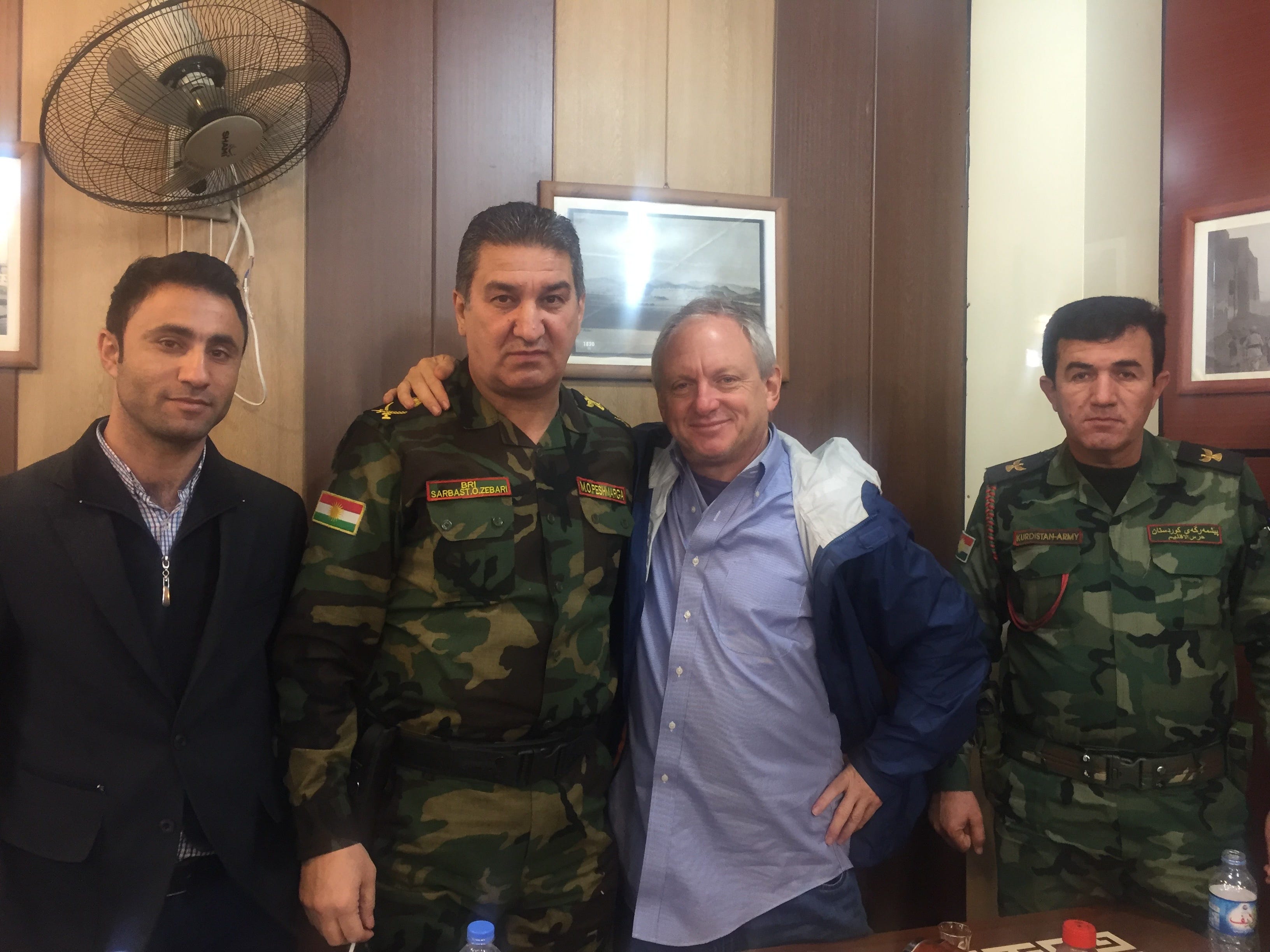
An officer asks to take a picture. I also give him my phone, Samir gives him his, and eventually there are at least seven phones shooting various combinations of our group. The General insists I eat some more and I am eyeing the massive bowl of beets, in a variety of shapes and textures, but the flight awaits and I want to complete our chat. The general expands his lesson on dealing with Daesh.
Don’t repeat Sykes-Picot. The USA are good allies, but you need to know that the most powerful ground forces in the region to defeat Daesh are Peshmerga forces. We are surrounded by Arabs, Turks, many enemies, plus Daesh and the financial crisis so we fight Daesh in the place of the international community. They all need to fight Daesh but we are on the front lines. We fight Daesh but America only supports the Iraqi army and the Iraq army never supports us.
He raises his voice, which is now filling the room, to the delight of his comrades.
If you support us directly, we will be the second Israel for you.
There is laughter all around, as we excuse ourselves to pay the bill and I take my leave of Iraqi Kurdistan.
Endnotes
[i] Anderson, S. (2013) Lawrence in Arabia: War, Deceit, Imperial Folly and the Making of the Modern Middle East. New York: Doubleday, p. 173.
[ii] Ibid, p. 174.
[iii] The Iran-Contra Affair. PBS: American Experience. Retrieved from http://www.pbs.org/wgbh/americanexperience/features/general-article/reagan-iran/.
[iv] U.S. Messages on July 1990 Meeting of Hussein and American Ambassador. (July 13, 1991). The New York Times: World. Retrieved from http://www.nytimes.com/1991/07/13/world/us-messages-on-july-1990-meeting-of-hussein-and-american-ambassador.html.
[v] Yant, M. (1991). Desert Mirage: The True Story of the Gulf War. Amherst, NY: Prometheus Books, p. 85.
[vi] Immerman, R.H. (2012). Empire for Liberty: A History of American Imperialism from Benjamin Franklin to Paul Wolfowitz. Princeton, NJ: Princeton University Press, p. 214.
[vii] Quiggin, T. (2007). Seeing the Invisible: National Security Intelligence in an Uncertain Age. Singapore: World Scientific Publishing, p. 126.
[viii] Quiggin, Ibid.
[ix] Quiggin, Ibid.
[x] Transcript of Meeting Between Iraqi President, Saddam Hussein and U.S. Ambassador to Iraq, April Glaspie. (July 25, 1990). Retrieved from https://whatreallyhappened.com/WRHARTICLES/ARTICLE5/april.html.
[xi] Members Questioned Bush’s Prewar Policy. CQ Press: CQ Almanac 1991. Retrieved from http://library.cqpress.com/cqalmanac/document.php?id=cqal91-1111066#.
[xii] Frank, J. (July 16, 2015). Twenty-Five Years after another Gulf War. The New Yorker: Daily Comment. Retrieved from http://www.newyorker.com/news/daily-comment/twenty-five-years-after-another-gulf-war.
[xiii] Headliners; In Her Own Words. (March 24, 1991). The New York Times. Retrieved from http://www.nytimes.com/1991/03/24/weekinreview/headliners-in-her-own-words.html.
[xiv] Members, Ibid.
[xv] Life and Career of Dick Cheney. (April 15, 1994). C-SPAN. Retrieved from http://www.c-span.org/video/?58277-1/life-career-dick-cheney
[xvi] The Downing Street Memo(s). Retrieved from http://downingstreetmemo.com/.
[xvii] President Bush Outlines Iraqi Threat. (October 7, 2002.) Cincinnati, OH: Remarks on Iraq at the Cincinnati Museum Center. Retrieved from http://tinyurl.com/cshyeb.
[xviii] Packer, G. (2005). The Assassins’ Gate: America in Iraq. New York: Farrar, Straus and Giroux, p. 114.
[xix] Packer, Ibid., p. 116.
[xx] Murphy, J. (May 01, 2003). Text of Bush Speech. CBS News: News. Retrieved from http://www.cbsnews.com/news/text-of-bush-speech-01-05-2003/.
[xxi] Sunday, December 21, 2006. Baghdad Burning. Baghdad Girl. Retrieved from http://riverbendblog.blogspot.com/2006_12_01_archive.html.
[xxii] Tuesday, February 20, 2007. Baghdad Burning. Retrieved from http://riverbendblog.blogspot.com/2007_02_01_archive.html.
[xxiii] Kelley, M.B., and Ingersoll, G. (Mar. 20, 2013). BY THE NUMBERS: The Staggering Cost Of The Iraq War. Retrieved from http://www.businessinsider.com/iraq-war-facts-numbers-stats-total-2013-3.
[xxiv] Sissons, M. and Al-Saiedi, A. (March 2013). IRAQ A Bitter Legacy: Lessons of De-Baathification in Iraq. New York: International Center for Transitional Justice, pp. 9, 1.
[xxv] Chemical Weapons Programs: History. Washington, D.C.: Federation of American Scientists (FAS). Retrieved from http://fas.org/nuke/guide/iraq/cw/program.htm.
[xxvi] What Happened in the Kurdish Genocide. KRG Representation: London. Erbil, Iraq: Kurdish Regional Government (KRG).Retrieved from http://uk.gov.krd/genocide/pages/page.aspx?lngnr=12&pnr=37.
[xxvii] Abdul Aziz Ala’Aldeen, D.(04/12/2008). DEATH CLOUDS: Saddam Hussein’s Chemical War Against the Kurds. Retrieved from http://www.dlawer.net/?q=node/79.
[xxviii] Wing, J. (May 30, 2012). Why The Talk Of A No Confidence Vote Against Iraq’s Premier Maliki Remains Just Talk. Musings Iraq Blog. Retrieved from http://musingsoniraq.blogspot.com/2012/05/why-talk-of-no-confidence-vote-against.html. Wing, J. (May 31, 2012). Why the talk of a no confidence vote against Iraq’s PM Maliki remains just talk. Ekurd Daily. Retrieved from http://ekurd.net/mismas/articles/misc2012/5/govt2013.htm.