
“Stop Stealing the Future: Chronicles of the Ukrainian Resistance” is a series of interviews and field observations recorded during travels across Ukraine during the Russian invasion.
The Road to Poltava
Scene of the 1709 Russian conquest of the Swedish army
We left Kyiv in the morning light, the city thinning into long roads and open sky, the effects of the night at Gonzo Craft Beer mostly metabolized. Alex drove, Natalia beside him. Their young son Dan claimed the backseat DJ role, switching from Ukrainian pop to metal.
After shuttling me around Bucha, Babyn Yar, and Kyiv the day before, as luck would have it, the family was heading east to my next destination: Poltava.
At a roadside stop, Dan and Natalia picked out candy for the trip—multicolored Haribo for himself and Ukrainian Toffifee for me. Breakfast of champions, and essential road trip fuel. I congratulated Dan on his power move commandeering the playlist and asked for his expert metal recommendations.
He gave a universal little boy smile—mischief, shyness, and a compulsion to say something clever.
“Carpetman,” he declared.
Alex laughed. “Not metal. A new Ukrainian musician.”
“Carpetman,” I repeated. “I’ll find it. What else? You must have more.”
“Metallica.” He confided his favorite tunes, with a little help from his dad.
After dropping off Natalia and Dan at their Poltava home, Alex drove me to an open field. We parked and walked.
The battlefield doesn’t announce itself—just open land, dry grass, an indifferent blue sky.
A small marker stands in the distance, one of several around the Poltava battlefield:
“The place where the Russian army crossed to the right bank of the Vorskla on three fords on June 20, 1709.”
It doesn’t mark the main clash itself, but the crossing of the Vorskla River was a decisive prelude to the engagement.
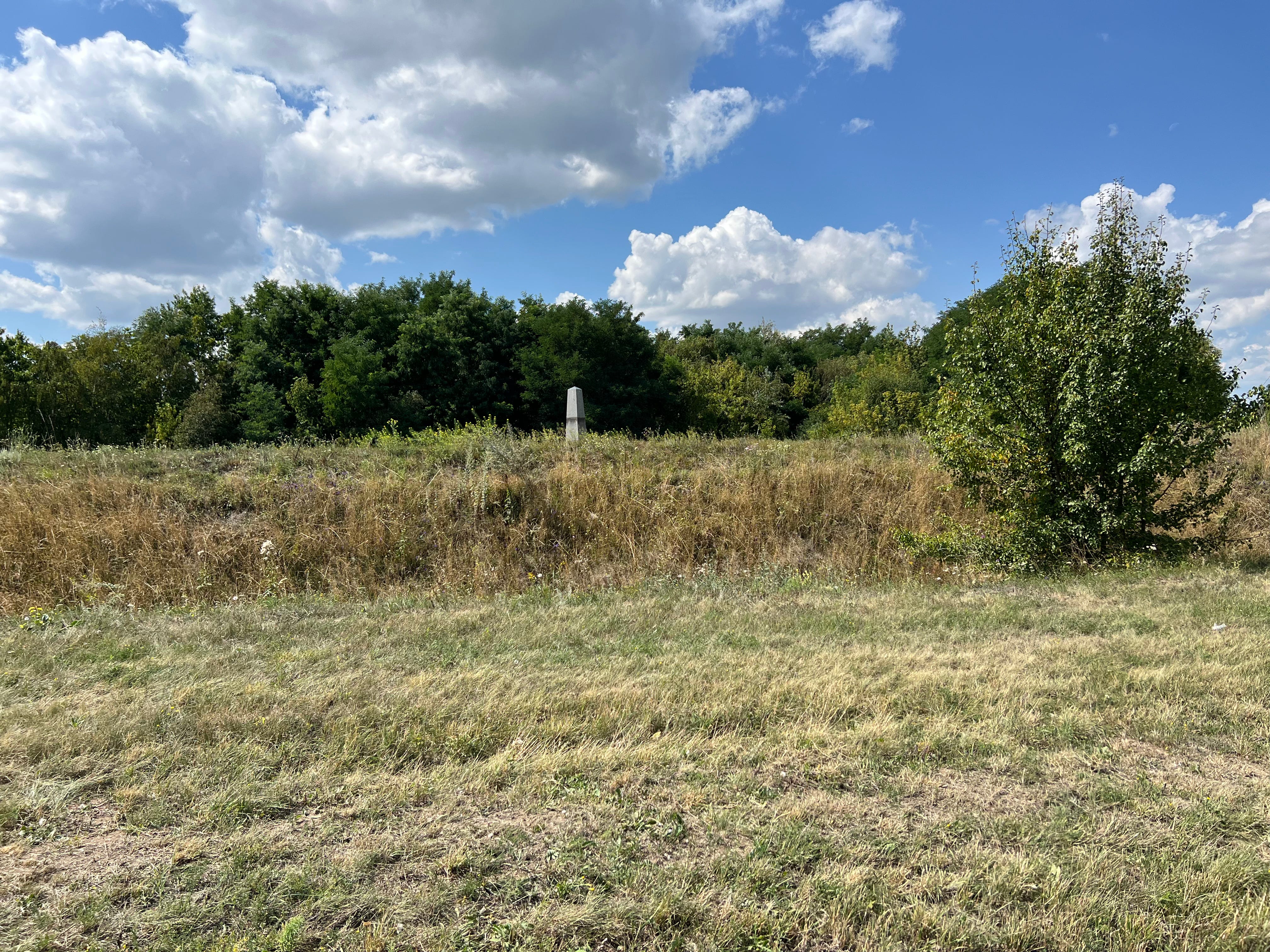
In 1709, this field was the site of one of the most consequential battles in European history. Peter the Great’s army defeated the forces of Sweden under Charles XII, marking the rise of Russia as a major imperial power.
For Ukraine, it marked something else: the long shadow of empire extending over land that had already been contested, divided, and fought over for generations.
Back in the car, Alex took me to the Poltava Battlefield Museum, where the story is laid out in careful detail—maps, uniforms, models, timelines.
One impression from the dizzying display of maps: lords, royals, generals, and commercial interests insisting that citizens and serfs throw their bodies into various slaughters to win slightly adjusted borders or economic prizes. Ukraine is often caught in between—resisting, aligning, breaking away, and being pulled back in.
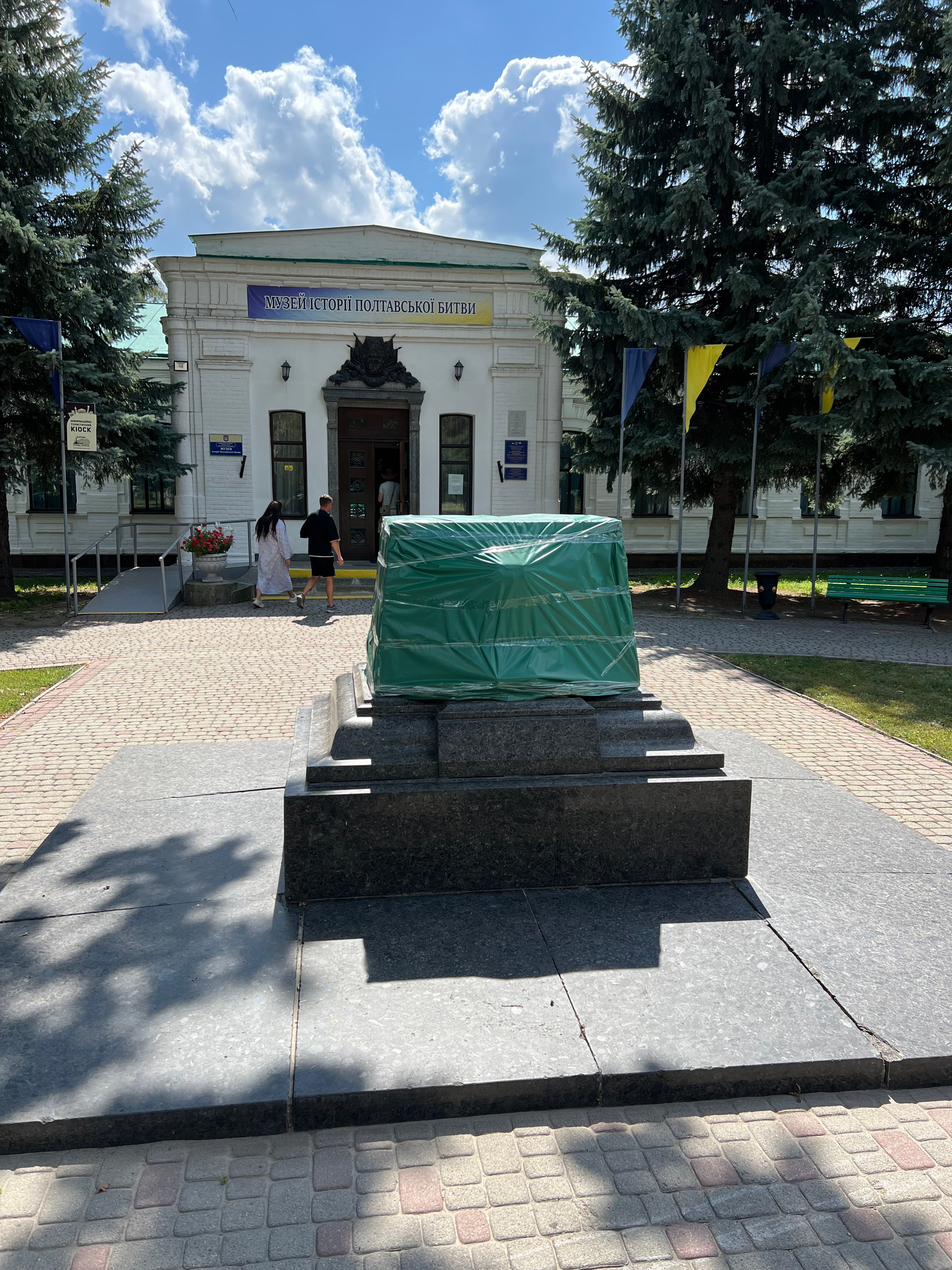
On the way out, Alex pointed out the space at the entrance where a statue of Peter the Great once stood.
It was dismantled in February 2025.
After a traditional Poltava lunch and fond farewells, I was dropped off at a restaurant overlooking the city for a meeting with local artist Margaryta Beus. I was curious how the war is affecting local children, and how art creates channels for expressions of grief, fear, depression, or hope.
Margaryta Beus on Mime, Kids, and the War’s End
Margaryta: When I was young, I often recited poems at school. I was good at it. I always wanted to be an actress, but my parents wanted me to be a lawyer. I began studying law, but my mother had been living in Paris for ten years, and one day she told me she’d found an interesting school I might want to see.
I went, and it turned out to be a mime school—a private one. The director was Ella Yaroshevich, who had been married to Marcel Marceau, the most famous mime in the world. She herself was a well-known mime artist in Paris in the 1970s and 1980s. She later founded her own school, and in 2009 I joined it.
I had just finished law school and didn’t speak French at all. Getting a visa was unusual because normally you’re required to speak the language, but I convinced the officer that mime was about movement, not words. At first it was difficult, but I learned French from friends who spoke English. Within about a year and a half, I could communicate fairly well.
Brian: The good thing about mime is you don’t have to talk much—unlike acting in Brecht’s theater in Paris, where you have to learn every line.
Margaryta: Exactly. In my second year, I became the best student in the school, and my director invited me to stay on and teach others. I did for a few months, but then my fiancé came to Paris, proposed to me, and I returned to Poltava.
Brian: How do you describe mime as an art form?
Margaryta: At first I thought it was simply acting without words. But it’s much more than that. It’s about creating your own world through movement. My teacher’s method was unique because she integrated ballet and dance techniques into mime. You use your entire body—your movements, face, and expressions—to create an imaginary world. It’s like a symphony of movement.
Brian: And when you thought about it as a career, were there limitations in Ukraine?
Margaryta: Yes. In Ukraine, mime is essentially dead. Maybe if I had started promoting it on social media five years ago, I could have built something, but I was fully involved in my work. When I came back, I tried offering classes, but no one was interested.
Mime is popular in France, South Korea, and the U.S., but not here. So I asked myself what I could do and began performing at weddings and children’s parties—first welcoming guests, then doing bubble shows, and eventually full performances for kids. That grew into a business.
Brian: Tell me about your business.
Margaryta: Our company organizes children’s parties, festivals, and events. We have our own costumes—characters like Elsa, Olaf, and Aladdin—and shows such as bubble shows, science shows, and paper shows.
We host events across Poltava—at clients’ homes, schools, and gardens—and before COVID, we traveled all over Ukraine: Odesa, Kyiv, Kharkiv, Mykolaiv, and more.
Now, because of the war and restrictions, we mostly travel within 100–200 kilometers. We used to drive through the night, but with the current curfew from midnight to 4 a.m., that’s no longer possible. So we mainly work around Poltava.
Brian: How have children been affected by the war?
Margaryta: When you talk to kids, they seem fine. They don’t often say they’re sad or scared, but when the topic of bombs comes up, they react. That’s why my work feels important—to bring joy, to show them life goes on, and to encourage them to dream and achieve. We try to support their belief in a future.
Brian: Poltava seems relatively insulated from direct attacks. Are parents also somewhat protected from the war’s effects?
Margaryta: Yes, we’re lucky. There isn’t much bombing here, and people don’t hear explosions every day. So they’re not as depressed as in other places.
When planning parties, they don’t say, “If everything’s okay, maybe we’ll do it.” They plan normally. Sometimes someone says, “My husband died at the front—could you do something free for the children?” and of course we say yes. But overall, life continues.
Brian: What’s the general feeling in Poltava about how people want the war to end—both realistically and satisfactorily?
Margaryta: I sensed the war was coming. I had a feeling. A friend in Poland and I talked about it a lot before February 2022. Even now, I don’t have clear answers.
Brian: That’s an honest response. Many Ukrainians I speak with say the same thing—not slogans, but thoughtful realism.
Margaryta: Some people say, “We’re going to win,” but I think that’s a bit fanatical. Most people just want it to stop. I don’t want to die, and I don’t want my husband to die.
I don’t see that as betrayal—it’s just that I don’t want to die for someone else’s political game. There’s a huge political game happening, and we are small pieces in it.
Brian: Who are the players in that game?
Margaryta: I think the U.S., Germany, Poland, and Russia all have interests. At first, maybe they wanted to divide Ukraine. Then, when Ukraine resisted, they adjusted their plans.
I feel they’re all still connected somehow. Poland is already preparing for war—my friends there say men are being trained and assigned roles. Something larger may be developing, maybe involving all of Europe.
Brian: So you think it’s bigger than Ukraine?
Margaryta: Yes. Maybe it’s about Europe as a whole—Germany, Russia, and the U.S. included. But whatever it is, I don’t want to die for someone’s plans.
Brian: If Russia broke through and occupied Poltava, what would you do?
Margaryta: I’d run. I wouldn’t die for a flag. I don’t think it will come to that, but if it did, I’d leave.
Brian: What do you think Russia wants in Ukraine?
Margaryta: Power and territory. Historically, Russia has done this before—with Armenia and others. It’s not about slavery, but control.
And Ukraine has valuable resources—gas, minerals—especially in Poltava. So it’s not just about Russia; others have interests here too.
Brian: Some argue Russia was provoked by NATO expansion. Others say it’s pure aggression. How do you see it?
Margaryta: I’m not a political scientist, but I feel it’s not only Russia. Even Trump said he’d end the war—but he didn’t. There are always negotiations, but nothing changes.
Maybe he’s just incompetent, or maybe he’s part of something bigger. I’ve even heard conspiracy theories about Israel or Poland having plans for Ukraine. I don’t believe them, but people talk.
Brian: You mentioned that Poland once controlled parts of Ukraine.
Margaryta: Yes, and of course Poland has helped Ukrainians a lot. But it’s still possible that some people there think about reclaiming those lands.
Many believe there was a plan for the war to end in three days and for Ukraine to be divided.
I’m not angry about negotiations over territory. Historically, Ukraine’s borders have changed many times—parts of Moldova, Romania, Poland, Belarus, and Russia were once Ukrainian and vice versa. This land, as it is now, has existed for only about 60 years.
That’s not enough history for me to die for it. Maybe giving up some territory could end the war—not forever, but at least to save lives.
Brian: Some Ukrainians say they don’t want to abandon those living under occupation who don’t want to live under Russia.
Margaryta: If they truly didn’t want to stay, they could leave. Many do. Others just want peace.
I have a friend whose grandmother lives near the front line and says she doesn’t care who governs—she just wants the bombing to stop.
People in Crimea or Luhansk live okay; maybe prices are higher, but they survive. I know Ukrainians who went to Russia to avoid conscription. Some live good lives there. I don’t judge them.
I’ve even seen Russian propaganda videos promising rewards to families of fallen soldiers. It’s tragic. Propaganda is powerful there. But I don’t blame all Russians. Many protested and were arrested. Not everyone supports the war, but they live in fear.
Brian: What do you think President Zelensky should do now?
Margaryta: I’m not in his position, but if it were up to me, I would try to end the war—maybe negotiate. We lack people and resources.
Then I would focus on strengthening the army and building the economy to support defense.
I admire how countries like the U.S. and Israel cultivate respect for their soldiers. In Ukraine, that sense of gratitude is still developing. We need more communication between the government and the people.
For example, after Soviet traditions like Ded Moroz were banned, the government didn’t offer strong Ukrainian alternatives. The Ministry of Culture could invest more in national stories and heroes, but they don’t. Sometimes it feels like they don’t prioritize unity.
Brian: When you hear an air raid siren in Poltava, what do you do?
Margaryta: Nothing. We’re used to it.
The last big attack was in May or June—a bomb hit a French-owned factory. Sometimes people think the Russians target kindergartens or apartment buildings, but I believe they’re aiming for military sites and the weapons miss.
One strike destroyed a nine-story building about 300 meters from a military base. I think the target was the base, not civilians—but people still died.
Even if we had shelters, they’re not always nearby or safe. If it’s my time, it’s my time.
Everyone dies eventually.
• • •
Additional chapters and forthcoming PDF and print editions of Stop Stealing the Future can be found in the Substack series archive.