
A Visit with Gwara Media
A young newsroom learns to report a war in real time
“Stop Stealing the Future: Chronicles of the Ukrainian Resistance” is a series of interviews and field observations recorded during travels across Ukraine during the Russian invasion.
I can smell startup energy. I founded two and supported others in my Silicon Valley days and the energy is equal parts inspired, driven, and exhausted. With the sudden, destructive withdrawal of USAID funding, projects like Gwara have to scramble to make do. No startup can afford to dwell on funding catastrophes too long. And so Gwara pushes on, doing work recently noted in the Columbia Journalism Review.
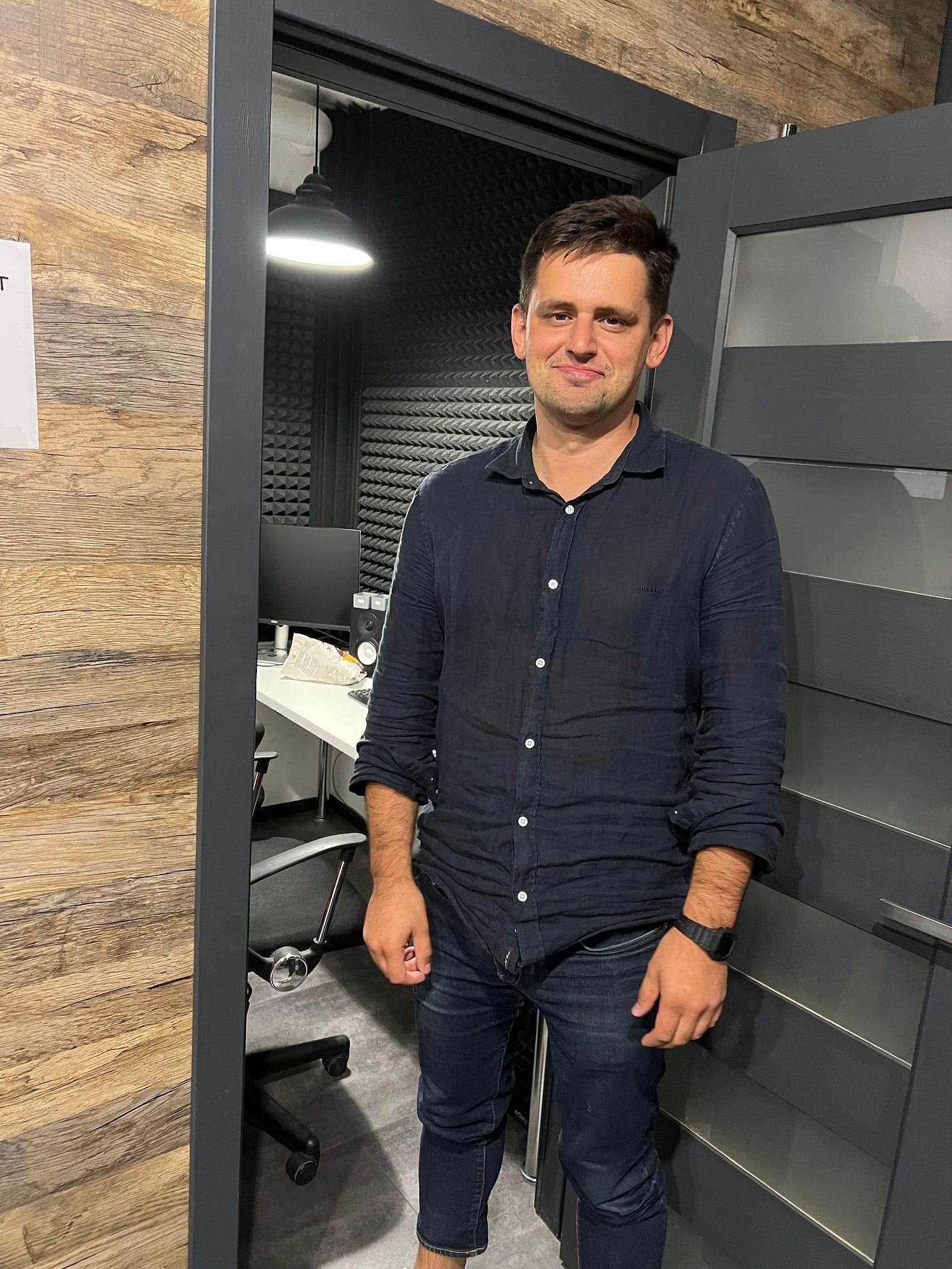
Founder and multitasking journo leader Serhii Prokopenko gives me the grand tour. The office is centered around a shared table used for both meetings and media recording. Microphones are mounted on adjustable arms, and a large circular reflector stands nearby. Cables run across the table and along the floor, connecting laptops, audio equipment, and lighting. A small recording room is lined with acoustic foam panels, containing monitors and gear. It’s a corporate office, it’s a television studio, it’s an assignment desk, it’s home to a very young staff.
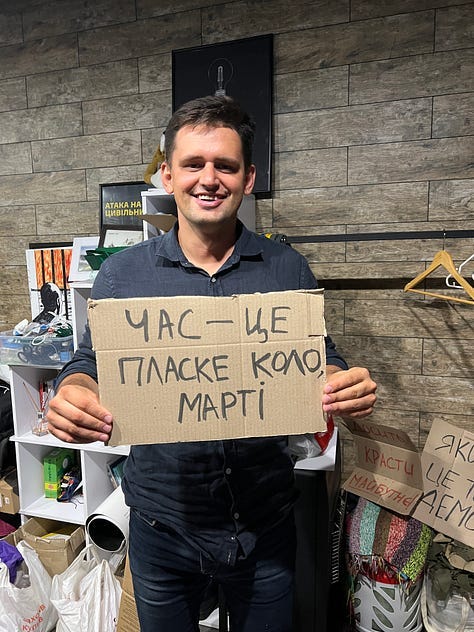
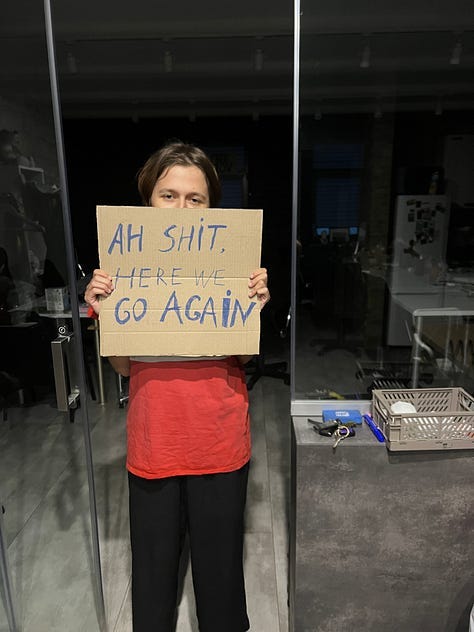
Cardboard protest signs are stacked along one side of the room and on nearby surfaces, written in Ukrainian or English. The messages range from direct political statements to cultural references and humor. “Corruption destroys development” plays off “AH SHIT, HERE WE GO AGAIN” and “WE LOVE DEMOCRACY.” And the ubiquitous “Free Azov.”
Serhii shows me a framed journalism award. We step outside.
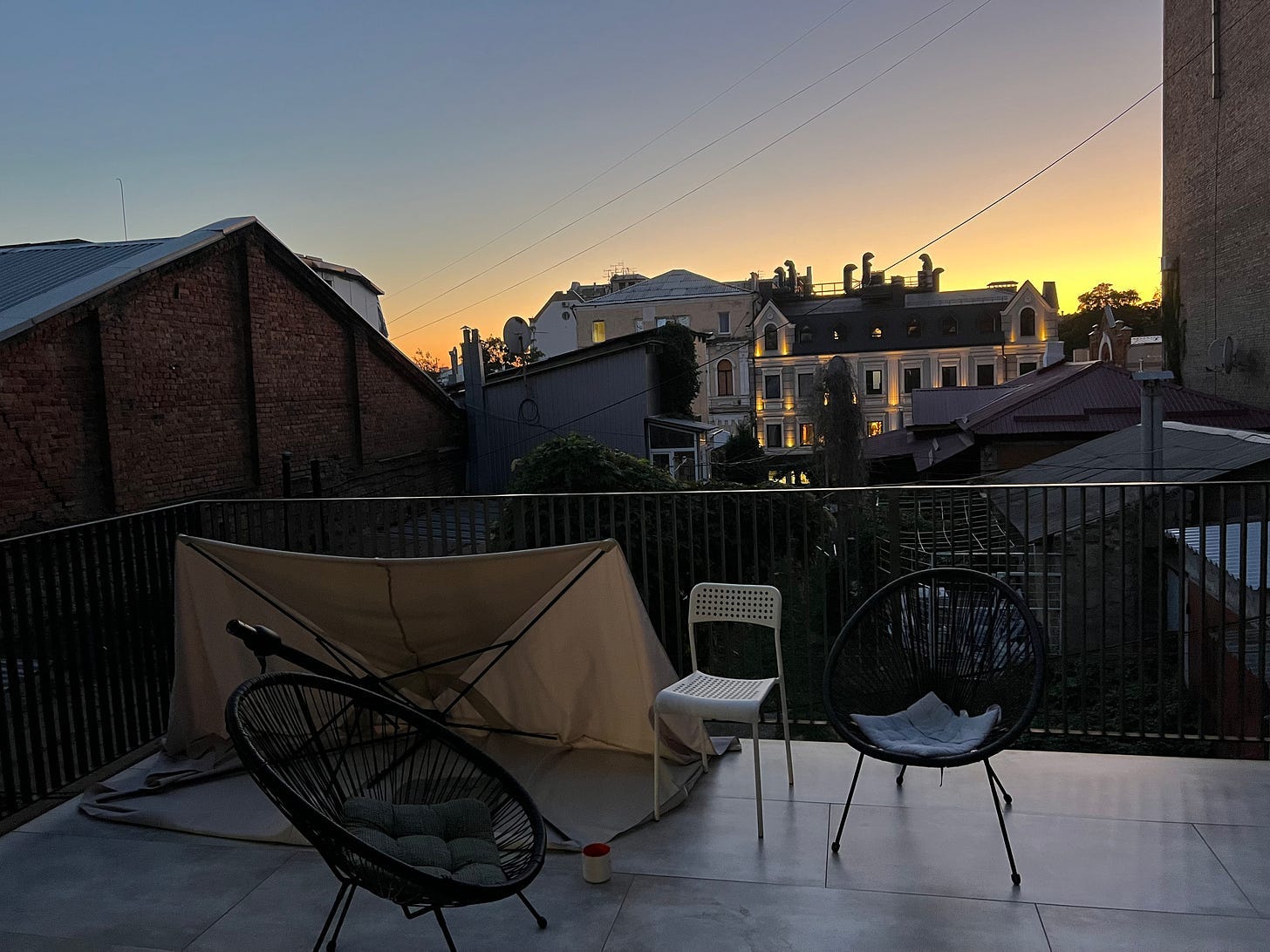
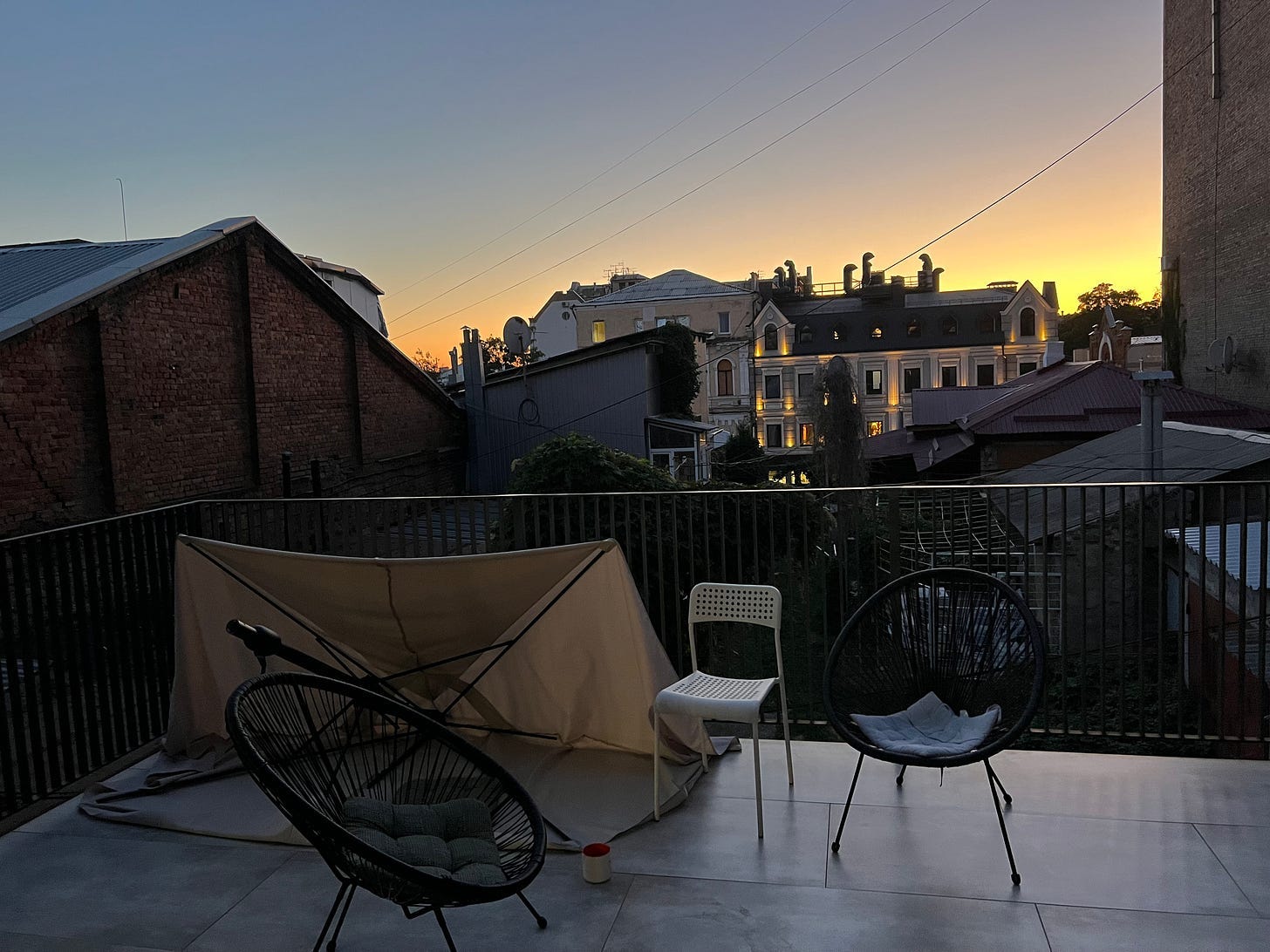
The interview takes place on a small terrace just above street level, with a view over low buildings and rooftops. The steep blue summer sky is fading into a narrow band of orange along the horizon. Streetlights begin to turn on across the neighborhood. There are a few simple chairs arranged around a small table. A folded umbrella leans against the railing. I continue to be astonished at the normal pace of daily life in Kharkiv and across the country, amidst constant air raid sirens and the threat of violence from the sky.
Gwara international editor Yana Sliemzina joins us.
Origins
Brian Gruber:
What is Gwara Media and why did you found it?
Serhii Prokopenko:
It started in 2015, just after Euromaidan. I was a participant in the protests, and Kharkiv at that time was both anti-Maidan and pro-Maidan. There was a big conflict and a lot of propaganda. People were saying things like “Bandera,” or “Nazis everywhere.” It was very distorted. I remember thinking how strange and how disconnected from reality this all was.
We were looking for a name for our newsroom, and we found the word “gwara.” It means something like dialect—local speech, local expression.
Yana:
Yes, like a dialect. A local way of speaking.
Serhii:
In western Ukraine, this word was used as a kind of cultural marker. And we thought: here in Kharkiv, we also have culture, local narratives, local language.
But the country was constantly being divided—east versus west, different identities being used against each other. So we wanted to take something that could unify.
Every community has its own language, its own narrative. We wanted media to reflect that—to become a platform that unifies different voices rather than divides them.
So we chose this word, even though it’s more associated with western Ukraine, and we brought it here, very close to Russia, as a kind of statement.
We wanted to show that Ukraine is one, even with different local identities.
That was the idea behind Gwara Media.
Journalism and the Price of Information
Brian:
How important is strong journalism to democracy in Ukraine?
Serhii:
It’s very important. I don’t want to sound banal, but during the war I really felt the value—the price—of information.
In normal life, when you scroll through TikTok, social media, or even ask something from AI, it’s all mixed together. It’s a kind of simulacra—everything blended, unclear sources, unclear reality. You don’t really know what’s happening.
But during the war, when something real happens—something terrible or something inspiring—you understand that only those who are on the ground can provide that information. All these bloggers, all these platforms—they use what journalists collect.
We collect the data. We verify it. We publish it. And I felt that very strongly—almost physically, like at the tips of my fingers. Without that, you live in emptiness. You have emptiness in social media, and you have real reporting. And that difference becomes very clear.
I don’t want to produce emptiness. I want to do something meaningful.
Yana:
For democracy, journalism is essential because it’s about truth, not just presenting different sides. If one side says it’s raining and another says it’s not, your job is not to present both views equally. Your job is to go outside and check.
That’s what journalism should be.
It’s about speaking to people who know, verifying facts, and presenting reality—even if it’s unpopular.
For example, with climate change, many scientists said it was real and urgent. Others said it wasn’t. Media often presented both sides, but that created confusion and downplayed the severity. Journalists should explain who those dissenting voices are, what their motivations are, and whether they are influenced by certain industries.
Right now, I think Western media has problems with naming things. They don’t say clearly who bombs Ukraine. They use passive voice. But we are here. We can say it directly.
We can say: this is the aggressor. This is a war crime.
And that matters.
Democracy Under Stress
Brian:
Is what’s happening with protests and anti-corruption institutions a sign of a healthy democracy or a corrupt system?
Yana:
Why only two options? It can be both.
If people hadn’t gone out to protest, anti-corruption institutions would have lost their independence completely. The government had justification—it said it was fighting Russian influence. And many officials genuinely believe that. They think it’s logical during wartime to consolidate power.
But people protested. Even during martial law. Even with curfews.
That’s important.
The government responded—not perfectly, but things became less worse. I’m not saying they became better. But it shows that civil society still exists and still functions.
If people can go out and say, “No, this is where we stop,” then there is hope.
Disinformation as Industry
Brian:
Why is Russia so effective at disinformation?
Serhii:
Because they do it at an industrial level.
It’s systematic.
They have troll factories. They have infrastructure. They invest money globally. They don’t limit themselves by values or truth. They use money from resources and invest it into propaganda. The main problem is that fighting disinformation is not industrial. It’s fragmented. It’s often volunteer-based.
Even strong organizations are small compared to the scale of propaganda.
Yana:
And propaganda is very effective because it amplifies existing tensions. It doesn’t create divisions—it finds them and pushes on them. Economic dissatisfaction, identity issues, social tensions—it uses all of that.
And there are many people involved—hundreds, maybe more.
So it becomes very efficient.
Fact-Checking as Resistance
Brian:
You emphasize fact-checking. Why?
Serhii:
We started fact-checking in the first days of the war. We asked ourselves how to adapt journalism to this reality. We decided to create a special fact-checking branch. Because during war, the role of facts increases. We also treat it as an archive—of fakes, of disinformation—for future research. We even produced research recognized internationally.
But fact-checking is difficult. It’s not viral. It’s not attractive. People prefer speculative content. So it becomes something for enthusiasts.
Serhii pauses.
And it’s becoming harder. Artificial intelligence is now used by propagandists, and fact-checkers must also use it. We need tools to flag content, to identify risks, to work faster. But still, much of the work is manual.
And the imbalance remains.
Brian:
When Russia hits civilian buildings, is that bad targeting or intentional terror?
Yana:
Of course it’s intentional. Sometimes they hit military sites. But they also target civilians deliberately. It’s not difficult to aim a drone. You can see in videos how they hit buildings directly.
Serhii:
Sometimes there may be bad intelligence, but—
Yana:
I don’t think focusing on bad intelligence is helpful. Russia targets civilians massively. It targets military and civilian sites. There is no ambiguity about that. They also spread propaganda afterward, claiming military targets, but that’s not what we see.
Leading a Team in War
Brian:
How do you manage a team under these conditions?
Serhii:
We made many mistakes. People burned out. People broke. We had journalists covering extremely traumatic events.
One journalist came back after a year and said something important:
“No one knows how to live through this kind of war.”
We realized that physical safety is not enough. Psychological support is equally important.
Yana:
You have to communicate constantly. You have to give feedback gently. People are in fragile mental states. Sometimes you just tell someone: stop. Go rest. Even if there is more work.
Brian:
What’s the average age of your team?
Yana:
Around 27. Many are in their early 20s.
Serhii:
Older people often leave, or go to the frontline. So young people take on serious responsibility very quickly.
Brian:
How do you personally sustain yourselves doing this work?
Serhii:
It’s difficult. We didn’t know how to do this at the beginning. We are still learning.
Yana:
You develop coping mechanisms. You rely on each other. You try to create some balance. But it’s not easy.
Serhii:
This kind of work… it’s strange. The level of responsibility is very high. But the financial return is low. I was speaking with someone in tech earning much more, with far less risk. And I thought: this is very unbalanced.
Serhii pauses, then smiles slightly:
But we still choose this.
As we wrap up, Yana mentions how rare it is to step out of the constant pace of work and talk about Gwara’s vision and evolution.
Serhii adds: “I like this kind of conversation. Usually we’re just in operation mode, especially today. It’s constant—boom, boom, boom. So this was good. A really good talk.”
On the way out, Serhii offers a parting gift—my choice of the cardboard protest signs used in past demonstrations.
At first, I’m drawn to a sly bit of Ukrainian humor: the iconic line from the first season of True Detective. “ЧАС — це ПЛАСКЕ КОЛО, МАРТІ.” Time is a flat circle, Marty. I’m a fan of the series, and it’s hard to resist.
Then Serhii holds up another.
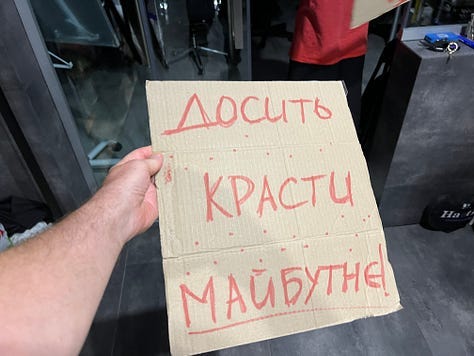
“ДОСИТЬ КРАСТИ МАЙБУТНЄ!”
Stop stealing the future.
I take that one.
It travels with me for the final week of my journey across Ukraine, tucked into my backpack.
It now sits on my bookshelf in Bangkok, where I pass it several times a day.
A declaration of independence and resistance.
Reporting a Drone Strike
Drinks with a young Gwara Media journalist
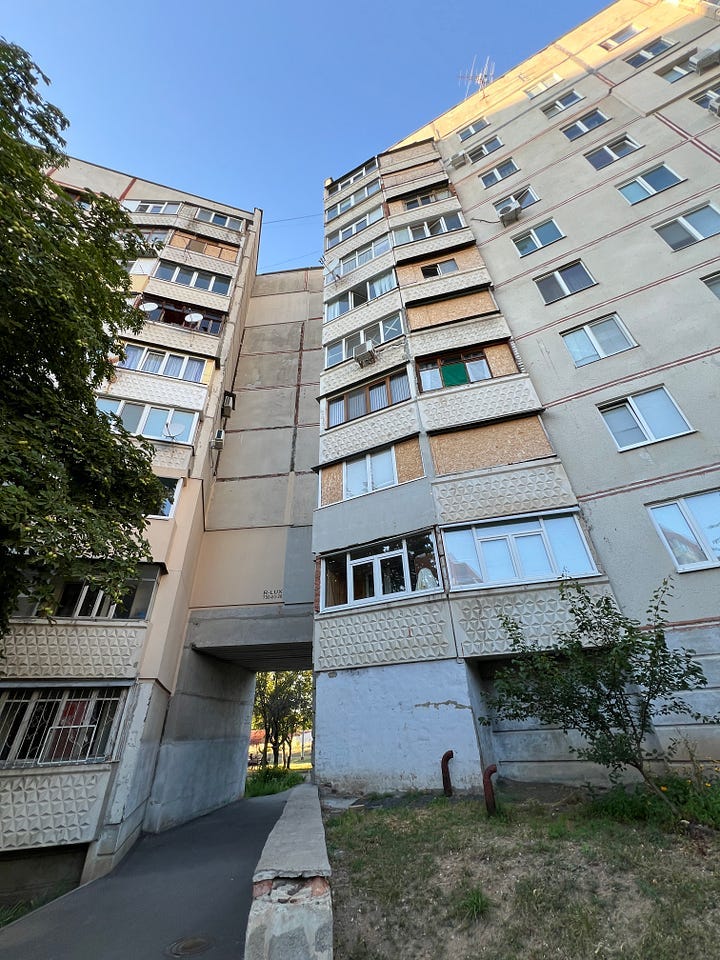
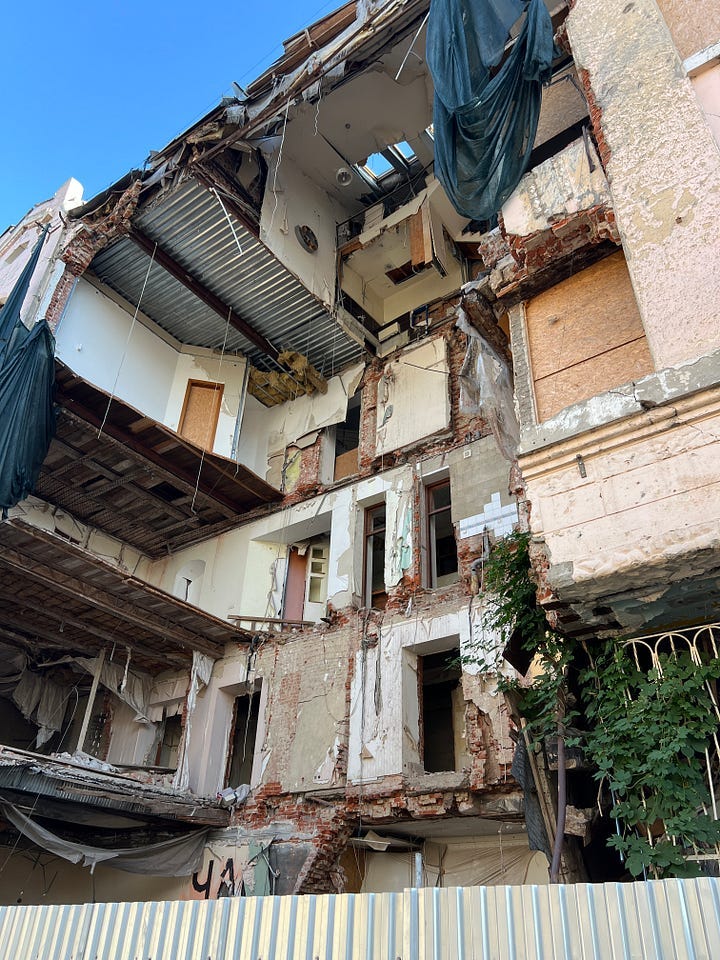
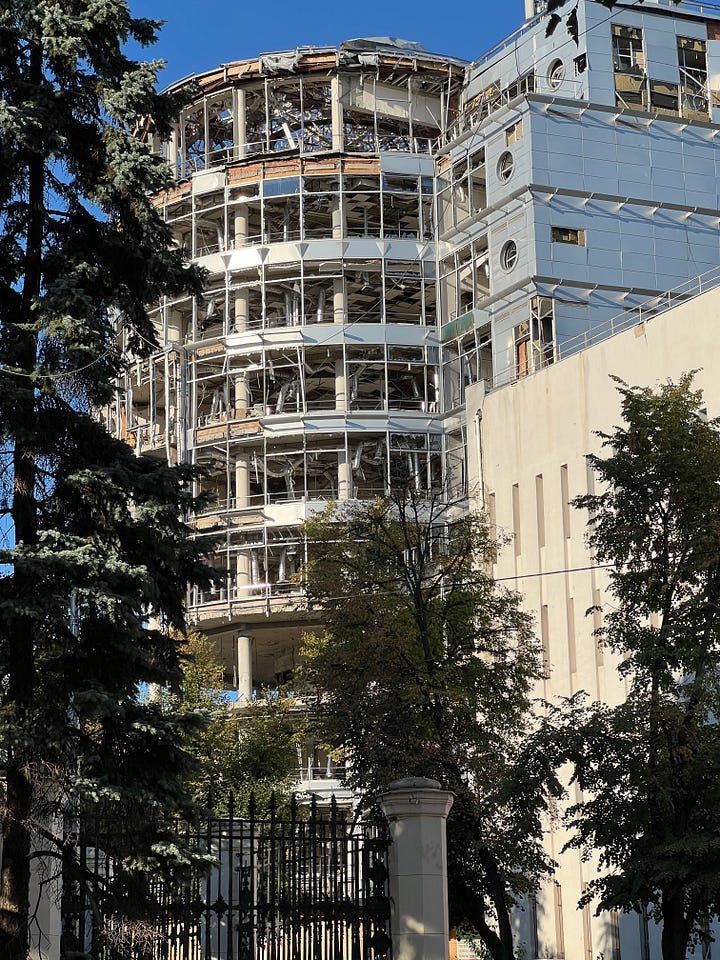
After spending time with Gwara Media’s founder and staff, I asked to speak with a reporter who was covering that day’s deadly Shahed drone strike, which killed a family of four in their apartment. I met one of their young frontline journalists at a popular local café.
Brian Gruber: Tell me what you do.
Hnat: My name is Hnat Holyk. I’m a journalist and head of the multimedia department at a local editorial outlet called Gwara Media. We operate in the Kharkiv region. I’m the producer, responsible for video reports about events in the region. We focus mainly on civilian stories in frontline villages and cities, asking people how they’re doing, how they feel about the news, and how the situation at the front is changing. We also interview military personnel about their motivation and conditions at the front. Lately, we’ve begun speaking with politicians, police, activists, and volunteers, trying to go deeper into how they work and what drives them.
Brian: Why is what you do important?
Hnat: I believe that right now, any work that helps is valuable—it depends on each person’s motivation. I started out volunteering, helping in a civilian humanitarian kitchen. Later, I switched to journalism because that’s what I studied—filmmaking. I realized I could help by documenting events. Our team is made up of professionals who taught me a lot. It’s not just about helping; it’s also about personal growth and making a larger impact on society and Ukraine’s support network.
Brian: Kharkiv is under constant threat. Air raid sirens go off all day. What’s the difference between what you can do here as a journalist and what a reporter in Belgorod, across the Russian border, could do?
Hnat: That’s a good question. Ukrainian politics and journalism work differently from Russia’s. Ukraine has corruption, yes, but the system is more pluralistic. Even though oligarchs once dominated, their competition has actually helped Ukraine endure. In Russia, there’s one central institution controlling everything. In Ukraine, multiple institutions—even corrupt ones—compete and balance each other. If we have an issue with one agency, another can sometimes help. It’s messy but transparent in its own way. Journalists can find alternate paths to information, and there’s less centralized control than in Russia. It’s closer to how checks and balances work in America, even if less efficiently.
Brian: You’re too young to have lived in Soviet times, but in your study of Ukrainian history, how far has Ukraine come from authoritarianism? What’s your report card for progress?
Hnat: I’m not a historian, but from what I’ve learned from older generations, the Soviet system rewarded some and crushed others. When the USSR collapsed, Ukraine inherited factories and industries without clear ownership. People received shares but didn’t know how to manage them, and those who understood economics took control. That’s how oligarchs emerged in the 1990s. You can’t undo that now—the game was set. But since 2014, after the Revolution of Dignity, things changed. People demanded a better country, something closer to European democracy. The journey’s been uneven, with corruption and economic crises, but there’s been progress in civic participation and accountability.
Brian: Were you involved in Euromaidan?
Hnat: I was only 12 at the time. My parents wanted to go but stayed home to protect our family. I watched it all on TV—it felt like a continuous, dramatic show. Every day brought something shocking. At the time, I didn’t understand the politics, only the violence and chaos. Later, I studied it and saw the bigger picture—why people protested, the role of right-wing groups, and how national identity shaped it all.
Brian: Tell me about your reporting. You recently covered a drone attack—what was that like?
Hnat: The attacks happened through the night, hitting one building five times. In the morning, after our daily briefing, I went to the site. By morning, several people were dead, and rescue teams were digging through rubble. I rushed there with my camera. The firefighters were just finishing their work. I filmed, took photos, and waited as more journalists arrived. It’s always hard emotionally—people grieving, waiting for news of loved ones. You don’t want to intrude, but documenting it is necessary. We know many of the emergency workers now from covering so many of these scenes.
Brian: How do you handle the emotional toll?
Hnat: During the work, emotions are off. You focus on safety and professionalism—filming, reacting quickly if there’s another strike, doing your job. The emotional part hits later, after a day or two. You start thinking about the people you saw, the lives behind the images. It’s heavy. You realize those weren’t just bodies—they were families. You question your role: asking grieving people for interviews feels cruel, but documenting the truth is essential.
Brian: Why do you keep doing it?
Hnat: Because I want to have an impact. I lost friends. My father serves in the military. I tried to enlist in 2022, but they said I was too young. I felt frustrated, so I started volunteering—building bunk beds for refugees, taking training courses. Eventually, I turned to journalism, which lets me help, earn a living, and grow. It connects me to people and gives meaning to my work.
Brian: Why do Ukrainians resist? What are they fighting for?
Hnat: It depends on the person, but mostly it’s anger—betrayal. Before the war, people here traveled to Russia freely. Many had family there. When the invasion began, Russian relatives would call saying, “Don’t worry, we’ll save you soon.” Ukrainians were shocked. They didn’t need saving. That betrayal—seeing people they loved justify the attack—fueled rage and determination. Many of my friends joined the army on their own. I didn’t stop them. We’re all adults making choices. The soldiers often tell me, “Don’t rush to join. You’re more useful as a journalist.” So I help from here.
Brian: When Kharkiv was under threat of occupation, what was life like then?
Hnat: I wasn’t in Kharkiv during the occupation—I was volunteering in Lviv. My parents evacuated my siblings, then returned home when the Russians stalled. When Kharkiv region was liberated, we went there as volunteers and later as journalists. We interviewed civilians who had stayed. Some said Russian soldiers didn’t harm them; others described looting and killings, like in Izium where around 400 people were buried in the forest. We documented all sides. Our concern now is protecting those we interviewed—both from Russian retribution if they return and from Ukrainian authorities who might suspect collaboration. Our job is to record what people experienced, truthfully.
Brian: People everywhere can grow tired of hearing about war. How do you and your editors keep your audience engaged?
Hnat: It’s hard. Locals are exhausted. You can’t shock them anymore—bombs and deaths have become routine. But we keep telling the stories, reminding them that every life lost could have been theirs. We focus on people—their strength, their humor, their survival. It’s not just about tragedy; it’s about resilience.
Brian: And what about you personally? How do you stay mentally healthy living so close to the border?
Hnat: Life has changed. I’ve learned how I react under stress. I don’t panic like I did in 2022. I focus on the job first and process emotions later. Like medics at the front, we use dark humor to cope. If you don’t laugh, you collapse. Everyone here is stressed. Air raid alerts have become background noise. I rely on Telegram channels that track incoming drones and missiles. They’re more accurate than official alerts. If I know a drone is heading for Saltivka, I don’t run to the shelter—I know it’ll take time to reach downtown. You adapt. It’s strange, but it becomes normal.
Brian: How often are there attacks now?
Hnat: They come in waves. Sometimes there’s nothing for two weeks, then several days of strikes. You never get used to it, but you adjust.
Brian: When Russians hit apartment buildings full of pensioners, what’s the purpose?
Hnat: In areas like Saltivka, those buildings were near the front early in the war. Some Ukrainian troops used abandoned apartments as defensive positions. So those high-rises became shields for the city. Civilians were evacuated when possible. It’s tragic—people lost their homes, their lives—but that’s war. Many soldiers were once civilians themselves. Now everything is mixed—there’s no clear line between soldier and civilian anymore.
Brian: What’s your view on conscription—forcing people into the army?
Hnat: I’m about to be mobilized myself. I’m 24. I haven’t been pressured, but I’ve seen friends taken suddenly. The system still works like it did in Soviet times—chaotic and sometimes abusive. Some mobilization officers are traumatized veterans who lash out. Now they’re paired with police, which makes it slightly more legal but still messy. I’m preparing myself. I don’t want to be grabbed off the street. There are legal ways to avoid service if you’re helping the country otherwise—through journalism, volunteering, or education. You just need to know your rights.
Brian: Do you think conscription is justified at all?
Hnat: It’s complicated. I’m against forced mobilization. It’s ineffective and undemocratic. But if no one volunteers, who will defend us? People should understand the risks and make an informed choice. You can serve in many ways—build drones, study, volunteer. You don’t have to run from the country. War takes lives—soldiers and civilians alike. What matters is doing something meaningful for those you love and for the country’s future.
• • •
Additional chapters and forthcoming PDF and print editions of Stop Stealing the Future can be found in the Substack series archive.