
The Choice to Fight
“Stop Stealing the Future: Chronicles of the Ukrainian Resistance” is a series of interviews and field observations recorded during travels across Ukraine during the Russian invasion.
Liam Fletcher is roughly half my age, but for a time we shared a similar life as neighbors on the Thai island of Koh Phangan—writing, beaches, a carefree expatriate rhythm.
Then Russia invaded Ukraine.
Our Russian friends Olga and Sasha went to the Polish border to help displaced families. Liam went to the front line, joining the International Legion in Ukraine’s defense.
Our first extended conversation took place while I was in Barcelona researching the Spanish Civil War for My Fabulous Fascist Summer Vacation. We spoke about George Orwell and others who chose to fight in Spain, and how that moment in history shaped decisions like Liam’s.
What follows are excerpts from four conversations, exploring his experience on the front lines and his understanding of Russia’s imperial project.
Notes From the Front Lines
Brian Gruber: Where are you as we’re speaking?
Liam Fletcher: I’m sitting outside near the central Maidan and administrative center—about to move, actually. Give me a minute and I’ll walk around the corner into a more… historical setting.
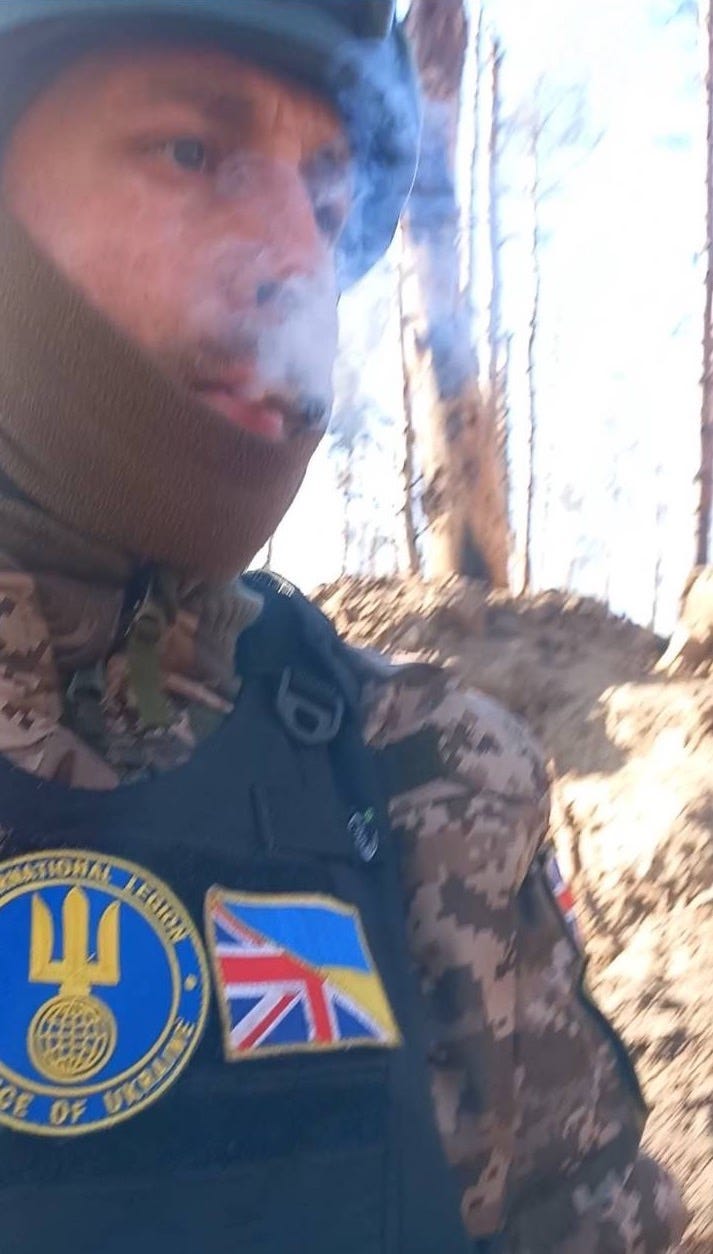
There’s a message just come through from a friend—we’re heading back to the safe house. Everything’s closing. No shops, no cafés. I’ve relocated now—I’m sat in the main maidan opposite the Slovyansk Town Hall, where all this brouhaha began. These administrative buildings were where Girkin’s first militia launched the initial seizures of Donbas territory. It happened here first, then spread to Donetsk and over into Luhansk, where my battalion is fighting now—98% Russian-occupied as of spring 2024, and the remaining sliver fiercely contested.
Curfew is imminent. It’s earlier in Donetsk, though in truth Luhansk is a battlefield in its entirety—from Borova towards Svatove and down to the Serebryansky Forest, our battleground, what Ukrainians call Lis Chudes—the Forest of Wonders—and what foreigners simply call Kreminna Forest and shudder at the name. Taxis will stop running in ten minutes or so, but I’ll sit here for a bit. Have a coffee. Contemplate things. Tell tales, and talk to you about the way the world was—and is.
Brian: Before we get into that—tell me about yourself.
Liam: I should probably begin with a disclaimer. If I ramble, it’s because I’ve had brain injuries—some before the war, and some more recently courtesy of Russian artillery and mortar fire. Diffuse axonal damage, traumatic encephalopathy, lesions and gliosis across both hemispheres, and about ten hemorrhages now. So if this goes long… blame that.
I’m 35. Ancient. Physically creaky.
I was born either in Ireland or England—born to an Irish mother, then adopted by an English Catholic family in Leeds. Arranged by the Church. But I was adopted by good people and raised by a loving mother, which makes all the difference in the world.
Arrival and Escalation
Brian: When did you go to Ukraine?
Liam: Late 2022. I started in Kharkiv doing humanitarian work—food relief, deliveries, hospitals, schools. World Central Kitchen mostly, six days a week, but I worked with a range of NGOs.
Then things escalated. Kupyansk evacuations, the Konstantynivka situation—where we retrieved medical supplies, couldn’t deliver them onward, and three days later a missile hit the market and killed twenty-six civilians. Bakhmut had fallen, the summer offensive had failed, and along the Kupyansk-Lyman axis things were deteriorating badly, especially in the Serebryansky Forest.
So in September 2023 I joined the army. Training, then the International Legion, then into the 2nd Battalion fighting in that forest—the so-called gates of the Donbas. It was some of the fiercest fighting. Foreign legions have historically been used as cannon fodder, and you expect to be thrown into the myasorubka—the meat grinder—and that’s exactly where we went.
And I’ll say this—people who laugh at the incompetence of the Russian army don’t understand what’s happening. They have overwhelming firepower. Their artillery teams are very, very good—sickeningly precise.
Time, Distance, and the Physics of War
Brian: How close are you to the front?
Liam: Close enough that time stops behaving properly. At the zero line, seconds drag and minutes vanish. You make decisions that feel like they take an age, and then you watch the footage later and it happens in a blink. Time perception becomes warped—almost unreal.
Even in Kharkiv, barely twenty-five kilometers from the Russian border, missiles come in from Belgorod. From launch to impact, you’ve got about thirty seconds. That’s the grim reality. So when people talk about air raid sirens—what are they for? What’s a babushka on the fifth floor supposed to do in thirty seconds?
There’s no time.
It lands—or it doesn’t.
And what struck me most is the calm. Nobody runs screaming. There’s a kind of serene apathy to it. They are a stoic, indomitable people.
Brian: What does that sound like?
Liam: It’s not constant, which is worse. You can sit in quiet, and then something lands with precision. That’s what unnerves you—the randomness paired with accuracy.
In the Serebryansky Forest, we’re sometimes thirty-five to seventy meters from Russian positions. That’s a few seconds running distance. There are mines and claymores between us, but at night they infiltrate—using thermal-masking ponchos, creeping right up to the trench line.
One moment it’s quiet—All Quiet on the Kreminna Front—and the next, they’re right there, fighting at close range.
You never relax.
Brian: How do you adapt to that?
Liam: Safety is as thin as a spring frost. You stop thinking in terms of safety. There is no safe—only more likely or less likely. Where you sit, when you move, how long you stay—it becomes instinctive. A kind of subconscious calculus.
Brian: You mentioned being hit.
Liam: A 120mm mortar landed essentially on me. It should have killed me. By some freak stroke of luck, I avoided the shrapnel and just took the blast wave.
Brain hemorrhages, cortical damage, ear bleeding. So now I’m just… slightly more frazzled than before.
That’s the nature of it. Sometimes you don’t die—you just carry the damage forward.
Capture, Threat, and Psychological Reality
Brian: What’s the hardest part?
Liam: The awareness—that if things go wrong, they go very wrong.
Not just death. Something worse. We’ve seen what happens when people are captured. Two Georgian comrades—close friends of someone I was with—taken. No one’s heard from them since.
You don’t need details.
And it’s not abstract. There are Telegram channels—millions of followers. They get hold of footage, identify people by face. They posted videos of me and two others—named us, wrote biographies, described what they’d do to us if captured.
Very graphic. It sharpens things. It reminds you who you’re actually facing. There’s no illusion. No romanticism.
Brian: What about the people around you?
Liam: It’s a strange mix—Georgians, Belarusians, Poles, Brazilians, Ukrainians. Different languages, different backgrounds. You end up speaking in whatever works—Russian, Ukrainian, Spanish, English.
But you end up in the same place, and that becomes its own kind of fraternity.
Different reasons, same reality.
Brian: How do you deal with losses?
Liam: There isn’t really a process. People die. People are wounded. People disappear. Often you don’t get closure. You just carry it.
Brian: Are you afraid?
Liam: Of course.
At first it’s overwhelming. Later it becomes background noise.
But you feel it differently—especially for your friends. When one of my comrades was hit by a tank—not a direct hit, thankfully—I was frantic. Fear evolves. What replaces it is clarity.
Brian: And you stay because of that clarity?
Liam: Yes. Once you see it up close, it’s very difficult to walk away. Not because of ideology. Because it’s real.
Orwell, Spain, and Moral Choice
Brian: You’ve mentioned Orwell—what’s the connection between your choice to fight here and Orwell’s choice to fight in the Spanish Civil War?
Liam: Orwell understood that history forces choices. For a culture to survive, it has to fight—even if that means dirtying yourself. Those who live by the sword may perish by the sword, but those who don’t fight die in other ways.
We’ve reached a strange point where people question whether democratic societies are worth defending at all, while ignoring the atrocities of genuinely totalitarian regimes.
Orwell saw through that.
I went to Orwell Plaza in Barcelona—I ended up tearful. Not nostalgia, but recognition.
Those volunteers were a minority—people who refused to be held hostage to history. They believed in a fraternity of ordinary people fighting back against what you might call the men of always.
Most people watched with indifference. That hasn’t changed.
Brian: So what are you fighting—fascism?
Liam: You can certainly make a case for fascism. Fascism, as its founder described it, is corporatism allied with religion.
Putin has a corporatocracy—oligarchs under his control—and like Hitler, those who don’t comply disappear. He also has the backing of the Russian Orthodox Church, which actively supports the war, framing it as something close to a holy mission.
That puts him closer to Franco or Mussolini—the original fascist model, corporatism with religious backing.
So yes, you can call it fascism.
Brian: But that’s not the whole picture?
Liam: No. Because it misses the deeper pattern. He’s not restoring the Soviet Union. He’s resurrecting something older—the Russian Empire. He’s a KGB man, historically aware, trying to restore what he sees as lost greatness. It becomes almost a religious crusade—the restoration of Mother Russia to its rightful place. This isn’t ideology in the abstract. It’s history repeating.
Brian: Explain that.
Liam: Russia has always been expansionist. Before the Soviets, you had the Tsar’s secret police—the Okhrana. Different system, same machinery. The Soviet Union collapses—chaos, oligarchy—and then a strongman takes control again.
Same pattern.
What Putin has revived is empire—territory, control, domination. That’s the through-line.
Brian: So this is about power.
Liam: Yes. People were desperate for stability after the Soviet collapse, so they accepted a strongman. It’s not unlike Germany in the 1930s—order at any price. Putin consolidates power, controls the oligarchs.
And religion reinforces it. It makes people obedient. It makes good people do wicked things and bad people do barbaric things. The Russian Orthodox Church has framed this war as a holy war.
Brian: So this war was inevitable?
Liam: In a sense. Once a strongman takes power, expansion follows. Any negotiated peace just delays the next phase. It always has—and always will.
Ukrainians understand exactly what Russian rule means—suppression of language, culture, identity. That’s why they fight. This isn’t abstract. It’s historical memory. They know if they stop, it doesn’t end. It pauses. They haven’t been softened. They still recognize an enemy and understand that survival requires resistance.
Brian: What do you hope for Ukraine?
Liam: A future where they’re left alone. Where people can live, create, breathe—without fear of missiles, of violence, of repression.
Brian: And for you?
Liam: I don’t think I’m special. I think I’m part of a small minority who didn’t sit it out. Every so often, something happens where the stakes are clear. And you decide whether to stay or leave. For now, I’ve stayed. And I intend to stay until the end, doing my part as best I can. As a friend once told me: just because it’s a cold and cruel world doesn’t mean we should stop trying to make it better.
The Doctor Is Always In
Liam spoke warmly of a Palestinian doctor named Yaser Alsaidi, who treated him after serious battlefield injuries. Liam insisted that I meet the doctor to understand another side of the city’s resistance.
We met in a café in the center of town before continuing on to Kharkiv National University.
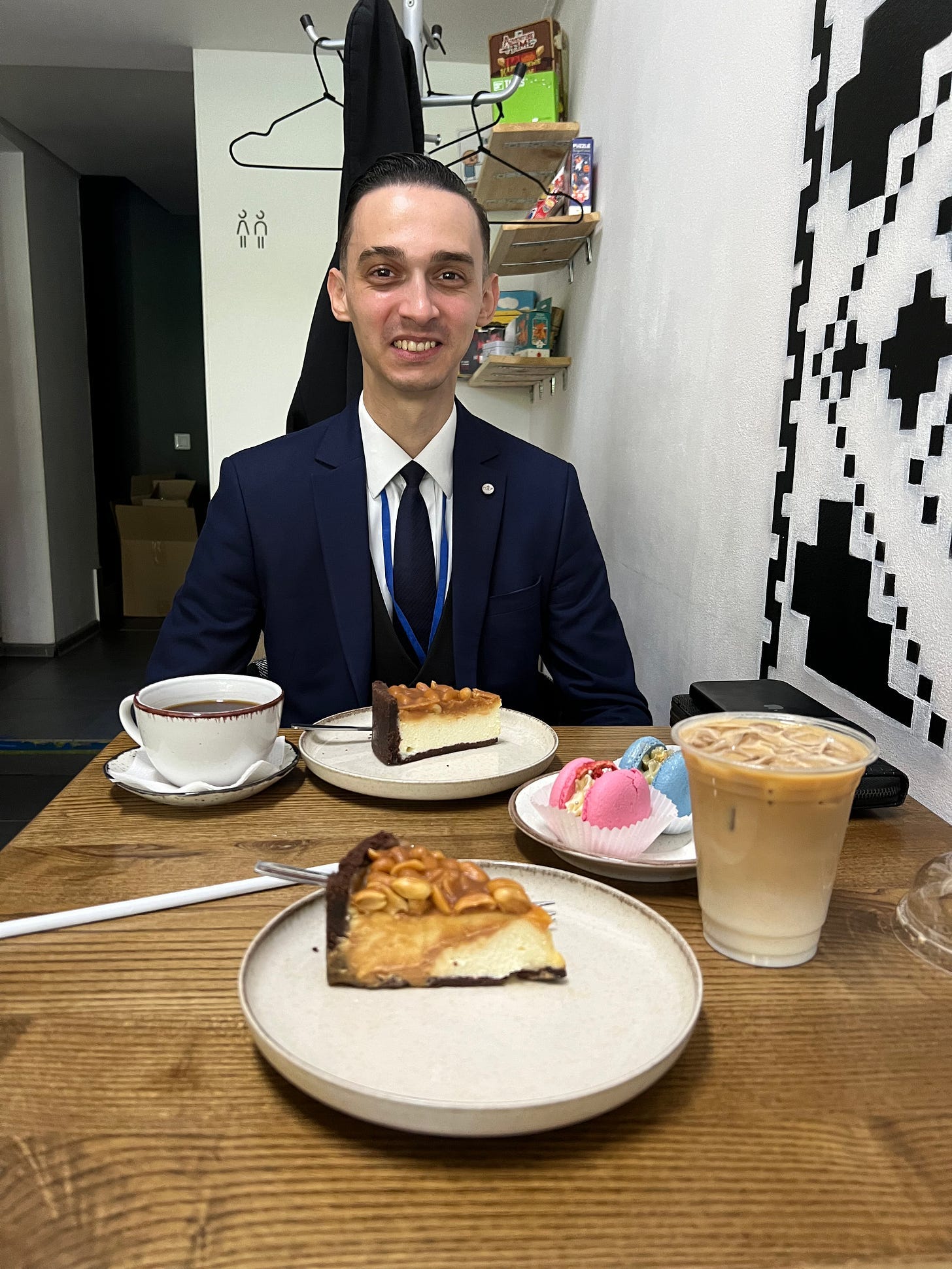
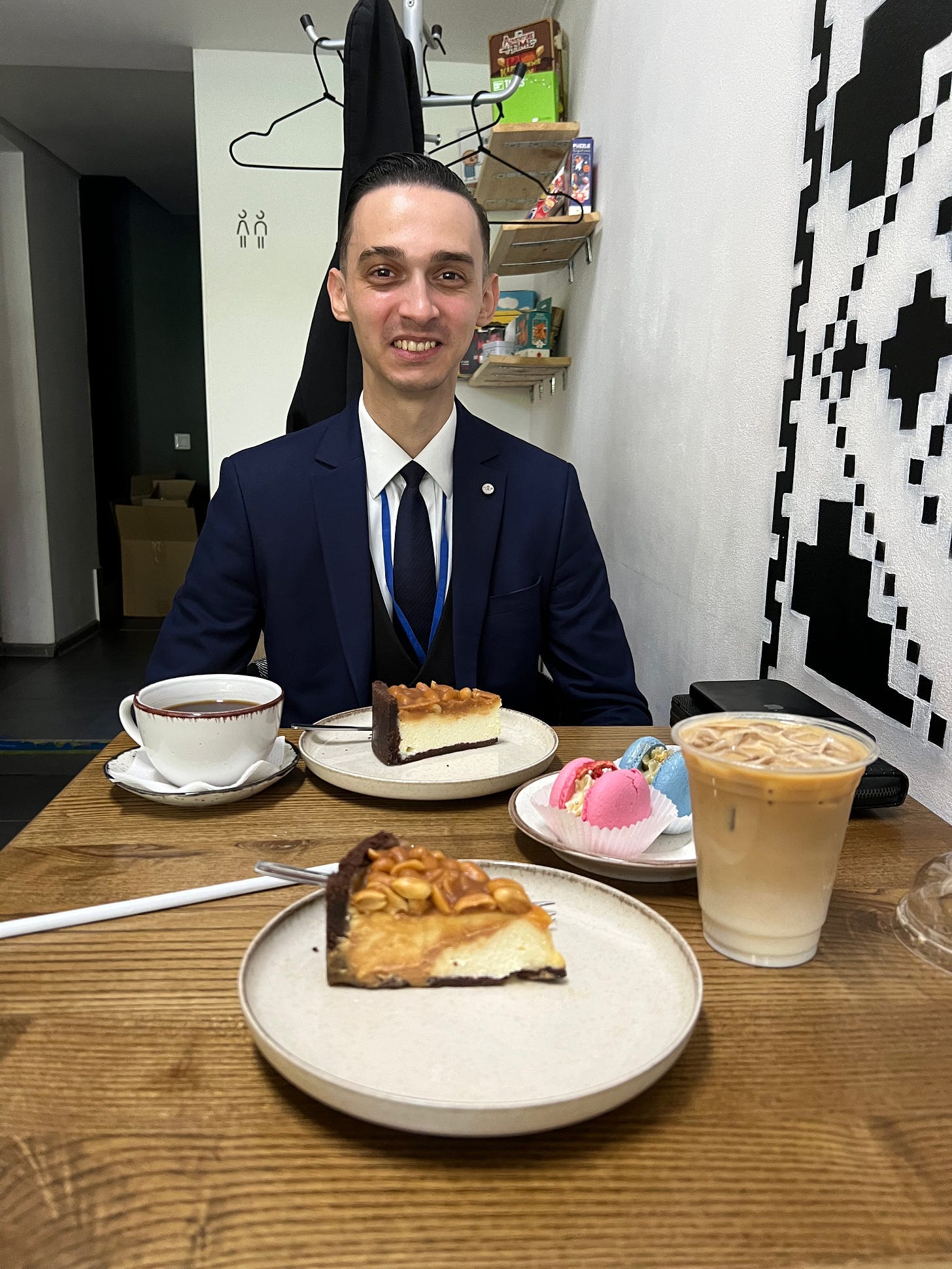
Yaser greeted me with an easy warmth and insisted I choose something from the case of brightly colored desserts. I hesitated—it’s not my usual afternoon habit—but he waved it off with a smile. His treat.
The macarons looked good. Maybe the cheesecake.
He ordered both. And one more for himself.
The sugar-caffeine surge set my heart racing. Watching him, I had the sense this routine indulgence was not unfamiliar as he moved through hospital shifts, wartime emergencies, and volunteer coordination.
He is a gentle presence—compassionate, attentive, fiercely committed to his work.
What follows are excerpts of our two encounters.
Brian Gruber: Tell me what you do.
Yaser Alsaidi: My name is Yaser Alsaidi. I’m Palestinian from Gaza and the head coordinator of foreign volunteers in Ukraine. I also work closely with many international organizations helping Ukraine — UNHCR, the Ukrainian Red Cross, the International Red Cross, and others.
Brian: What does a typical day look like for you?
Yaser: Most of my days are spent at the hospital. When I get home, I might get three hours of sleep—sometimes less. Often, I sleep at the hospital. That’s the daily reality.
Brian: Why are you committed to this work?
Yaser: Because it’s the right thing to do. It’s about being human and helping people when they need it most. In times like this, doing the right thing means helping.
Brian: When you see what’s happening in your homeland in Gaza and what’s happening in Ukraine, how does that affect your sense of the human condition in 2025?
Yaser: I feel the pain of the Ukrainian people because I’ve lived through similar suffering in Gaza. It motivates me even more to help. I know what it means to lose your home, family, everything—in a second. I don’t wish that on anyone.
Brian: How do you maintain your psychological and emotional balance when exposed to so much suffering?
Yaser: Believing that I’m doing this to help people eases the pain. It’s dangerous work—we could die at any moment. But knowing we’re helping gives meaning and strength.
Brian: You live and work a short drive from the border. Why did Russia invade Ukraine? What do they want?
Yaser: They claim they’re protecting Russian speakers in eastern Ukraine. That’s nonsense. You don’t protect someone by killing them. Those areas are destroyed. This invasion isn’t logical—if you’re “protecting,” you don’t wipe out the people you say you’re protecting.
Double Standards
Brian: When we entered the university, you mentioned it was founded in the 1700s, under Imperial Russia. Kharkiv has been part of the czarist empire, the Soviet Union, and now independent Ukraine. What’s similar in the mindset of those three systems?
Yaser: From Putin’s point of view, the Soviet Union never ended. He believes there’s no world without Russia and wants to rebuild that empire. Ukraine is only the beginning. If the world doesn’t stop him, he’ll move on to other countries. Stopping him here protects all of Europe.
Brian: Is there a lesson that connects what’s happening in Gaza and Ukraine?
Yaser: Yes—the double standards of the international community. It’s unacceptable that bombing civilians is condemned in one place and tolerated in another. What’s happening in Ukraine and Gaza are both massacres, genocides, and war crimes. International law should apply equally to everyone.
Brian: You came to Ukraine 13 years ago. What brought you here?
Yaser: I came to study medicine. I graduated from Karazin University with honors in general medicine and later specialized in neurosurgery. Ukraine supported me from the start; it became my home.
Brian: You’ve lived in Kharkiv for many years. How do people here manage to live normal lives under war?
Yaser: Ukrainians have an incredible capacity for resilience. But psychologically, adapting to war isn’t normal. I don’t wish it on anyone. People try to live their lives, but we all want real peace and normal life back.
Brian: When air raid sirens go off and no one reacts, what does that say about adaptation?
Yaser: People have gotten used to it. In Kharkiv, alarms sound every few minutes. Often, the bomb hits before the siren even finishes. People know if it’s your turn to be hit, you won’t even hear the alarm. So it becomes background noise.
Brian: How frequent are those sirens compared to western cities?
Yaser: In Kharkiv, more than 20 times a day. Sometimes an alarm lasts for hours. Because Kharkiv is so close to the border, every missile heading west passes over us. It’s constant.
Brian: Yesterday there were five Shahid drones striking a residential building and killing a family. Why target civilians?
Yaser: It’s psychological warfare—to create fear and force people to flee. Over 90% of attacks target civilians. When five Shahids hit one apartment building, killing children and families, that’s not a mistake. It’s terror and a war crime. Like the direct missile strike on Kyiv’s children’s hospital. Russia invents military excuses for propaganda, but the intent is to destroy lives.
Freedom and Solidarity
Brian: We have a mutual friend in the Legion, Liam Fletcher. He speaks highly of you. Many foreigners have come to Ukraine to fight. Why do they risk their lives?
Yaser: Because they believe in freedom and solidarity. They see injustice and want to help. Some donate, others volunteer, and some fight. Many are disappointed in their governments’ inaction, so they act themselves. That’s courage.
Brian: Some argue Ukraine should surrender to stop the killing. Why do Ukrainians keep fighting?
Yaser: Because it’s their homeland. You fight for your home and your freedom—not for money. No Ukrainian will accept losing Crimea or any occupied region. This war didn’t start in 2022—it started in 2014. Yet global attention fades. We need steady, real support until victory.
Brian: Some leaders have nominated Donald Trump for the Nobel Peace Prize. What do you think?
Yaser: Peace isn’t about words; it’s about results. If he deserves that prize, we need to see real action—peace, not promises. For Ukraine, peace means full freedom and restoration of its territory.
Brian: How can that happen? Russia has a massive army and no limits.
Yaser: That’s why international support is essential—not only words but real action. Russia is backed by other authoritarian countries, which makes things worse. To balance the scales, Ukraine needs weapons, logistics, and commitment. Words don’t stop missiles.
Life in Gaza
Brian: You lived in Gaza 13 years ago. What was life like then?
Yaser: Peaceful—but peace in Gaza never lasts. It’s always interrupted by conflict. One moment life is calm, the next you hear bombs. That’s normal there.
Brian: Is there a path to peace?
Yaser: The conflict’s been going for 75 years. Peace will only come when freedom comes—like in Ukraine. There must at least be a ceasefire and humanitarian aid—food, medicine, evacuation of patients. Otherwise, the suffering will deepen.
Brian: With so much destruction and settlement expansion, is a two-state solution still realistic?
Yaser: Even the idea of a two-state solution is broken. Israel’s occupation keeps expanding—taking more land, more lives. If they truly wanted peace, they’d stop. Many people around the world, including Jewish communities, now see the truth and support Palestine. Despite misinformation, the truth always emerges.
• • •
Additional chapters and forthcoming PDF and print editions of Stop Stealing the Future can be found in the Substack series archive.