
Congratulations to Spain on its World Cup win. As Donald Trump and J.D. Vance have allocated millions of U.S. taxpayers dollars to support far-right and neo-fascist political parties in Europe, the story of the Spanish Civil War and the rise of Franco remain relevant markers for the growing authoritarian streak in U.S. politics.
This week, the new second edition of My Fabulous Fascist Summer Vacation will be released with new material and a book-length sequel covering my trip to Ukraine, Stop Stealing the Future: Chronicles of the Ukrainian Resistance. Here is my 2024 interview with Hochschild, warning of what was to come if Trump was re-elected.
Adam Hochschild
The Global Battleground
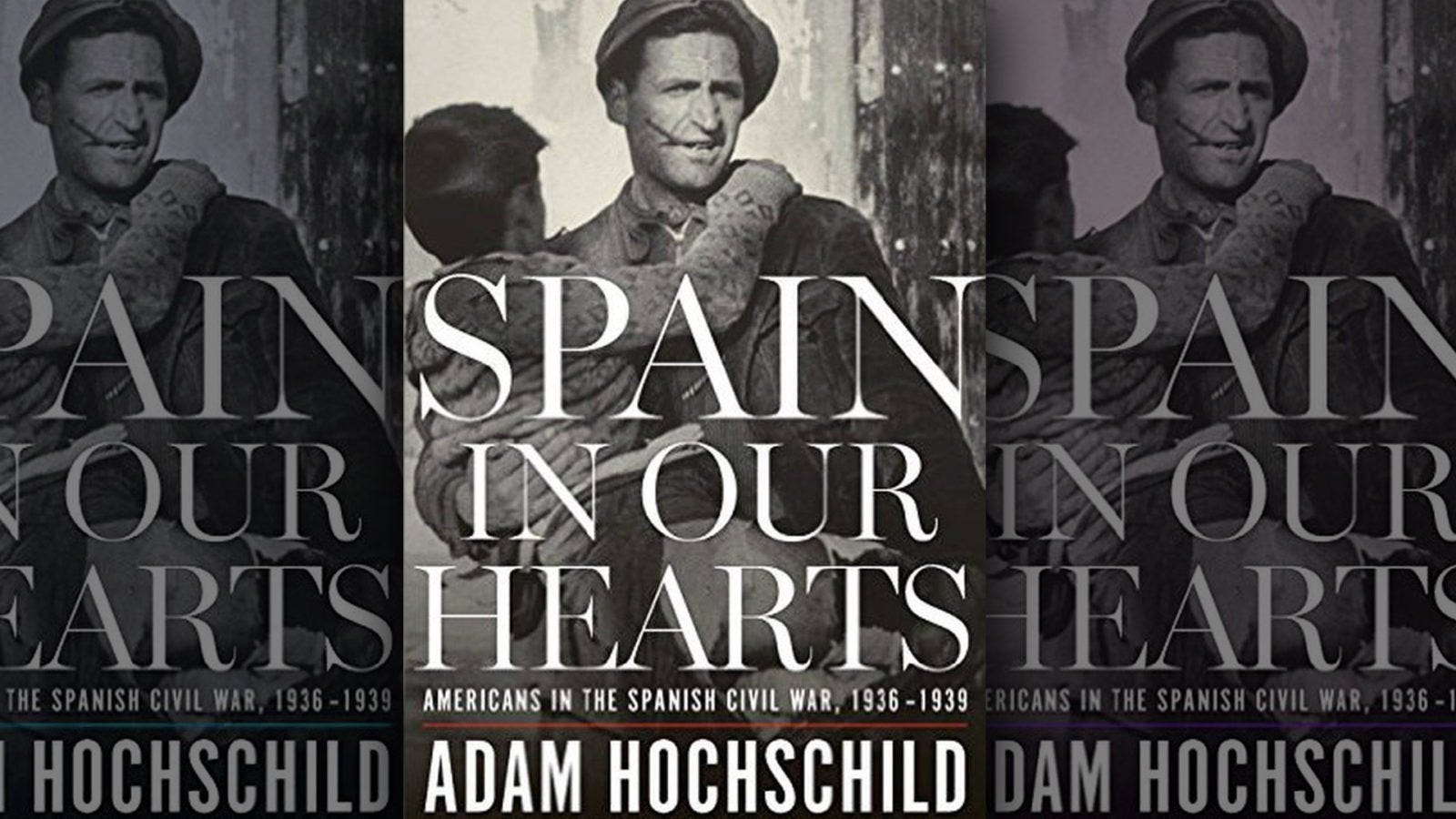
Adam Hochschild is the author of eleven books. My world view was dramatically altered a quarter century ago by my reading of his King Leopold’s Ghost: A Story of Greed, Terror and Heroism in Colonial Africa. He is the author of Spain in Our Hearts: Americans in the Spanish Civil War, 1936-1939, published in 2016. In his storied career, he also served as a reporter for the San Francisco Chronicle, a commentator on National Public Radio’s All Things Considered, and a co-founder, editor, and writer at Mother Jones magazine. He has received the Theodore Roosevelt-Woodrow Wilson Award from the American Historical Association and was elected a fellow of the American Academy of Arts and Sciences.
BG: You spent a lot of time in the book covering the international brigades, especially the U.S. brigades and Orwell. What were they all resisting? Yes, Franco and the Nationalist army, but what idea were they resisting, what was their political fight?
AH: I think Lincoln volunteer Maury Colow, whom I quote in my book, said it best: “For us it wasn’t Franco. It was always Hitler.” Millions of people all over the world were worried about the spread of fascism. But only in Spain was there a place where you could volunteer to go and fight against it.
BG: What is fascism? And in what way does Franco qualify?
AH: Historians differ about this. Many don’t call Franco – or Salazar, in Portugal – fascist. After all, the Spanish fascist party was only one of several groups Franco welded together into his movement. But certainly Franco’s regime, like Mussolini’s and Hitler’s, was a dictatorship – and a ruthless, authoritarian one. Unlike Mussolini and Hitler, though, his regime was tightly entwined with the Catholic Church, whose hierarchy in Spain had long been deeply right-wing.
BG: Part of the story of those times and certainly part of Orwell’s story was of the various leftist factions. In Spain in our Hearts, you talk about the predominance of communists among the Americans who went over, and you wrote, ‘We cannot understand them without understanding why communism then had such a powerful appeal’. Americans think of communism in its Marxist-Leninist, Soviet/ Maoist incarnations. What did communism mean to those boys who went over to fight?
AH: To them, I think, the Communist Party was a group that militantly supported labor, and that was bold enough (after getting the OK from Stalin) to organize volunteers from all over the world to go fight in Spain. No one else was doing something for Spain on that scale. The Soviet Union seemed far away, and with few exceptions (several of whom figure in my book), few Americans who went to Spain had ever been to the USSR or had much idea of what was really going on there.
BG: More than 6,000 clergy were murdered by Republic supporters. How important was the participation of the Spanish (Catholic) Church in justifying both colonial and pre-Republic oppression, and what accounts for the rage that led to so many killings?
AH: The Catholic Church in Spain was seen by almost everyone as an integral part of the existing power structure, closely allied with big business, the big rural landowners, and the colonial regime in North Africa. It was deeply hostile to labor unions and the left, and so clergy became a target when those tensions in Spain boiled up into civil war.
BG: Americans today do not have the grievances that Germans had post-WWI or the economic and political challenges faced by Italians when they embraced Mussolini. What is the appeal of authoritarians in the U.S, and how do you account for the continued appeal of Donald Trump?
AH: That’s a big one! But I do think that one similarity between many Trump enthusiasts and the groups that embraced fascism in Europe in the ‘30s is that they feel left behind. They tend to disproportionately come from smaller towns and rural areas that have not shared in the tech boom, or that had industries that have lost jobs, like coal mining. And they’re on the losing end, very often, of the huge and growing income disparities in the U.S. And then along comes a savior who says, “I can tell you who to blame.”
BG: In ‘Exterminate All the Brutes’, Sven Lindqvist suggests (the phrase comes from Joseph Conrad’s Heart of Darkness about the Belgian rape of the Congo, subject of Hochschild’s King Leopold’s Ghost) that years of colonial brutality laid the moral foundation for, desensitized cultures to, brutality on the European continent. Do you agree with that notion?
AH: I think there’s some truth in what he says. But human beings in so many different societies at so many different times have shown the capacity to be incredibly cruel to each other. So I’m wary of blaming it all on one source. There was warfare and slavery in Africa, for example, before the Europeans got there.
BG: You describe in your book past fascist movements in the U.S, such as the 20,000 who joined the Order of the Black Shirts, the American Fascisti. Is some uniquely American flavor of fascism a longstanding trend or tradition in the country’s politics?
AH: I think it’s amazing that we didn’t have a strong fascist movement in the U.S. in the 1930s. I ascribe that at least in part to Franklin D. Roosevelt. But we certainly have a long tradition of somewhat similar things—the Klan, for example.
BG: Back to November! What would you expect in a second Trump term?
AH: Much trouble. It will be far worse than the first term. He’ll appoint more extreme people at all levels. The Heritage Foundation is already drawing up lists for him. And he has a more powerful motive than ever for wanting to stay in power, because otherwise he’s got several cases against him that may send him to jail.
BG: Spanish fighters against fascism declared, ‘No Pasaran’. What should American lovers of liberal democracy be declaring or doing between now and November?
AH: They should be out there knocking on doors, raising money, writing letters, doing everything possible to make people feel the urgency of what we’re up against.