
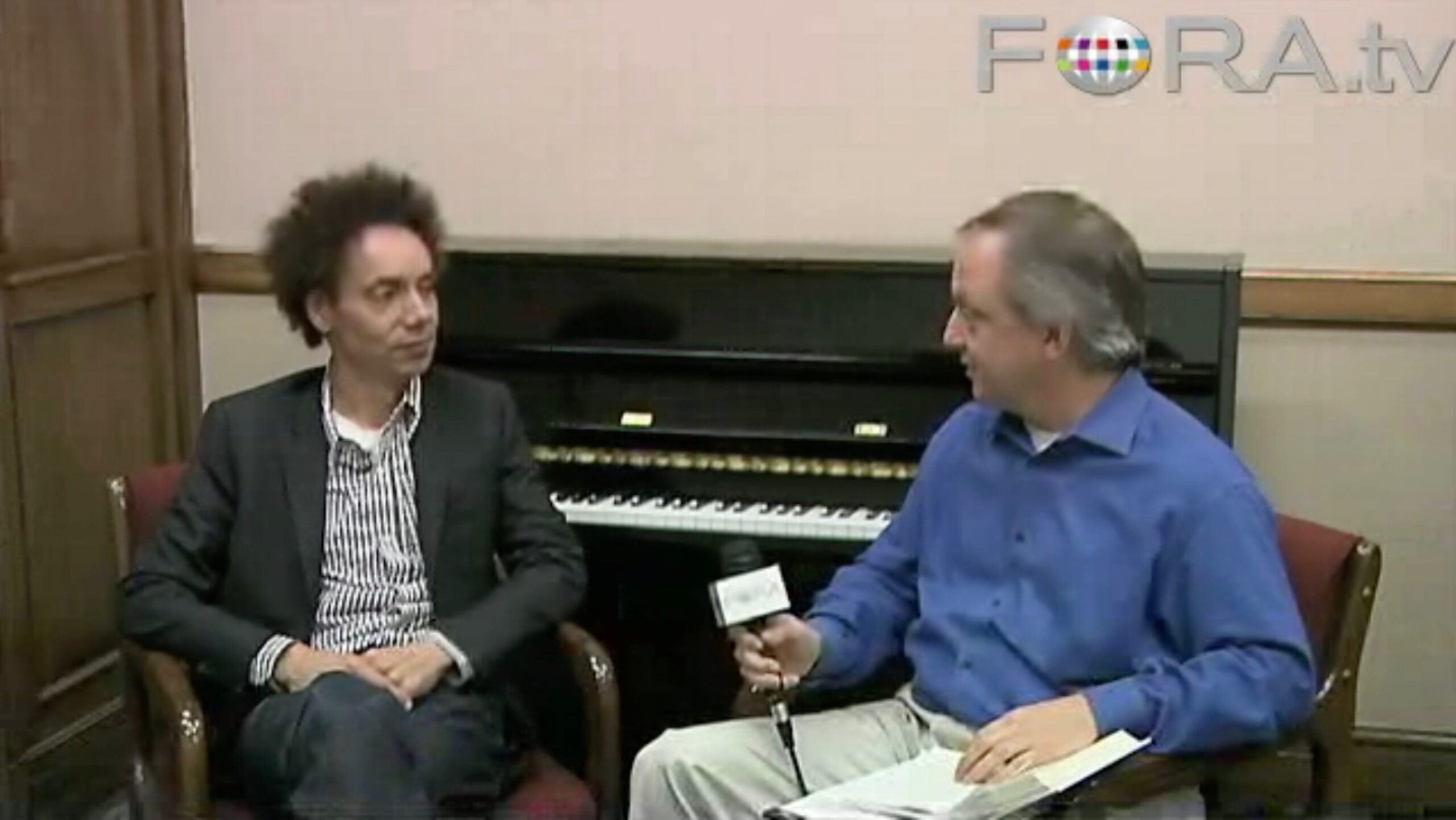
I mentioned my Malcolm Gladwell interview in a recent Substack post paying respects to Robert Thurman. I interviewed both men backstage at San Francisco’s City Arts & Lectures for FORA.tv, the public affairs media startup I founded. We webcast City Arts events for the first time in the organization’s history, bringing conversations with leading thinkers and authors to a global audience.
Several readers asked me to repost the Gladwell interview, so here it is.
In January 2009, just days before Barack Obama’s inauguration, I talked backstage with Gladwell before his City Arts appearance.
Gladwell had already become one of the most influential nonfiction writers of his generation through The Tipping Point and Blink. His newest book, Outliers, explored a deceptively simple question: Why do some people succeed?
Success, he argued, is not simply the product of talent and hard work. Timing, culture, opportunity, family circumstances, and luck often play a larger role than we care to admit.
The video below includes a brief excerpt from Gladwell’s onstage appearance followed by my backstage interview. A lightly edited transcript of our conversation follows.
Brian Gruber: Malcolm Gladwell, on the very last page of Outliers, you write that “the outlier, in the end, is not an outlier at all.” Why is that?
Malcolm Gladwell: Once you understand the full range of factors that contribute to success, and how much of the roots of success lie outside the individual—in generation, culture, circumstance, and good fortune—you’re much less inclined to think of highly successful people as outliers, as somehow existing outside ordinary experience.
This book is really an attempt to demystify the exceptional person and puncture the balloon we carry around in our heads about people who achieve extraordinary things.
Brian Gruber: You have three books with very different themes. How do you develop ideas for your books? Is it the same process you use for a New Yorker story?
Malcolm Gladwell: It’s all the same.
I wish I could say there was a system, but there isn’t. It’s mostly random.
Obviously, a book requires more material than a magazine article, but the process is similar. It’s just me wandering around hunting for truffles, following my nose until I find enough interesting things that seem to fit together in a narrative.
Brian Gruber: There’s a very poignant and somewhat surprising final chapter that’s personal and intimate. You begin it by writing, “My great-great-great-grandmother was bought at Alligator Pond.”
Why build the conclusion of a book about successful athletes, entrepreneurs, and high achievers around such a personal family story?
Malcolm Gladwell: I wrote the first part of the book and then realized it lacked a conclusion.
When I thought about my own life, I realized there was a wonderful example of what I had been talking about throughout the book, and that was my mother’s story. As I looked into it more closely, I realized it illustrated many of the book’s themes perfectly.
I spend a great deal of time thinking about structure. The structure of Outliers moves from the extraordinary to the ordinary, and from the impersonal to the personal. We begin with the Beatles and Bill Gates and elite athletes and people with extraordinary IQs. We end with little girls in the South Bronx and my grandmother.
I wanted to bring the story back to ordinary people. It seemed appropriate to conclude with what is, in the best sense of the word, an ordinary story—my mother’s story and her family’s story.
Brian Gruber: We’re speaking at the Herbst Theatre just days before Inauguration Day. By the time this interview appears, Barack Obama will likely be President of the United States. Is Barack Obama an outlier?
Malcolm Gladwell: Of course he is.
He’s about as outlier-ish as outliers get. Five or six years ago, almost nobody knew who he was. Now he’s the most powerful man in the world. It would be fascinating to write a chapter about him and all the factors that contributed to his rise outside of his own extraordinary intelligence, talent, and personality. I think he fits very much within the themes of this book.
Brian Gruber: In that same final chapter, you write:
“In the American South during that period, it would have been highly unusual for a white landowner to have such a public relationship with a slave. Sexual relations between whites and blacks were considered morally repugnant. Laws prohibiting miscegenation remained on the books until 1967.”
That was within my lifetime.
Given the stories you’ve heard within your own family about race and the role it played in the lives of your ancestors, what was your reaction to Obama’s nomination and impending inauguration?
Malcolm Gladwell: For me—and for millions of other people—it was an extraordinary moment. A lot of my faith in this country had been tested in recent years, and suddenly something remarkable happened.
Over Christmas I was in Jamaica, where my mother is from. We went to rent a car at a small independent rental agency in the middle of nowhere. I walked in and saw a large photograph of Barack Obama hanging on the wall. I jokingly asked the woman behind the counter, “Do you always put a picture of the American president on your wall?”
She looked at me very seriously and said, “We’ve never done it before.”
That was a marvelous moment. It captured the sense that America had suddenly captured the imagination of people far beyond its borders through its choice of leader.
Brian Gruber: You’re an author, but you’re also part of the magazine world through your work at The New Yorker. I recently interviewed Louis Rossetto, founder of Wired, who predicted that within five years The New York Times would effectively cease to exist in its current form. What do you think about the future of journalism and the magazine business?
Malcolm Gladwell: I’m probably not as pessimistic as that.
The number of magazines will shrink. The number of newspapers will shrink. But take The New York Times. I don’t think anyone would dispute that The New York Times is better today than it has ever been. I don’t think anyone would dispute that it’s more important today than it has ever been. The quality of analysis organizations like that bring to the problems we face is more valuable now than it was twenty, thirty, or forty years ago. And it’s more widely read than at any point in its history.
There’s nothing wrong with the newspaper business except that it doesn’t currently make money. Now, you could argue that’s a devastating problem. But you could also say that it’s simply a question of finding a way to monetize something extraordinarily valuable. The New York Times as a global brand matters more today than it ever has. That’s not a reason for pessimism. It’s a reason for optimism. They simply need to figure out how to charge appropriately for what they produce.
Brian Gruber: Are there any projects you’re working on now—either a book or a magazine piece—that readers should watch for?
Malcolm Gladwell: My next piece for The New Yorker will be out in a couple of weeks.
It’s an attack on To Kill a Mockingbird.
Brian Gruber: I look forward to reading it.
Malcolm Gladwell: Thank you.
For more on my seven books, life storytelling project, interviews, and personal history, come visit electric-memories.com. You can now read my entire collection of interviews from my travels through Ukraine here on Substack or download a free PDF at https://archive.org/details/stop-stealing-the-future-chronicles-of-the-ukrainian-resistance.