
I was saddened to learn of the death of Robert Thurman, one of the world’s most influential Buddhist scholars, teachers, and public intellectuals.
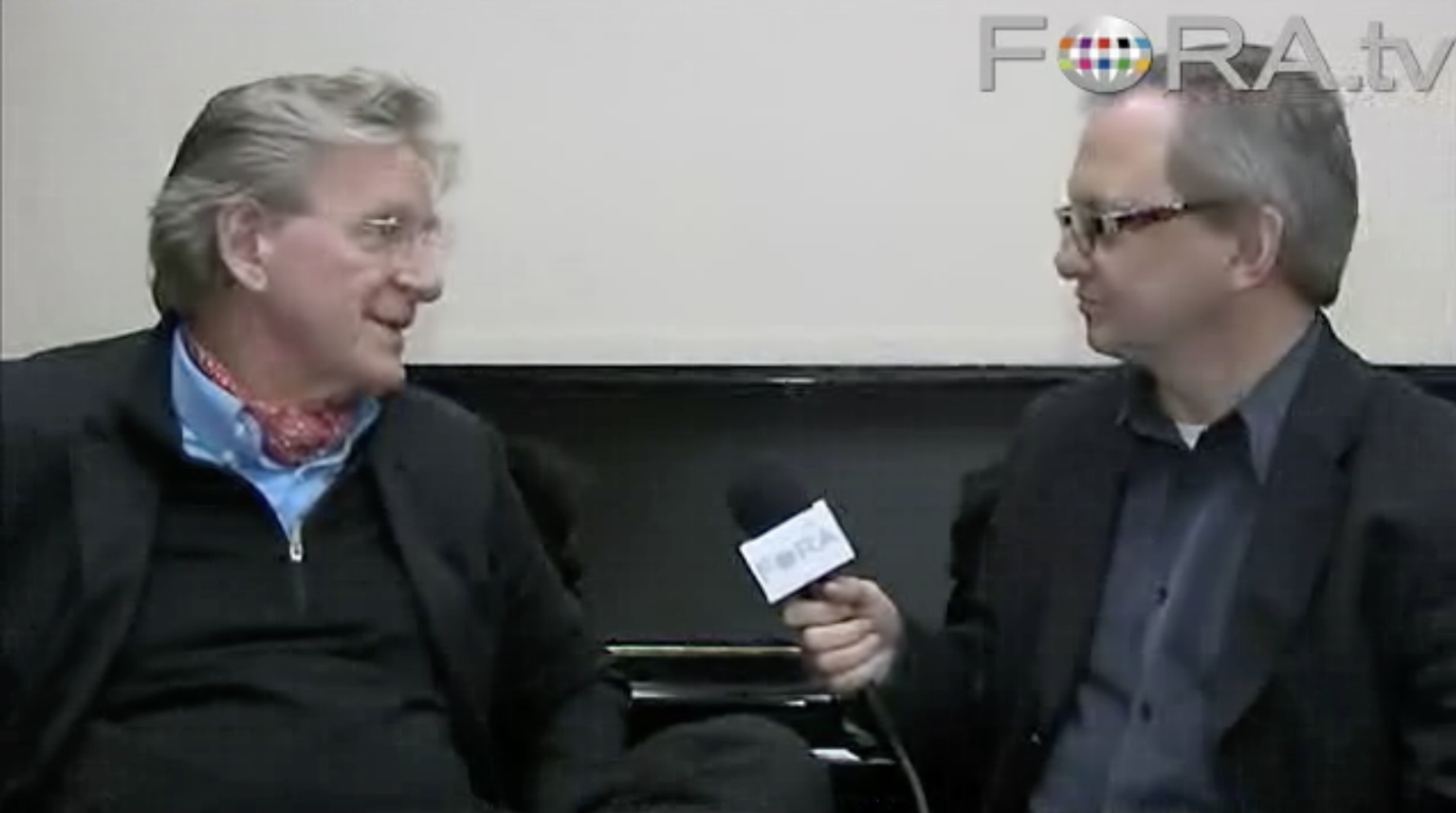
In 2009, I interviewed Thurman backstage before his appearance at San Francisco’s City Arts & Lectures. At the time, I was founder and CEO of FORA.tv, an early video platform dedicated to bringing the world’s leading thinkers, authors, artists, scientists, and public figures to a global audience.
FORA.tv recorded thousands of talks over the years. Because our licensing agreement with City Arts allowed us to post only a limited portion of each event, I conducted backstage interviews with speakers in the green room before their talks.
Over the years I had the privilege of interviewing remarkable figures including Christopher Hitchens, Norman Mailer, Malcolm Gladwell, Quincy Jones, Michael Tilson Thomas, and many others. Robert Thurman was one of my favorites—deeply knowledgeable, intellectually fearless, funny, and generous with his time.
The video includes both Thurman’s City Arts & Lectures appearance and the backstage interview that followed. A lightly edited transcript of our conversation appears below.
For more about my interviews, books, oral history projects, and life-storytelling work, visit electric-memories.com
Backstage with Robert Thurman
San Francisco, February 2009
Brian Gruber: There were a number of people who commented on the inclusive message toward nonbelievers, Hindus, and Muslims in President Obama’s inaugural address.
Robert Thurman: He didn’t mention Buddhists. I noticed that as well. Maybe he thought they were among the nonbelievers. You never know.
Brian Gruber: Does the fact that there’s someone new in the White House affect the way Americans look at religion?
Robert Thurman: I think everything affects it. Americans are relieved that the religious fanatics are gone because they were so destructive.
I love Obama. I’m very fond of him. But I think he’s catering too much to some of these tendencies. He didn’t really have to have Rick Warren there. Joseph Lowery was fabulous at the end—just fantastic. He blew everybody out of the park. Obama himself made some nice statements.
Warren, on the other hand, was self-promoting and not really very good, I thought. He concluded the prayer with a fairly specific reference to his own faith.
It doesn’t surprise me, but I think it’s unfortunate that so many people have embraced this idea that we’re a Christian nation. I find it incorrect and very ineffective.
Think back to Thomas Jefferson. The separation of church and state was originally championed by groups like the Baptists. Yet some advocates of what they call dominionism now believe they should effectively own the United States. They would persecute everybody else and make it just like the Europe people fled from. That’s really terrible, and I think most Americans are relieved to have that influence diminished.
Brian Gruber: Where does this idea come from that America is a Christian nation?
Robert Thurman: It’s a delusion on their part, frankly.
I think it largely comes from the battle with communism. “In God We Trust” was added under Eisenhower. The addition of “under God” to the Pledge of Allegiance came during that period as well.
Even the Constitution doesn’t require a president to say, “So help me God.” A president can affirm rather than swear an oath.
Obama wants to be nice to everybody. He thinks people will be nice if he’s nice. But he should have learned by now from Republican members of Congress and the Senate that they have no intention of being nice or admitting their mistakes.
Brian Gruber: You mentioned communism. I have a question about China. Why was Tibet so important to China that, so soon after its revolution, it decided to occupy Tibet?
Robert Thurman: Tibet is a huge piece of territory. People don’t realize that what China calls Tibet today is only about one-third of Tibet.
During the uprisings last year, the press kept expressing surprise that Tibetans were protesting outside what China calls Tibet. The point is that Tibet is the entire Tibetan Plateau, where people have lived for thousands of years with a physiology adapted to life at three miles altitude.
Chinese populations historically haven’t been able to live there in large numbers. Neither could you or I. We’d develop serious health problems if we tried to live there long term. Even Chinese scientists acknowledge that.
Tibet covers roughly a million square miles. It increases the territory of the Chinese Republic enormously. There are also strategic concerns. China wants to maintain control over Xinjiang, Inner Mongolia, and the territories inherited from the old Manchu Empire. Those non-Chinese regions account for more than half of China’s territory.
Then there are minerals, geopolitical considerations, access to Central Asia, and strategic positioning relative to both Russia and India.
The irony is that the Chinese revolutionaries overthrew the Manchus as foreign rulers. They appealed to Mongolians, Uyghurs, and Tibetans to help them remove foreign domination. But once they succeeded, they claimed all the territories the Manchus had controlled.
That created an impossible contradiction. They presented themselves as anti-imperial revolutionaries while simultaneously acting as imperialists.
And they are, in fact, imperialists.
Brian Gruber: Isn’t it all over at this point? They’ve been there for half a century.
Robert Thurman: No, I don’t think so.
It’s all over in places like Manchuria, perhaps, where the demographic balance has completely shifted. But Tibet is different.
One reason is geography. Tibet sits at an average elevation of about 14,000 feet. Large-scale colonization is extraordinarily difficult.
When Mao invaded in 1950, he predicted there would be 100 million Chinese living on the Tibetan Plateau within ten years. Ten years later there were only a few million.
The second major effort came under Deng Xiaoping after the collapse of the Soviet Union. He feared a similar breakup could eventually happen in China. So the government invested heavily in railroads, subsidies, and migration programs designed to move Chinese settlers into Tibet.
But colonization at that altitude simply doesn’t take root the way planners hoped. It’s not really possible on the scale they envisioned.
Brian Gruber: You released a book last year about why the Dalai Lama matters. Why does the Dalai Lama matter? Is it simply a Tibetan issue, or is there something broader?
Robert Thurman: It’s a worldwide issue on many levels, expanding outward in widening circles like a stone dropped into a pond.
Of course it’s a Tibetan issue. Tibetans deserve their freedom. They were free for centuries. They are a distinct people; they’re not Chinese. The Chinese government has been racist, oppressive, and at times genocidal toward them. That’s bad for Tibet and bad for the world.
But there’s a second issue. Tibet is the water tower of Asia. That’s a good expression. The rivers that nourish roughly three billion people originate there. Some estimates say 3.7 billion.
The purity of the Tibetan environment and the stability of its climate are critically important. The glaciers feed the rivers during dry seasons. China’s great rivers come from Tibet. The Mekong comes from Tibet. The major rivers of India come from Tibet.
The attempt to intensively colonize the plateau is raising temperatures there faster than global warming alone would. Deforestation, desertification, and concentrated urban development are damaging a fragile ecosystem.
Chinese settlers can’t really live spread out across the plateau, so development becomes concentrated and environmentally destructive. Ironically, China is damaging the very source of its own water systems.
In that sense, they’re shooting themselves in the head—on the top of their head.
I don’t believe this situation will last forever. Tibet will eventually be free. The world will demand it. The Chinese themselves may eventually recognize it when they get their Gorbachev.
The tragedy would be if that doesn’t happen before the Dalai Lama passes away.
The Dalai Lama has offered the Chinese government a path to legitimate sovereignty through genuine autonomy and democratic consent. He could persuade Tibetans to support such an arrangement.
But if the Chinese insist on sitting on top of the Tibetans rather than living alongside them, they make that impossible.
I often compare it to Rhode Island joining the United States. Rhode Island never would have joined if the other states had said, “We’re all moving in, and there will be ten times more of us than there are Rhode Islanders.”
Instead, Rhode Island benefited from joining a larger union while keeping its identity and control of its own land.
That’s the key.
Brian Gruber: One final question. Why do you think the Dalai Lama has achieved such extraordinary stature in the world? If people were asked to name major religious leaders, he would almost certainly be one of the first mentioned.
Robert Thurman: He was ranked in a worldwide poll not long ago as one of the most respected people on the planet.
I think it’s because he walks his talk.
The other important reason he matters is that he’s trying to liberate his country nonviolently.
Some Tibetans criticize him and say, “It’s not getting you anywhere.” But if you look at liberation movements that use violence, they’re not getting anywhere either. Maybe violence worked a hundred or two hundred years ago. It doesn’t seem to work now.
Nobody is really getting anywhere through violence.
Nonviolence is the direction humanity has to move. Our conflicts have to be resolved through dialogue, negotiation, and win-win solutions. That’s what the Dalai Lama represents.
He’s genuinely living those values.
People around the world don’t want war. Think back to the worldwide protests before the invasion of Iraq in 2003. Millions and millions of people opposed that war.
Europe largely refused to go along. Ordinary people don’t want war. Chinese people don’t want war. Arab grandmothers don’t want war. Americans don’t want war.
What we need are examples showing that nonviolence can succeed.
The Dalai Lama provides that example. He demonstrates that moral authority can be exercised without hatred, revenge, or violence.
That’s why he matters.
Brian Gruber: That’s a good note to stop on. Bob Thurman, thanks so much for joining us.
Robert Thurman: Thank you. My pleasure.