
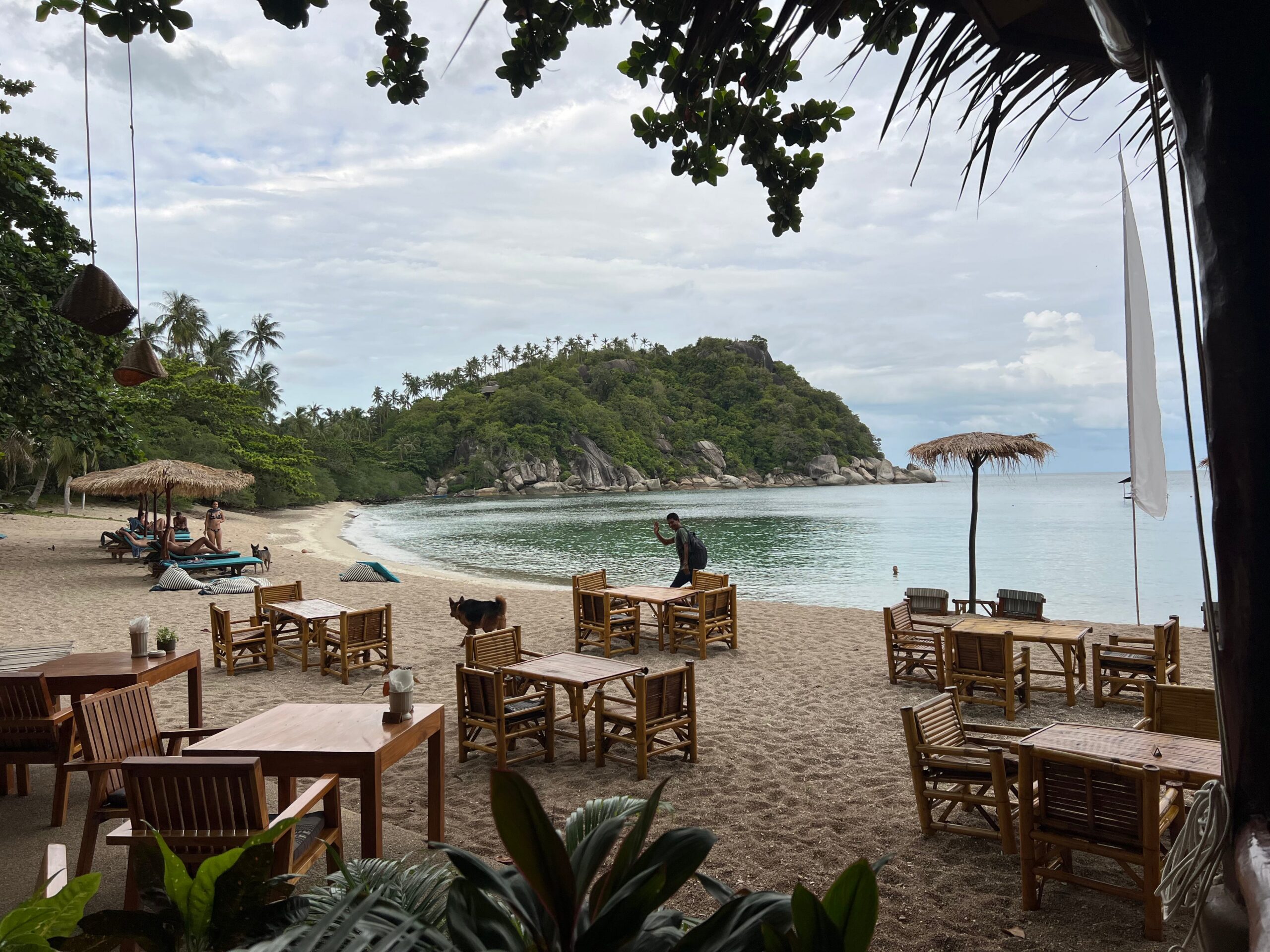
I’m hosting writing meetups at the incomparable Sanctuary Thailand, a place that has held a special place in my life for 15 years. It was here that I discovered my writing voice while completing my first book.
In this resurfaced interview, I speak with Sanctuary cofounder Gill Beddows about the unique magic of Koh Phangan – its allure, its community, and the qualities that draw free spirits to this extraordinary island.
The interview is excerpted from my book Full Moon over Koh Phangan: What Adventurers, Dancers, and Freaks Seek and Find on Thailand’s Magic Island.
Photo: The Sanctuary today.
Gill Beddows:
It Was Utopia
Sanctuary owner Gill Beddows personifies essential elements of the early expat experience on Koh Phangan. A young woman leaves everything behind to travel the hippie trail across Asia to Kathmandu. She spends time with Osho initiates in Pune, India. Wanders Khao San Road. Becomes part of the fledgling Haad Rin cluster of alternative communities and creative projects. Co-creates a near-utopian community and experience on a gorgeous, unspoiled beach, likely inspiring the backpacker classic The Beach. And touches the lives of tens of thousands who come to her “sanctuary” for wellness, serenity, and transformation.
I recently saw a Paris Match photo essay from 1972 about the hippie trail. Turkey, Afghanistan, Iran, India, Nepal. It was a bit condescending, a stereotypical look at hippies at the time. A short time later, back home in San Francisco, I visited City Lights Bookstore where Jack Kerouac, Lawrence Ferlinghetti, Allen Ginsberg, and others popularized the Beat movement, the precursor to hippie counterculture. Both movements – and many on the hippie trail – sought different models for living.
Gill Beddows: It was utopia when we first found Haad Rin. There was nothing. I drove up from England to Nepal. Yeah, so I was part of that trail. Me and my partner, early ‘80s. I did exactly what you’re talking about. We ended up in Kathmandu. There was obviously no Internet.
We split up, just basically being in a van that long doing that trail, and then he came on to Thailand. I had the vision for this then because I’d spent a long time with Rajneesh (Osho) in Pune. He arrived to the island before me and we met in Bangkok out of the blue because, remember, there was only snail mail or Post Restante (mail held by a post office until it is retrieved). I remember in Khao San Road he said, “I’ve found the most wonderful place in the world, Gill, it’s a little island.”
I came down and jumped on a fishing boat that took me across to Haad Rin – can you imagine – and it was just amazing.
Brian Gruber: What motivated you to take that trip to Kathmandu?
All of it. The Beatles and the idea of just following your dreams, that there must be something different in life than just the Western existence. And, basically, Asia, and the Indian vibe and meditation and drugs. Let’s be honest, this place is built on detox/ retox. It was that balance of Ibiza meets ashram; and a lot of the ideas of The Sanctuary vision came from Pune, from that original trip.
That’s where I got the concept to start something like this. I spent some time in Pune, just finding myself, really. And then, next thing I know, I’m on a paradise island, with all the drugs you could ever imagine in Haad Rin; I think there was about 50 of us.
It seems many of the early expat explorers on the island were Osho sannyasins.
It was sannyasins. We arrived and there were monks. To find somewhere so beautiful, with the lighthouse and the sunrise, the sunset. Everyone’s chilled. There were no police.
We had a Tai Chi school open from the most amazing guy called Jay who came from Pune. We had this balance.
The approximate year of when you first arrived?
It was probably about ’88 I’m guessing.
It was like an avalanche
There was no formal Full Moon Party.
No, no, no, we used to beg Paradise to let us do the party. They didn’t want to do it. We used to pay for them to do it (because) there was no one drinking beer.
It’s like the Hacienda in Manchester, once one of the most popular clubs in the world. One of the reasons they went out of business was everyone was high on ecstasy and nobody was buying drinks.
Different people would come in and pay. I remember the first couple of parties, and I don’t know, 50, 100 maybe max. And it just grew from that. I mean, it was just mad how it grew, it was like an avalanche.
Do you remember moments that were transcendent, special for you from that time?
Oh my God, there are so many. It was the people, that original group of people. Nathan (Parker) arrived probably five years later. Ritumba was working in the temple, building things, she was probably an instigator of the Full Moon Party. She was a sannyasin; there were a lot around then.
I was too young to get to the Rajneeshpuram (in Oregon), but I hit Pune when he came back from America (late 1985/ 86). I met him in the flesh a few times. I wasn’t a complete devotee. His teachings were a very modern way of introducing meditation, which I still use here. Most of my sessions are Osho-based because of it. He was clever. He saw the new generation of westerners coming in, finding it hard to sit here and go aum; he created dance meditation, surfing meditation, movement meditation.
Perhaps my best meditation experience was when I was here for the first time in 2010. There was a Russian woman, leading meditation after a yoga class, and in that hour and a half, she did four or five different segments. One was, think of someone who you want to forgive, or send love. It was really very different.
And that’s what he was very good at. Kundalini sourcing, one hour split into four sections. ‘Cause our minds are so busy coming from the West. To put a really crazy spanner in the works, Jay was the security at the (Oregon Rajneesh) ranch. I met Sheela (Jay’s partner and Osho’s key lieutenant). She visited Jay here in Haad Rin.
In my first years on the island, there seemed to be a certain undercurrent of philosophical material or language. Do you think Osho’s teachings have influenced the teaching and application of yoga, meditation, and Eastern philosophy on Koh Phangan?
It had a profound effect on me, on a lot of us that were attending Pune. And it happened that a lot of us ended up here. There were all these visa problems with India. When I started The Sanctuary, I wanted to get some healers in; I flew over to the ashram and I got my first ten healers. “Oh, hold on a minute, you’ve got your visa run? I’ve got a place now I can give you accommodation, come do a bit of work for me.”
The mythology that I remember from years ago was that the Sanctuary started with one bungalow.
Just me and my lover (Steve), because he’s an architect/ builder and I’m a cook. Yeah, basically. I worked in the Pune kitchens. I’ve always believed food is sharing. It was then just one big meal every night. I couldn’t do a menu. I would cook lunch and dinner. I found ‘breaking bread’ was a great way to meet people and just share stories and experiences.
We had one bungalow and Steve and I started it. I remember the first day we actually hired someone, it was mad, we got our first employee, we’re like, my god, we’ve got somebody else.
Where did Michael (Doyle) come in?
Five, maybe seven years after.
He was a guest. By then I knew that it was just too much. We could have 30 people, but it was just me, I’m cleaning bungalows. I’m a people person. So, admin, I realized I was getting in a right old mess. That’s not my forte. I’m a food… I like talking to people.
That’s why he got the nickname “Sanctuary Michael” ‘cause he came in and took over my affairs.
The parties were the juice for this place, because we realized as the parties got bigger and bigger, the core of Haad Rin, which Nathan was involved in as well, we’re like, do we want to be part of what’s happening here? Because, actually, there’s no balance anymore. You know, it’s just going too druggy, and the wrong drugs, and the wrong vibe.
And Steve rung me up and said, look what I found, an empty beach, what you think, about your vision?
I didn’t like it. When I first saw it, I wanted to get the next beach, because it was empty. But we knew the guy who owned it, and I came back and looked at it again. There was a big monitor (lizard) about three meters long. He’s still there. And I followed him, I got on my hands and knees. And when I got to his rock, where he lives, I decided that’s where I’d build my house. Steve picked that place, Ocean View. It took years to get the houses together. But that was the start of The Sanctuary really.
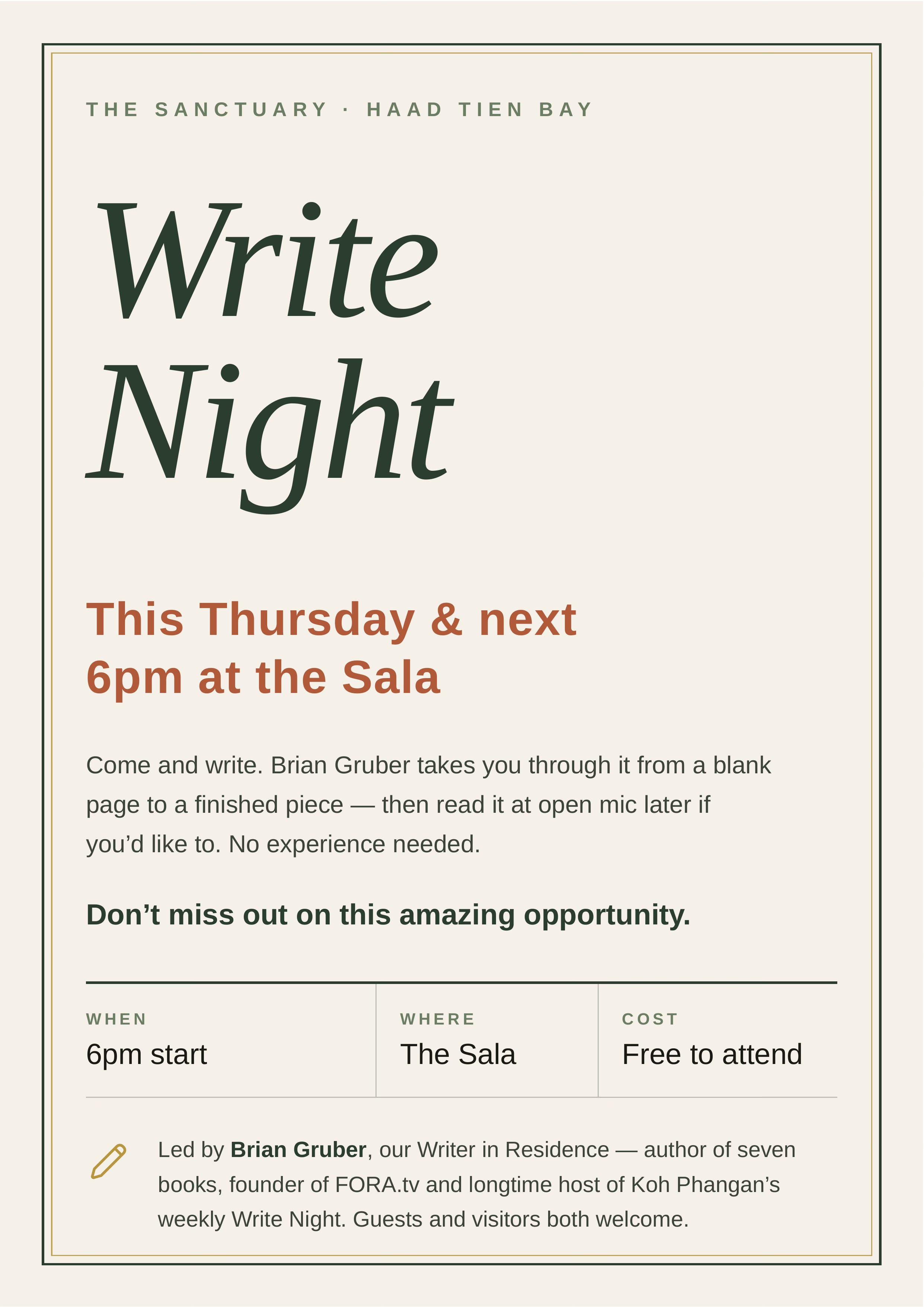
I’ve led writing events at the Sanctuary for some year. It’s a glorious creative space.
The Boa and the Geomancer
Why did people come here?
Now there’s word of mouth, but there’s definitely a feeling there, going back to the soul of the island. We used to have this (Thai Buddhist) spirit house at the big tree.
We had a lot of snakes when we first came. I like snakes. I’ve been bitten three times. Thais say it’s very lucky. But we had this big boa, we nicknamed him Monty, and he lived a lot at my house and then he got too much, because the builders were here, and I knew he was going to get killed. So, we decided to put him on the boat to take him down the island. We had an Israeli snake catcher and he caught him at Why Nam. He always turns up there at Full Moon, it took three people to catch him. We put him on the boat at Full Moon, me and my four hippies.
Tor, the old guy who owns the land, was the only one who would allow me to put this big snake on this boat. We got on the boat and there’s people on the beach singing. It’s like something out of The Beach, we went round the point, and one of the biggest branches of the spirit tree fell off. And the Thais told me that was because I was taking the spirit away from the land.
Anyway, he was back in two days. A huge boa. Four meters long.
So, that happened. And another (memory) that for me was very important. We had lots of little accidents here, silly little things. And then this hippie girl turned up one day on the long tail coming in, the main boat; we would sit here and wait for the boat. It was like a lifeline. Bad weather, no boat. And a girl came off and she was quite… I wish I could remember her name. I can still see her face now. This very hippie look about her, really nice, just looked kind. There were only 10, 20 of us here. She said, “I’m a geomantress.” And I said, “What?” “I just feel places, I feel spirits.” So, I said okay…
A geomantress?
Basically, she feels people, well, she feels spirits. I think the word’s geomancer, but she called herself geomantress.
And what did she have to say about Haad Tien?
I said to her, there’s some things happening, and we’ve had a few mishaps, and she said, that’s because you’re not talking to the land. I asked, “How do I do that then?”
A reasonable question.
So, she walked around for a day. And then she took me and said, “Right, I’m going to show you where they all live. And then all you’ve got to do is say to them, ‘Hi there, everything’s okay.’ And just, you know, thank you for looking after us.” And so that’s what we did. And they live on… Look! My hairs have gone up now because I still remember her saying it. So, it goes from the spirit tree all the way to the house, and it ends at my rock. And they live on that vein of the land, which is a vein of the boundary between The Sanctuary and the next beach. I have to go on the rock when I come back, and just say, “I’m here. Thanks, guys.” And I still do it to this day.
There’s mythology around the island’s geology, rose quartz, crystal; that it’s located on ley lines or meridians, on a vortex.
It’s like the island’s spirit. Yeah, no, it is.
Or maybe it’s just no airport, natural beauty, stories of Rama V, the people who came for the early Full Moon parties, Alex Garland’s bestselling book and movie. Maybe that’s enough, but then there’s a feeling that no, there are other phenomena.
It’s more than that, I think. It also spits quite a lot of people out as well. When I started this, I might tell a few people to come, I didn’t do any advertising at all. I believe in word of mouth. And people know about it. But it was amazing how many people I told, “You’ve got to come here and you’re gonna love it.” And they didn’t love it at all.
The boat threw them before they got in. A centipede bit them, a scorpion, the kids got bitten by mosquitos, and they left with their tail between their legs and, “That fucking horrible place.” I used to get so upset. Because I’d be so excited that people were coming. I’d be watching the sea, going, “Waves, don’t come in, don’t come in,” and of course they’d come in. Then we had to get somebody off the boat who’s a bit overweight and they can’t swim.
This came about as a balance to Haad Rin, and a lot of people would come here after the party, just to chill out. It was too much in Haad Rin. Before that, we were all living up the hill.
I lived in a tiny hut halfway in the middle of nowhere on my own for two years. There was quite a little community up there. We all had our own little houses and huts. Our first leaflet was beautiful, it said, “In the middle of three pristine beaches.” Literally, as I started walking, I’d take my clothes off. So that was the nude beach, that side. It was just our beaches.
When you think of that woman who took the hippie trail out of London, who had a certain vision, or a certain inquiry, a search for a certain kind of life, did that match what you were experiencing here?
I used to cry when I had to go back and work; at that time, I was running festivals. And I had to go back for four, five months a year, and make a lot of money doing festival work. It was the same sort of vibe, to be honest, it’s a bit of a mini-festival here.
Then we started this place, I was still going back for about the first seven, eight years at least, because Steve was building, and I was earning good money doing festivals. I used to just send all the money back, so we could build more. Because earning money here at that time wasn’t happening. We had 20 people, if you made $1,000, it went straight away for another bungalow. I’d go back and do the season in England, bring it all back and then could build another yoga hall or whatever. It was only about ten years ago that it went into profit. Can you believe it?
Every single thing had been painted fluoro
When I come to the TriBay (the triple coves of Haad Yuan, Haad Tien, Why Nam), go to the Tea Temple or Why Nam, there seems to be a certain attitude or sensibility. Was there an identifiable ethos in that community, in Haad Rin? Was that talked about at the time?
The drug vibe was very strong in Haad Rin. There were no boundaries.
Hallucinogens mostly?
Yeah. You could do whatever you wanted, whatever you pleased. Ganja was everywhere. None of us were drinking beer. I didn’t drink beer till I think I was about 38. Because it didn’t go with drugs. Now, I love a glass of wine.
I remember having a party for my birthday here. It was the last big party we had in The Sanctuary. A hundred people partying like crazy. And I said to everyone, please don’t paint the restaurant with the fluoro, because I like the natural colors in the restaurant. And then somebody got the paint out. All over the restaurant, the whole floor, everything, the ceiling. Everyone was covered in fluoro paint, everything painted, everything.
I got up in the morning, can you imagine, I came down. Everything, every single thing had been painted fluoro. [H3] [BG4] [H5] Of course, in the night it was amazing.
I just said, no one’s leaving until you’ve finished. Cause it’s such hard work. Fifty of us scrubbed off that paint. You know what it’s like it getting it off. It was in every crack, every cranny. And that was the last time I had fluoro in the restaurant.
Things change you know. Guy used to work for me, he was the boatman. Then he started talking about his opening his own club, Guy’s Bar. His wife was a chef for me. In a way, it was a natural transition for us not to have parties here. It sort of happened; somebody else was doing the parties.
We could concentrate on being the core, right, the grounding place. And to this day, we only have the New Year’s party in The Sanctuary, impromptu little gatherings, no more parties.
The Sanctuary is just a sun
Are there certain revelations or conclusions about what’s been learned?
I live near Glastonbury. I have a beautiful circle of friends and a lot of them come from here. It’s very hard for people to really understand what went on here. It was so magical, the full moons, and the hundreds of like-minded people coming together. I don’t know why to this day.
I still see myself here. Last year, I was here in April, and I saw six young girls on the beach, young, 30s. And that was me, years ago. I cried.
I still get people coming in out of the blue. And they go hi, Gill, do you remember me, or I’m their daughter or their son.
I remember. I’m the only one really left and I’m only here now three months a year. Because obviously they’ve got on with their lives. The only reason I’m here is it became my business; it became my life. I realized that I had other things to do in life. I’ve done a long time on the beach. I still got another project left in me. And 25 years on the beach, that’s enough.
Did Alex Garland write The Beach here?
Who knows, he visited, but we don’t know.
Tell me about the folks who live in the TriBay, in Haad Tien, healers, long-time residents. Is there a community here that you consider a part of what The Sanctuary is, at least in the…?
The Sanctuary is just a sun. That’s how I see it, it’s really that simple. There’s sort of these little planets flying around it. Gae (Guy’s brother) married my friend Lorraine, (who opened) Spice (the seafood BBQ restaurant behind The Sanctuary). Guy worked for me. We’re all interrelated. Now, a lot of the new youngsters that come in, they often have opinions about what The Sanctuary is; the fact is, we were just here first. It was never meant to control things. It was more the fact that we got it together. It’s all changing now because all this work permit stuff, years ago, there was much more freedom. I remember the healings were being done in here at one time. There were sessions going on where someone was having a cup of tea, there was back crunching going on. It was one big place. None of that top bit, The Sanctuary was just a tiny square. The healings were in the restaurant.
A DJ is never gonna play music that works for everyone. There’s always somebody who doesn’t like the music, who’s going to make comments. And to be honest, when I was younger, it hurt me a lot when I heard negative stuff about how it was being run. And my answer is, I don’t do everything right. I just have a go. And I think when you do that, that’s all you can do. I spent many years on my own just totally obsessed with this. A bit like The Beach, but I didn’t kill anyone.
Tilda Swinton’s not a bad person to play…
It’s hard to be judged. In life, if you stand up, as a writer, when you publish a book, you’re open to criticism, the same way I own this.
Well, it’s delightful to finally meet you. This place is so special to me.
I’m glad you feel it because, otherwise, you can’t write about it.
All Substack pieces are shared to electric-memories.com/stories. Come visit the site for my books, bio, and life storytelling project.