
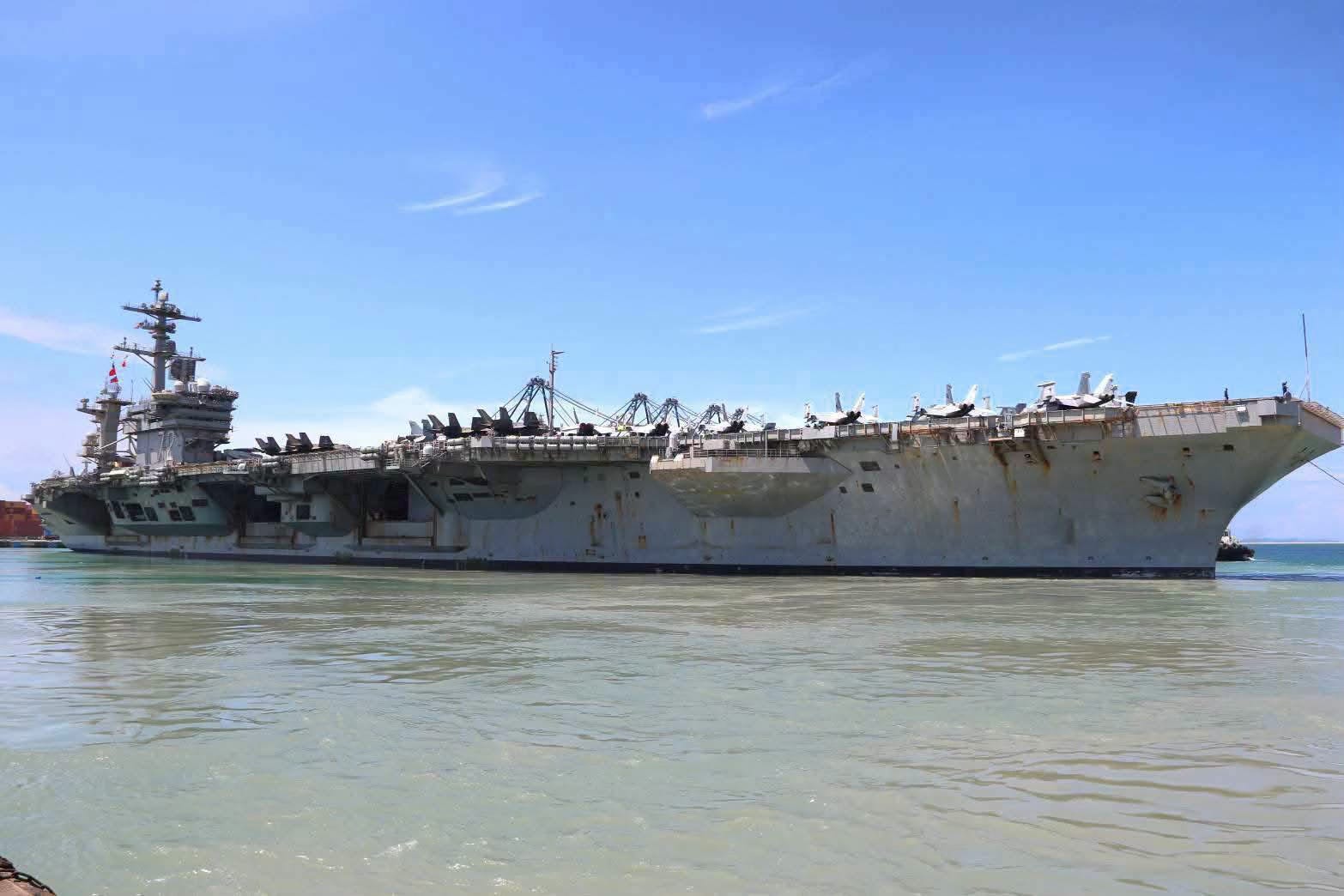
September 5, 2026
Pattaya, Thailand
I know this scene. It’s college students away for a beachfront holiday. It’s young industry professionals on the last day of a conference, squeezing in as much comradery, booze, and good times as possible. It’s the men and women of the USS Abraham Lincoln, away for four days of shore leave after a nine-month run, much of it within shooting range of Iran.
Both the tour and the mission are rife with controversy and violence but, for today, here in the expansive upscale lobby of the Hard Rock Hotel Pattaya, it’s Young Americans on Holiday. The media juice was all about Pattaya’s reputation as Sin Central of Southeast Asia, originally earned when U.S. troops on R&R leave from Vietnam flooded the seaside town.
I expected that too. I expected large and small posses of drunken, aggressive sailors letting loose after challenging months onboard. Stars and Stripes, the editorially independent U.S. military newspaper, reported that sailors and family members described food shortages and rationing, drinking- and hot-water problems, inadequate air conditioning, more than a week without laundry, disrupted mail, limited access to fresh food, long workdays, little time off, deteriorating living conditions and serious mental-health concerns, including a reported attempt by a sailor to go overboard; the Pentagon fired the publication’s publisher, editor-in-chief, and reporter for their coverage.

WANDERING PATTAYA’S BACK ALLEYS
On shore leave, Pattaya-esque pleasures of the flesh on Walking Street and Soi 6 – and other less fabled side streets – awaited them. I spend hours wandering those streets. No brawls, no outwardly aggressive behavior, no strength-in-numbers groups, just wide-eyed men, solo or in pairs. Maybe they were warned to behave. Or had unusually good manners.
Who knows what happened behind closed doors or down back alleys but the buzz in the dining and relaxation centers of the Hard Rock is about less mundane affairs. Soap, for one. A servicewoman from California gleefully describes the thousands of baht she spends on the simple amenity. Everyone seems to be carrying shopping bags. And backpacks. Some carrying gifts, but much of the bulk is personal supplies. They compare notes, like students or conventioneers, and announce their shopping wins.
Some are just back from visits to Nong Nooch Tropical Garden, Ko Lan, or Wat Phra Yai. I am asked by a couch mate if it was true that the malls were closed by seven. They are checking out, then shipping out of the hotel by 9pm. Surely not, I declare, and send a small group on their way to Central Pattaya mall. The fellow leaning into his phone across from me had a My Chemical Romance t-shirt, pressed neatly, beyond what that band’s fans might require. I pass by an African-American woman in a Lebron 23 Lakers jersey in the pizzeria and ask what she thinks of his move to the Sixers. We both hail from New York City. After comparing notes on Jaylen Brown and the fortunes of Atlantic Division teams, I ask if she needed this trip. Yes, she sighed, stoically, without complaint, but hinting at some tough times physically and psychologically.
VISITING LAEM CHABANG PORT
Earlier today, I connected with G, a senior Thai government official overseeing the port used by U.S. warships. She brought me to the pier to get me on one of the ships for an interview. In deference to her position of authority, a series of officers took her request seriously, each one asking, Tell me again who you are and what you want to talk about? I chatted up one officer, who volunteered his view about the efficacy of current modes of combat.
“What I’ve noticed is Iranian ballistic missile attacks tend to be only as effective as based artillery because they cannot support their missiles tracking the target. It may be that basing strategies on weapons that were created experimentally by Nazi Germany that proved to be too little too late may be a critical misstep.” I asked if he meant Iranian or American missiles. “Both,” he answered, “because in a contested environment in a theater like China, we may not be able to support our missiles the way we can with, say, Iran. Let me put it this way. Ballistic missiles are fast but they have to go a long way. Conventional artillery may be slower, but it’s a lot closer so it’s a lot harder to dodge.” When I pressed for conditions at sea, the conversation paused. “Life at sea is inherently taxing and dangerous. It can be that to anyone in a combat zone, or anywhere.” We talked hockey a while and I took my leave.
MISSION ACCOMPLISHED
The USS Abraham Lincoln has some colorful literary history. When the U.S. Navy wanted to track down the Nautilus in Jules Verne’s “20,000 Leagues Under the Sea,” it sent the Lincoln. Captain Nemo’s mythic submarine was attacking vessels involved in various forms of violence that he surmised were symptoms of a humanity in need of a spanking. He sank the ship, and took on board the survivors, forming the crux of the book’s central drama. The book recounts Nemo’s (and Verne’s) utopian notions for a new, enlightened world, free of violence and injustice. Verne left Paris for Amiens in 1871 during the Paris Commune, where he gave a speech on the subject titled, “Une Ville Idéale.”
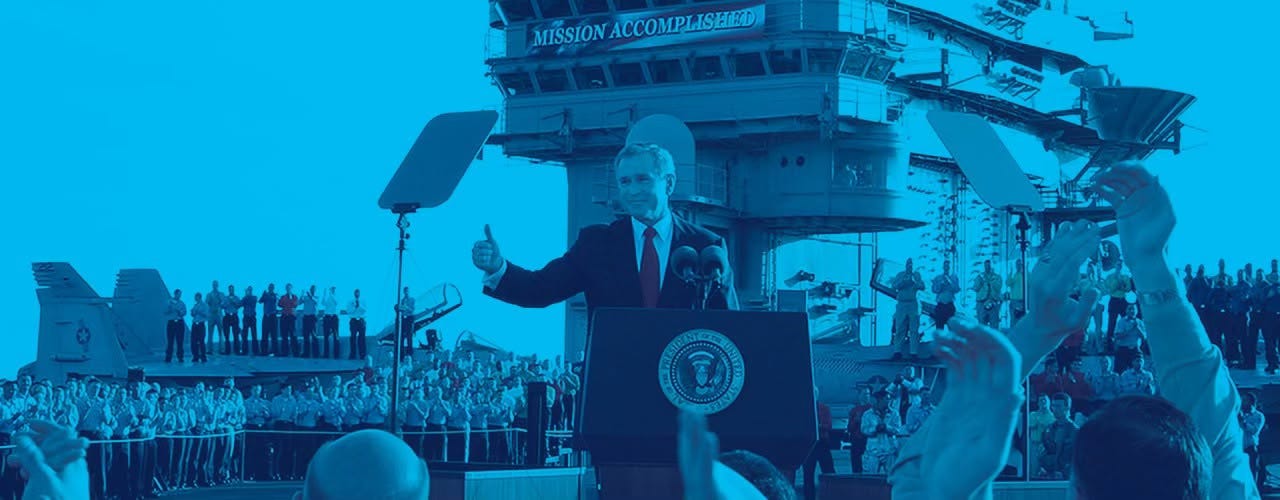
President George W. Bush, Jr. gave a May 1, 2003 speech aboard the Lincoln off the coast of San Diego, California. The speech is famous (or infamous) for declaring major combat operations in Iraq complete, fronting a massive banner announcing, “Mission Accomplished.”
Reality intervened. The Iraq conflict turned into a years-long debacle with massive human and financial costs – destabilizing the Middle East to this day – sending two million agitated refugees into Syria, sparking a horrific civil war, which sparked massive emigration, which sparked anti-immigrant sentiment in Europe.
SUPPORT OUR TROOPS
We are told to ignore all that and Support Our Troops. We did and we do and it’s a costly affair. Democratic Socialist Senator Bernie Sanders has been a leading critic of the shoddy way veterans have been supported, especially by those so eager to send them into yet another quagmire.
The cost for lifelong support for those who served in Iraq, many with horrific injuries kept alive by the miracle of modern military medicine, is extensive. Of course, supporting those troops would have been best achieved by keeping them out of harm’s way in futile interventions. The toll in Iraq: 4,488 U.S. service personnel killed; 32,223 injured (not including PTSD); $490 billion in benefits owed to war veterans; $7 trillion in projected interest payments on war expense, due by 2053.
The United Nations Charter restrictions on aggression against sovereign nations were not imposed by radical anti-American forces in the General Assembly. They were directly inspired by the August 1941 Atlantic Charter presented by Franklin Delano Roosevelt to Winston Churchill as a precondition of U.S. support to the United Kingdom in its struggle with Nazi Germany. The subtext was, time to get out of the colony business. It established a foundational principle of the postwar order: nations should abandon the use of force as an instrument of international relations, reject territorial aggrandizement and aggression, and allow peoples to determine their own governments and borders. Four years later, those principles were given legal force in the UN Charter, whose Article 2(4) requires member states to refrain from the threat or use of force against another state’s territorial integrity or political independence. In Southeast Asia, Roosevelt said that, unless the French pledged eventual independence for her colonies, the United States wouldn’t be justified in returning them “at all, ever.”
The post-WWII rules-based order – no matter how often ignored by its signatories – had a simple, urgent notion. You don’t get to invade, bomb, destabilize, or torment other countries because you don’t like their domestic or foreign policies. That went for Nazi Germany. And for Soviet Russia. And the USA. It’s a sensible way to avoid a global conflagration that could extinct the species.
The United States Congress, exclusively empowered by the Constitution to declare war, has done little to stop illegal military adventures. That paralysis has a Southeast Asia hook as well. President Lyndon Baines Johnson went on national television on August 4, 1964, to ask for the Gulf of Tonkin resolution, an escalation of the Vietnam conflict, bypassing constitutional requirements because the USS Maddox was attacked by two North Vietnamese vessels. (Naval officers later admitted it was a radar blip, and there was no attack).
So, bon voyage USS Abraham Lincoln. My personal interaction with its sailors left me with an impression of talented, committed, nice people. Who are called by their government to commit violations of internationally accepted norms of military action, inflicting misery and suffering on millions.
“A large standing Army in time of Peace hath ever been considered dangerous to the liberties of a Country. Why quit our own to stand upon foreign ground?”
– George Washington
“Of all the enemies to public liberty, war is, perhaps, the most to be dreaded, because it comprises and develops the germ of every other. War is the parent of armies; from these proceed debts and taxes; and armies, and debts, and taxes are the known instruments for bringing the many under the domination of the few.”
– James Madison
——————-
To read more, visit electric-memories.com for information on my four books on war and peace, citizen movements, and fascism, and my ongoing work on Substack.